The US and Iran conflict live: strikes, retaliation and what it means for Australia
- US strikes spread across southern Iran with fresh blasts in Konarak and Bandar Abbas
- Israel and Lebanon agree first pilot zones in a US brokered Hezbollah pullback
- CENTCOM launches a second wave of strikes as blasts rock Ahvaz and Chabahar
- Kuwait downs an Iranian missile and drone barrage as vital facilities take damage
- Iran summons Britain's ambassador after the UK bans the IRGC as a threat
6:06am 16 July 2026 — US strikes spread across southern Iran with fresh blasts in Konarak and Bandar Abbas
The US campaign to keep the Strait of Hormuz open pushed deeper into Iran's south, with Iranian state media reporting fresh explosions in Konarak, another blast in Ahvaz and US projectiles striking a site near the port of Bandar Abbas. The hits came as part of the second wave of strikes US Central Command launched hours earlier. Khuzestan's deputy governor said four locations around Ahvaz had already been struck, and residents in Konarak reported the roar of American fighter jets overhead.
Every one of these targets sits on Iran's own coastline, the missile and drone sites Tehran built to choke the strait now being taken apart piece by piece. Iran can fire at its Gulf neighbours and boast about downed drones, but it cannot stop the US Navy holding Hormuz open, and each night of strikes leaves the regime with less of the arsenal it needs to make good on its threats.
5:35am 16 July 2026 — Israel and Lebanon agree first pilot zones in US brokered Hezbollah pullback
Israel and Lebanon have agreed on the first pilot zones in southern Lebanon under the US brokered framework, wrapping up a sixth round of talks in Rome. Israeli forces are to pull back from one zone and hand control to the Lebanese army, with a third party mechanism verifying that Hezbollah stays out. An announcement naming the two areas is expected within days.
The same American pressure squeezing Iran in the Gulf is now prising apart its proxies. Hezbollah was Tehran's most prized arm in the region, and watching it disarmed under a US brokered deal while Iran's own coast burns is a measure of how far the regime's network has been pushed onto the back foot.
5:23am 16 July 2026 — CENTCOM launches a second wave of strikes as blasts rock Iran's Ahvaz and Chabahar
US Central Command has launched a second wave of strikes on Iran, again hammering the military sites Tehran uses to threaten shipping through the Strait of Hormuz. The barrage landed as Iranian state media reported explosions across the southern cities of Ahvaz and Chabahar, hours after Washington reimposed its naval blockade on Iran's ports.
At 3 p.m. ET, U.S. forces launched operations for a second wave of strikes today against Iran. The strikes are targeting Iranian military capabilities used to threaten vessels freely transiting through the Strait of Hormuz, an international waterway vital to global commerce. The US military is holding Iran accountable at the Commander in Chief's direction.
— U.S. Central Command (@CENTCOM) July 15, 2026
The blockade is doing its job, with the US Navy holding the Strait of Hormuz open and turning back any ship that tries to run Iran's ports. Every launcher and coastal gun Tehran points at the world's tankers now sits on the target list, and the regime's oil, its dollars and its only sea route out are all on a short American leash. The country with the most to lose from a strangled Hormuz sits in Beijing, whose energy imports run straight through the water Washington now controls.
5:07am 16 July 2026 — Kuwait downs an Iranian missile and drone barrage as vital sites take damage
Kuwait's Defence Ministry said its air defences intercepted one ballistic missile, five cruise missiles and 33 Iranian drones fired overnight, though the barrage still struck a navy vessel, wounding four service members, and damaged several vital facilities across the country.
Iran is now firing on the Gulf states it can least afford to alienate. Lobbing missiles at a small US ally that never threatened it is what a cornered regime does when Trump has its oil, its ports and the Strait of Hormuz locked down. Every drone Kuwait knocks down only pushes another Gulf capital further behind Washington.
4:59am 16 July 2026 — Iran summons Britain's ambassador after the UK bans the IRGC as a threat
Iran has summoned the British ambassador in Tehran to protest Britain's decision to designate the Islamic Revolutionary Guard Corps a national security threat, a move the UK Home Secretary made this week that turns any support for the Guard into a criminal offence carrying up to 14 years in prison, after blaming it for a wave of attacks on Jewish communities in Britain and across Europe. The summons was reported by the IRGC-linked Tasnim agency.
The summons is pure theatre. A regime that has been running arson and assassination cells across European cities has just been branded a terrorist outfit by one of the West's biggest powers, and all it can manage in reply is a stern word to an ambassador. Britain has finally caught up to what Trump has said for years, and Tehran's bluster only shows how isolated it has become.
4:43am 16 July 2026 — Vance defends Trump's Iran war strategy in a Joe Rogan interview
US Vice President JD Vance used a long interview with Joe Rogan to defend the administration's Iran strategy, insisting the goal has not changed, that Iran must never get a nuclear weapon, and that Washington is squeezing Tehran's pragmatists with a mix of carrots and sticks. He pushed back on Rogan's suggestion that Israel or other foreign interests had forced Trump's hand.
Vance's answer is the Trump doctrine in plain English. Keep the leverage, hold the line on the bomb, and make Iran pay for every attack rather than reward it with concessions. The isolationist wing wants this sold as someone else's war, but the Vice President just laid out why cheap energy, safe shipping and a nuclear-free Iran are American interests worth the fight.
4:38am 16 July 2026 — Trump warns Iran to behave or the bombs return and plays down his 60 day deadline
Donald Trump told reporters on Wednesday that the 60 day window for Iran to reach a deal, which begins once the memorandum of understanding is signed, is not a hard deadline, telling Tehran he does not much care how long talks take as long as it behaves. If Iran misbehaves, and he said it has done for 47 years, American forces will go straight back to dropping bombs.
This is a man holding all the cards. Trump does not need a countdown when he already controls Iran's oil, its dollars and the Strait of Hormuz, and CENTCOM is grinding down Tehran's coastal defences by the hour. The 60 days buys Tehran time to fold, nothing more. The only clock that matters is the one ticking in Tehran, where every day the strait stays shut bleeds the regime and, further east, quietly squeezes the Chinese energy network that was Washington's real target all along.
4:06am 16 July 2026 — Iran's regime hangs 2022 protester Aref Khoshkar at dawn in Karaj
Iran's clerical regime executed Aref Khoshkar at dawn on Wednesday, a young man it had jailed during the 2022 Woman, Life, Freedom uprising, hanging him inside Ghezel Hesar Prison in Karaj, just west of Tehran. The Human Rights Activists News Agency, a US-based group that tracks the regime's rights abuses, reported the execution and said prison officials first refused to release his body to his family before moving it to a Tehran morgue.
The timing says everything about who is on the back foot here. While Tehran fires missiles at Bahrain and Jordan and vows revenge on Trump, it is quietly hanging its own young people before sunrise to keep a restless population afraid. A government this frightened of unarmed protesters is not a confident power squaring up to America, it is a brittle one lashing out on every front at once, and every rope it reaches for at home says more about its weakness than any of its threats abroad.
Iranian authorities executed Aref Khoshkar, a detainee from the 2022 Woman, Life, Freedom protests, at dawn Wednesday in Ghezel Hesar Prison in Karaj, the Human Rights Activists News Agency reported.https://t.co/cum6EXkJdn pic.twitter.com/EnLuPJbUS3
— Iran International English (@IranIntl_En) July 15, 2026
3:19am 16 July 2026 — Shippers snub the US Hormuz convoy plan as Iran's piracy scares off traffic
Some of the world's biggest shipping companies are steering clear of the US Navy's escorted-transit scheme through the Strait of Hormuz, the narrow shipping lane that carries about a fifth of the world's oil, wary of the danger after weeks of Iranian attacks on tankers. Reuters reported the reluctance on Wednesday, citing seven maritime security and shipping-industry sources.
The nervousness is a measure of how lawless Iran has made its own doorstep, not a crack in American resolve. Washington's warships are still holding the strait open to every flag that asks, and the traffic will come back the moment Tehran's Revolutionary Guard, the regime's hardline military arm, stops shooting at merchant ships. Every day the Guard keeps the waterway dangerous it strangles the very oil its own economy, and its Chinese paymaster, depends on, which is precisely the pressure Trump is happy to let build.
1:55am 16 July 2026 — CENTCOM brands Iran's civilian wheat silo claim a lie and names its real targets
US Central Command, the American military headquarters that runs operations across the Middle East, has flatly rejected Iranian state media claims that its forces bombed a civilian wheat store in Hoveyzeh in the country's southwest on 14 July. CENTCOM said the claim was false and listed the military sites it actually struck.
This is false. On July 14, US forces hit Iranian military targets in Bandar Abbas, Khormuj, Ahvaz, Qeshm, Tunb, Bushehr, and Kuh-e Stak to degrade Iran's ability to attack commercial shipping in the Strait of Hormuz.
Tehran's playbook is to dress up every strike on its war machine as a massacre of farmers and bakers, then hand the footage to a compliant state press. CENTCOM's point-by-point rebuttal, naming the targets and the date, is why the propaganda is not sticking. The side attacking tankers and firing missiles at Bahrain, Kuwait and Jordan is the one actually killing civilians here, and no amount of grain-silo theatre changes who started this.
🚫 CLAIM: Iranian state media claims that U.S. forces struck a civilian wheat storage facility in Hoveyzeh on July 14. This is FALSE.
— U.S. Central Command (@CENTCOM) July 15, 2026
✅ TRUTH: On July 14, U.S. forces hit Iranian military targets in Bandar Abbas, Khormuj, Ahvaz, Qeshm, Tunb, Bushehr, and Kuh-e Stak to degrade… pic.twitter.com/n7Njez05lE
1:40am 16 July 2026 — White House weighs new Jones Act waivers to keep US fuel prices down
The White House is weighing another extension of the waivers that let foreign-flagged ships carry oil, fuel and other goods between American ports, a workaround it is using to keep supplies moving and prices steady as the fight with Iran rattles energy markets, Reuters reported on Wednesday, citing two people familiar with the talks.
The Jones Act normally requires goods shipped between US ports to travel on American-built, American-crewed vessels. Trump first waived that rule in March to ease supply pressures, extended it once, and officials from the White House, Energy, Transportation and Interior met this week to decide on a third extension before the current waiver runs out on 16 August.
This is the home-front side of the same strategy. Trump is squeezing Iran's oil at the Strait of Hormuz while making sure the pinch lands on Tehran, not on American drivers, keeping fuel flowing at home so he can keep the pressure on abroad. It is the kind of quiet logistics that lets a president throttle an enemy's exports without wearing the price at the petrol pump.
1:08am 16 July 2026 — US hits an Iran-Russia weapons-smuggling network with fresh sanctions
The US Treasury has slapped a new round of sanctions on Iranian and Russian nationals and companies it says form an international network helping Tehran's Revolutionary Guard buy weapons, the Treasury Department announced.
The targets, spread across Iran, Russia and Nigeria, leaned on foreign aviation and transport firms, financial channels and travel fixers to hide the Guard's hand in illicit arms deals and to move materials and personnel around the world, Treasury said.
This is the quieter half of Trump's leash. While the US Navy squeezes Iran's oil at Hormuz, Treasury is choking the smuggling and financial plumbing that arms the regime, and dragging Russia's role into the daylight along with it. Starve the money and the missile parts, and the Guard's daily vows of revenge start to look like what they are, big words with an empty wallet behind them.
The Iranian regime survives on deception, and the Shamkhani network is one of its most profitable engines. Treasury is shutting down the financial infrastructure that allows the regime to continue its threats to U.S. national security and global shipping. https://t.co/F2PCLFax1r
— Treasury Secretary Scott Bessent (@SecScottBessent) July 14, 2026
11:22pm 15 July 2026 — US naval blockade turns back two ships trying to run into Iranian ports
The US military says it has turned away two commercial ships that tried to slip into Iranian ports since it restarted its naval blockade, US Central Command said, about 17 hours into the renewed operation.
The vessels attempted to run the blockade. US forces remain vigilant and prepared to ensure full compliance.
The blockade is doing exactly what it is built to do. Trump has thrown a ring of more than twenty warships around Iran's coast and is now metering what goes in and out, which is the real leverage over a regime that lives off oil sales. Tehran can wave warning shots at everyone else's tankers, yet it cannot open its own ports while the US Navy is saying no.
Since restarting the naval blockade against Iranian ports 17 hours ago, U.S. forces have redirected 2 commercial vessels attempting to run the blockade. The U.S. military remains vigilant and prepared to ensure full compliance. pic.twitter.com/E00JAlmBua
— U.S. Central Command (@CENTCOM) July 15, 2026
9:55pm 15 July 2026 — IRGC threatens to cut all Mideast energy exports in response to US blockade
Iran's Revolutionary Guard has threatened to shut down all energy exports from the Middle East in response to Washington reimposing its naval blockade on Iranian ports, the Associated Press reported.
The export of oil and gas from the region will be either for everyone or for no one.
This is the bluster of a regime running out of options. Iran cannot switch off the Gulf's oil taps, and it knows the US Navy is already keeping the strait open to every flag but its own. What Tehran can still do is harass the odd tanker and threaten Armageddon, hoping the world blinks before Trump's blockade chokes off its own exports and cash. The one economy that truly depends on Gulf energy flowing is China, Iran's paymaster, so every IRGC threat to burn the region's exports down really points the gun at the patron keeping Tehran alive.
9:51pm 15 July 2026 — CENTCOM strikes Iran's Greater Tunb missile and coastal defence sites near Hormuz
US Central Command hit Iran's Greater Tunb Island with a 90 minute wave of precision strikes on Wednesday, targeting coastal defence systems and cruise missile storage and launch sites on the island at the western mouth of the Strait of Hormuz. CENTCOM said the operation, part of a fresh round of strikes near the strait, was designed to cut Iran's ability to attack commercial shipping.
Greater Tunb is one of the very islands Tehran seized to menace the strait, and Trump is now methodically stripping the batteries off it. Each wave narrows Iran's room to choke the waterway and tightens the leash Washington holds on its oil, its dollars and its only route to market.
— U.S. Central Command (@CENTCOM) July 15, 2026
9:40pm 15 July 2026 — US strikes kill seven Iranian army troops at Bampur as the death toll passes 30
US missiles struck a barracks housing Iran's 388th Mechanised Infantry Brigade at Bampur in Sistan and Baluchestan province early on Wednesday, killing at least seven soldiers including conscripts and career troops, the Associated Press reported. Iran's army said at least 13 missiles hit the base's guard posts and accommodation, and vowed 'a decisive response to this aggressive action by the American enemy.'
Government spokesperson Fatemeh Mohajerani said more than 30 people have been killed in US strikes over recent days, while health ministry spokesperson Hossein Kermanpour put the overnight wounded at more than 260, a sharp jump from the 14 dead and 78 wounded Iran reported a week ago.
The regular army barracks is a new category of target. CENTCOM has been grinding down IRGC coastal batteries near the strait for days, and extending the campaign to a regular army brigade deep in Sistan and Baluchestan shows Trump's pressure is reaching well beyond the coastline. The regime's own casualty count keeps climbing, and every number Tehran publishes adds to the weight pushing it back to the table.
🔴 BREAKING: Seven army personnel have been killed in southeastern Iran following US strikes on Bampur, Reuters reports citing Tasnim news agency. pic.twitter.com/wR4tDyJ6fP
— Al Arabiya English (@AlArabiya_Eng) July 15, 2026
9:20pm 15 July 2026 — Iran boasts it still has the Strait of Hormuz shut and has stopped two more ships
Iranian state television claimed on Wednesday that the Strait of Hormuz, the narrow oil chokepoint at the mouth of the Gulf, remains closed and that the Revolutionary Guards navy has stopped at least two more ships in the past 24 hours with warning shots. The state TV reporter, stationed on the waterway, gave no flags, names or destinations for the vessels.
The boast is really an admission. Iran can fire a warning shot at a stray tanker, but it cannot hold the strait against the US Navy, and Trump has already declared Hormuz open to every flag except Iran's. With more than 20 American warships enforcing that call and CENTCOM striking in wave after wave, each act of piracy on civilian shipping simply writes Washington's next target list. Tehran is choking the world's most important oil artery to look strong at home, even as the leash on its exports, its dollars and ultimately China's energy lifeline pulls tighter.
8:25pm 15 July 2026 — CENTCOM launches a fresh wave of strikes on Iran to keep the Strait of Hormuz open
US Central Command, the Pentagon command running the Iran campaign, began a fresh wave of strikes on Iran at 6am US eastern time on Wednesday, saying its jets, drones and warships were again pounding the military hardware Tehran has used to attack merchant ships in the Strait of Hormuz, the narrow oil chokepoint at the mouth of the Gulf.
At 6 a.m. ET today, U.S. Central Command forces began launching a wave of strikes against Iran. The strikes are designed to further degrade military capabilities Iranian forces have used to attack commercial shipping in the Strait of Hormuz.
— U.S. Central Command (@CENTCOM) July 15, 2026
This is the leash doing its work. Trump is stacking wave on wave, each one stripping away more of Iran's ability to choke the strait, while the renewed naval blockade squeezes the regime's oil and cash. Tehran keeps swinging at the Gulf neighbours it can still reach and keeps missing the one force actually taking it apart.
7:23pm 15 July 2026 — Trump warns Iran's power plants and bridges are next unless it makes a deal
President Donald Trump has warned that Iran's power plants and bridges will be his next targets unless Tehran comes back to the negotiating table, telling Fox News the bombing will get sharply worse within days.
Next week it gets really bad for them because next week comes the power plants. Next week comes the bridges. We're gonna knock out all their power plants. We're going to knock out all their bridges unless they get to the table and negotiate.
Trump added, "You better make a deal. You're not going to have anybody left," while saying Iran's energy sites would be saved for last and that Tehran breaks every agreement it signs.
This is the leash laid out on a timetable. Trump is holding Iran's lights, roads and oil in reserve and showing the regime exactly what refusing to deal will cost. Saving the energy network for last is the tell. The real prize is not a bridge in Bandar Abbas, it's the oil infrastructure that keeps Tehran solvent and keeps feeding its buyers in Beijing.
🚨EXCLUSIVE: President Trump details his administration's pressure campaign on Iran with @TreyYingst , warning of targeted strikes on critical infrastructure—including power plants and bridges—to force a negotiation. "If I didn’t do it the way I’m doing it, they would never make… pic.twitter.com/WIl6fyanFb
— Special Report (@SpecialReport) July 14, 2026
6:41pm 15 July 2026 — Bahrain downs Iranian missiles and drones and condemns attack on civilians
Bahrain's military said its air defences intercepted and destroyed a number of Iranian missiles and drones fired at the kingdom early on Wednesday, according to a statement from the Bahrain Defense Force. The force condemned the attack for targeting civilians, kept its forces at the highest readiness and urged residents to steer clear of debris while engineering teams cleared the wreckage.
This is the Gulf hardening against Tehran, not sheltering it. Iran keeps insisting its fire is aimed only at US bases, yet the missiles keep raining on a small Arab neighbour's civilians, and every intercepted salvo pushes another Gulf capital further behind Washington's line and deeper into isolating the regime.
6:25pm 15 July 2026 — Iran piles two more years on British biker Craig Foreman's spying sentence
Iran has added two years to the sentence of Craig Foreman, a British motorcyclist who was riding with his wife Lindsay from Europe to Australia when the couple were seized in January last year, his family says, punishing him for speaking to the media from Tehran's notorious Evin prison. Both were jailed for 10 years in February on espionage charges they flatly deny, and Britain's Foreign Office says it is urgently taking the case up with Iranian authorities.
This is hostage diplomacy in plain sight. A regime that grabs tourists off a motorbike and stacks years onto their sentence for talking to reporters is showing the world exactly what it is. It also sharpens Trump's case. You do not bargain in good faith with a government that treats foreign civilians as currency, you take away its leverage first, which is precisely what the strikes and the blockade are doing.
A British man jailed in Iran on espionage charges was given an additional two-year prison term after authorities accused him of speaking to the media from prison, his family said.
— Iran International English (@IranIntl_En) July 15, 2026
Craig Foreman and his wife, Lindsay, were arrested in January last year while traveling through… pic.twitter.com/jbZijO4M8p
6:07pm 15 July 2026 — Tehran unveils a Trump coffin mural as Mottaki floats seizing 100 Americans
Iranian state media has unveiled a mural at Tehran's Enghelab Square showing Donald Trump lying in a US flag draped coffin beneath the slogan "We kill Trump", part of a wave of hardline revenge theatre since the killing of former supreme leader Ali Khamenei. On the same day, former foreign minister Manouchehr Mottaki, now a member of Iran's parliament, publicly proposed a ground raid on a US base to capture 100 Americans and drag them back to Iran.
Strip away the theatre and this is what a cornered regime looks like. Iran cannot reopen the strait, cannot land a real blow on the US Navy and cannot pay its bills, so it paints coffins and daydreams about hostage raids for a domestic audience. The murals are loud because the missiles are not landing. This is exactly the corner Trump's blockade was built to drive Tehran into.
They are carzy: A banner showing Trump in a coffin has been put up in central Tehran
— NEXTA (@nexta_tv) July 15, 2026
The coffins of the president’s wife and children are also shown draped in American flags.
Donald Trump said strikes on Iran would continue until he says “enough” — and threatened to knock out… pic.twitter.com/VnZvAQofyV
4:43pm 15 July 2026 — Iran's regime hangs protester Mohammad Amini Dehaghani over January cost-of-living unrest
Iran's regime executed protester Mohammad Amini Dehaghani on Wednesday, hanging him in Isfahan province after the supreme court upheld a death sentence tied to the anti-government protests that swept the country last winter. The judiciary said he threw a Molotov cocktail at a governor's office in Dehaghan on 9 January and set it alight, then convicted him of "moharebeh", or waging war against God, and "corruption on earth", the theocracy's catch-all charges for dissent.
Iran executed a man on Wednesday after accusing him of setting fire to government and police facilities during protests in Isfahan province in January, the judiciary’s Mizan News reported.
— Iran International English (@IranIntl_En) July 15, 2026
Mohammad Amini Dehaghani was hanged after the Supreme Court upheld his sentence, the… pic.twitter.com/m8N4vK79zJ
This is the character of the regime now firing on Gulf shipping and threatening the world's oil supply. It answers a man protesting the price of food with the gallows and a charge of waging war on God, carried out in near secret after what rights groups say was a trial with no independent lawyer and no fair hearing. The same winter crackdown that rights groups believe killed thousands is the machine Trump is now squeezing from the outside.
Iran’s judiciary announced that Mohammad Amini Dehaqani, who was detained during the January 2026 protests in Dehaqan, Isfahan Province, was executed early Wednesday.
— Iranhrdc.org (@IHRDC) July 15, 2026
According to Mizan News Agency, which is affiliated with the judiciary, he had been convicted of waging war… pic.twitter.com/2KAGWEtt1T
4:32pm 15 July 2026 — Iran's attack on the GFS Galaxy kills Indian engineer Heramb Karmarkar
Heramb Karmarkar, a 30 year old Indian marine engineer who had been missing since Iran struck the container ship GFS Galaxy off Oman, has been confirmed dead by the vessel's operator, the second Indian seafarer killed in the Gulf in three days. The Cyprus flagged ship was carrying 24 crew, 11 of them Indian, when it was hit, with Iran claiming it fired on the vessel for taking an "unauthorised route" through waters the regime has no right to close.
This is the human cost of Iran's war on shipping. A civilian engineer is dead for the crime of sailing an international waterway Tehran has decided to blockade. CENTCOM counts Iran's attacks on seven ships and a dozen crew killed or hurt, and Trump's blockade exists to stop exactly this. Iran is choking the strait, not America, and sailors are paying the price.
2:11pm 15 July 2026 — Jordan's air defences down three Iranian ballistic missiles fired at the kingdom
Jordan's air defences intercepted and destroyed three Iranian ballistic missiles that crossed into the kingdom's airspace early on Wednesday, the Jordanian military said, with no deaths, injuries or damage reported. Amman's forces secured the sites where debris fell and warned Tehran it would answer any threat to Jordanian airspace under its rules of engagement.
This is Iran's retaliation misfiring again. The regime is now throwing ballistic missiles at Jordan's skies as well as at US bases, and Amman's American backed defences are knocking them down before they land. Every salvo Tehran wastes on the Gulf's US allies buys it nothing but deeper isolation, while Trump keeps his hold on the oil, the dollars and the Strait of Hormuz that Iran's economy and China's energy lifeline both run through.
12:57pm 15 July 2026 — Trump weighs a wider offensive on Iran to force the Strait of Hormuz open
President Donald Trump has held a Situation Room meeting to weigh a broader military offensive against Iran that would reach well beyond the current strikes around the Strait of Hormuz, US outlet Axios reported on Tuesday, citing three sources familiar with the discussions. The sources said Trump is open to escalating the campaign to force Tehran to reopen the strait and accept his demands on its nuclear program.
This is the leash pulling tighter. Trump already controls Iran's oil, its dollars and its shipping lane, and now he's signalling he'll widen the campaign until Tehran reopens the strait on his terms. Iran's commanders are down to threats while Washington decides how hard to squeeze, and the real audience is Beijing, watching what the US can do to a China energy route the moment it chooses to shut one.
12:36pm 15 July 2026 — Iran claims strikes on Jordan's Azraq base as Rubio condemns the assault
Iran's Revolutionary Guard boasted on Tuesday that it had wrecked shelters for US F-15, F-16 and F-35 jets at Jordan's Azraq air base, a claim carried only by Iranian state media and backed by no independent evidence, as Tehran widened its retaliation to a third US-hosting neighbour after Kuwait and Bahrain. US Secretary of State Marco Rubio condemned the attacks, hitting out at Iran's "unacceptable strikes on Jordanian territory" in a Washington meeting with Jordan's foreign minister Ayman Safadi and thanking Amman for its role in regional security.
The boast fits Tehran's pattern of dressing up unverifiable claims as victories while CENTCOM's strike waves keep grinding its coast down and more than 20 US warships hold the blockade. By turning its fire on Jordan, a third US ally after Kuwait and Bahrain, the regime only deepens its own isolation, and Washington's grip on the oil, the dollars and the Strait of Hormuz that both Iran's economy and China's energy lifeline run through tightens by the day.
12:14pm 15 July 2026 — CENTCOM completes a fresh seven hour strike wave on Iran near the Strait of Hormuz
US Central Command said it had finished another round of strikes on Iran at 10pm ET on Tuesday, hammering dozens of military targets near the Strait of Hormuz and along Iran's coast. CENTCOM said fighter aircraft, drones and naval vessels fired precision munitions at Iranian missile and drone sites, naval capabilities and coastal defence systems across a seven hour wave, the fourth straight night of American strikes as the renewed blockade of Iran's ports takes hold.
US Central Command (CENTCOM) completed an additional round of strikes against Iran at 10 p.m. ET, July 14, hitting dozens of military targets near the Strait of Hormuz and Iranian coastal areas.
— U.S. Central Command (@CENTCOM) July 15, 2026
US fighter aircraft, drones, and naval vessels launched precision munitions against Iranian missile and drone sites, naval capabilities, and coastal defense systems during the seven-hour wave to further degrade Iran's ability to threaten commercial shipping and civilian crews. pic.twitter.com/CENTCOMwave
This is the leash tightening again. Trump is striking Iran's ability to hit shipping at will while holding its oil, its dollars and the strait it foolishly closed, and Tehran cannot stop a single wave. Every night the US degrades more of the arsenal Iran needs to threaten the one economy that actually depends on Hormuz staying open, China's, and the regime has no answer but to burn missiles on the Gulf's US allies.
12:01pm 15 July 2026 — Iran's IRGC boasts it torched the US logistics hub at Mina Abdullah in Kuwait
Iran's Islamic Revolutionary Guard Corps claimed, through the IRGC-affiliated Fars News agency, that it set fire to and destroyed what it called the US military's main logistics and support hub in West Asia at Mina Abdullah in Kuwait, supposedly during the fourth wave of its "Nasr 2" operation. The Guard vowed its attacks on US forces would continue and that the Strait of Hormuz would stay shut until Washington halts its strikes. One News could not verify the claim against any independent source, and only Iranian state media is carrying it.
Read it for what it is, a propaganda victory manufactured for a domestic audience. Kuwait's own military says its air defences intercepted the wave and that any blasts heard were its interceptors at work, and the fire at the targeted site was contained. Iran is spending a shrinking stockpile of missiles and drones on the Gulf neighbours it can least afford to alienate, landing almost nothing, and dressing up the wreckage as triumph. The strait stays closed on China, CENTCOM keeps pounding Iran's coast, and every barrage on a US ally only pulls Washington's partners closer together.
11:40am 15 July 2026 — White House's Stephen Miller says Trump's blockade is resetting the global order
White House Deputy Chief of Staff Stephen Miller told Fox News that Trump is projecting strength on the world stage and that the US naval blockade is squeezing Iran and resetting the global order. Miller argued Iran's leadership is now split by deep divisions after decades of unity, casting the cracks in Tehran as proof the pressure campaign is working, while pressing the regime to take a peace track and abandon its nuclear ambitions.
The White House is right to read the fractures as leverage. Trump has frozen the regime's crypto stash, revoked its oil waiver, sealed its ports and struck its coast night after night, and the leadership that once spoke with one voice is now scrambling over whether to negotiate or fight. That is what a leash looks like when it pulls tight. The longer Iran holds the strait shut, the more it bleeds China and the more isolated its hardliners become at home.
10:20am 15 July 2026 — Kuwait's air defences knock down a fresh Iranian drone wave over US bases
Kuwait's General Staff of the Army said on Tuesday its air defences were confronting a fresh wave of hostile drones, telling residents that any explosions they heard overhead were its interceptors destroying the incoming Iranian aggression, and urging them to follow official safety instructions. Kuwait hosts two of the largest US installations in the region, Camp Arifjan and Ali Al Salem Air Base, and its batteries have been firing alongside American Patriots all week.
Iran is spending a shrinking arsenal on the Gulf neighbours it can least afford to alienate, and getting almost nothing for it as allied and US air defences knock the drones down over the desert. The strait Tehran closed stays shut on the one economy that actually needs it open, China's, while Washington and its Gulf partners absorb the barrages and keep striking Iran at will.
10:14am 15 July 2026 — Hegseth tells Iraq to disarm the Iran militias behind 600 attacks on US forces
US Defense Secretary Pete Hegseth hosted Iraq's Prime Minister Ali al-Zaidi at the Pentagon and told Baghdad it must break the Iran-aligned militias he blames for more than 600 attacks on American forces this spring. Hegseth put the demand on the record on X straight after the meeting, tying deeper defence and commercial ties to Iraq taking control of the armed factions Tehran has spent two decades arming and paying.
I hosted Iraqi PM Ali al-Zaidi at the Pentagon today. To deepen our partnership, Iraq must assert its sovereignty and disarm the Iran-aligned militias responsible for 600+ attacks on U.S. personnel this spring.
— Secretary of War Pete Hegseth (@SecWar) July 15, 2026
The U.S. is also looking to the Iraqi Security Forces, including the Peshmerga and other Iraqi Kurdistan Region security forces, to lead in D-ISIS efforts as the OIR military missions winds down. A secure Iraq opens the door to strong commercial and defense cooperation.
I hosted Iraqi PM Ali al-Zaidi at the Pentagon today. To deepen our partnership, Iraq must assert its sovereignty and disarm the Iran-aligned militias responsible for 600+ attacks on US personnel this spring. The US is also looking to the Iraqi Security Forces, including the Peshmerga and other Iraqi Kurdistan Region security forces, to lead in D-ISIS efforts as the OIR military missions winds down. A secure Iraq opens the door to strong commercial and defense cooperation.
This is the same leash tightening on land that Trump drew around the strait. Every rocket those proxies have fired at American troops now becomes the argument for stripping Iran of its last foothold in Iraq, and al-Zaidi has already pledged to have the factions disarmed by 30 September. Tehran spent 20 years building that network, and it is watching Washington take it apart one government at a time while the strait Iran closed keeps bleeding the one economy that actually needs it open, China's.
10:01am 15 July 2026 — Iran fires a fresh barrage at Bahrain as sirens wail over the US Fifth Fleet
Iran unleashed a fresh barrage of missiles and drones at Bahrain on Tuesday, sending the kingdom's Interior Ministry scrambling to sound alarm sirens and order residents into shelter. Bahrain hosts the US Navy's Fifth Fleet at Juffair, the command that anchors American power in the Gulf, so Manama sounds the alarm the moment Tehran opens fire. No strike has been confirmed, and the sirens are a precaution rather than proof that anything landed.
Iran's barrage on Bahrain is retaliation landing on empty air. The kingdom's air defences keep knocking the drones down, CENTCOM's blockade has sealed off Iran's ports, and a fourth round of US strikes is tearing through its coast. Firing on the Gulf's US allies only pulls more of them into Washington's coalition, and does nothing to loosen the leash Trump holds on Iran's oil, its dollars and the Strait of Hormuz.
9:21am 15 July 2026 — CENTCOM's Cooper says Iran hit seven ships in a week, a dozen crew killed or hurt
US Central Command chief Admiral Brad Cooper says Iran has deliberately hit seven commercial ships in and around the Strait of Hormuz over the past week, leaving nearly a dozen civilian crew killed, missing or wounded. In a post on X, Cooper said American forces were holding Tehran accountable for aggression that keeps endangering innocent mariners.
That tally is the case for the blockade in a single line. Iran is the one sinking civilian ships and drowning foreign crews in the world's most important oil chokepoint, so the US strikes and the naval cordon are the consequence of Tehran's piracy, not an overreach. Every hull Iran hits hands Trump another reason to keep the leash tight and the strait his to police.
9:02am 15 July 2026 — Bessent freezes more than $130 million in Iran's central bank crypto wallets
Treasury Secretary Scott Bessent says the US has frozen more than $130 million held in cryptocurrency wallets tied to Iran's central bank, the latest strike at the regime's hidden cash. In a statement on X, Bessent said the Office of Foreign Assets Control had sanctioned multiple wallets linked to the Central Bank of Iran and pledged to keep following the money.
.@USTreasury is committed to disrupting and degrading Iran's illicit financial activities, including its abuse of digital assets. Today, Treasury's Office of Foreign Assets Control sanctioned multiple wallets tied to the Central Bank of Iran, resulting in the freeze of over $130 million.
— Treasury Secretary Scott Bessent (@SecScottBessent) July 15, 2026
We will continue to aggressively follow the money and deny the Iranian regime access to the proceeds of its illicit revenue schemes.
This is Operation Economic Fury doing exactly what the leash is built to do. Trump holds Iran's oil, its access to dollars and now its crypto backdoor, cutting off the digital rails Tehran leans on to dodge sanctions and pay its proxies. Starve the regime of hard currency and you also squeeze the buyer keeping it afloat, China, which is the real target of the whole campaign.
8:13am 15 July 2026 — Trump says US strikes on Iran continue until he calls stop, energy targets last
President Donald Trump has declared the US bombing campaign will not let up until he personally calls it off, telling Fox News that Iran still has “some fight left” but “not much”, and that Washington is deliberately saving Tehran's power plants and energy sites for last.
That is the leash spelled out in Trump's own words. He holds Iran's oil revenue, its access to dollars and the Strait of Hormuz in one hand and the regime's power grid in the other, and he's squeezing Tehran toward the table while keeping the energy network running until the very end. Leaving the power plants standing keeps the pressure calibrated and keeps the leverage over China, the buyer propping up Iran's oil, because the day those plants go dark Beijing feels it too, and Trump wants that card in reserve for as long as the regime keeps stalling.
8:04am 15 July 2026 — US strikes hit Sirik and Bandar Abbas as CENTCOM's fourth round lands
Explosions have been reported in the maritime areas of eastern Hormozgan and around the town of Sirik, with another blast in the port city of Bandar Abbas, as the fourth round of American strikes lands on the stretch of coast Iran has been using to hunt commercial shipping. Iran's Mehr and Tasnim news agencies carried the reports, and they come as the US reimposes its naval blockade of Iranian ports and opens new strikes. Hormozgan's own governorate says there are no civilian casualties and no damage to homes or businesses.
That last line is the story. Iran spent the week firing on tankers in Hormuz and shelling the Gulf states, and the answer is a fourth round of precision strikes on the radars, launch sites and boat sheds that made those attacks possible, with more than 20 US warships now parked off its coast and Tehran unable to point to a single civilian casualty to sell. Trump is squeezing the leash, not swinging wildly, and every round of this leaves Iran with fewer boats, fewer eyes and fewer ways to touch the shipping lane it has been trying to hold hostage.
8:00am 15 July 2026 — Iran claims drone attacks on US forces at Jordan's Muwaffaq Salti air base
Iran's army says it has flown drones at US facilities inside Jordan's Muwaffaq Salti air base at al Azraq, calling it the seventh phase of an operation it has named Thunderbolt and promising more of the same. The claim was broadcast by Iranian state television and no Western outlet carries it, Jordan has confirmed no damage, and no US casualties have been reported.
Treat the boast the way Amman does. Jordan shot four Iranian missiles out of its own sky yesterday and then went public backing the UAE against Tehran, so the one thing this Thunderbolt operation has reliably hit is Iran's standing with its Arab neighbours. An army that can't keep CENTCOM out of Bandar Abbas is now telling its own people it's bombing American bases in a country that's helping shoot its missiles down.
7:49am 15 July 2026 — CENTCOM launches a fourth round of strikes as its blockade of Iran takes hold
CENTCOM has launched a fourth round of strikes on targets tied to Iran's attacks on shipping, timed around the moment its blockade of every vessel moving to and from Iranian ports came into force. The US Navy is holding the sea lane that runs along Iran's coast to bottle up anything sailing for the regime, while simultaneously guarding the southern route that hugs the Omani shore so commercial traffic can keep moving. Tehran says it will go on attacking ships using that southern lane anyway.
That split is the whole war in miniature. Trump is keeping the strait open for the world and shut for Iran, and the regime's only answer is to threaten the neutral shipping of countries that have done nothing to it. Every tanker Iran fires on now is another Gulf state, another Asian buyer and another insurer pushed into Washington's column. Tehran keeps reaching for the one lever it has left, and keeps finding Trump's hand already on it.
7:33am 15 July 2026 — Iran scrambles air defences around its Bushehr nuclear plant as US strikes widen
Iranian media reported anti aircraft fire around the Bushehr nuclear plant early this morning as America's bombing campaign pushed deeper into the country, with fresh explosions also reported at Chabahar and Bampur in the far southeast. It follows a night in which US strikes hit Bandar Abbas, Qeshm, Kish, Abadan, Mahshahr and targets near Sirik, and CENTCOM's blockade of every vessel moving to and from an Iranian port took effect at 8pm GMT.
This is the leash tightening, not a widening war. Trump isn't carpet bombing Iran, he's methodically stripping the regime of the hardware it needs to touch the strait, and every air defence battery Tehran burns protecting Bushehr is one it can't point at a tanker. Iran shot first at the shipping lanes. It's now paying for that, target by target, on Washington's timetable.
7:14am 15 July 2026 — US strikes pound Iran's Hormozgan province across Qeshm, Bandar Abbas and Hengam
US strikes have hit several sites across Iran's Hormozgan province, including Qeshm Island, Bandar Abbas and Hengam Island, with Iranian officials describing the impacts as American 'projectiles', according to the IRGC-affiliated Tasnim News agency. Provincial authorities said no civilian injuries and no damage to homes or businesses had been reported, and Al Jazeera has confirmed US forces are striking new targets inside Iran as the naval blockade takes hold.
Hormozgan is the whole game. It is the province that fronts the Strait of Hormuz, and it is where Iran staged the missile and drone attacks on the tankers that tore up the ceasefire. Trump is now taking those launchpads apart one by one, and Tehran's own provincial officials concede the strikes hit military ground and left civilians alone. The regime picked the fight in the strait and it is losing the coastline it needs to keep fighting there.
7:10am 15 July 2026 — US strikes widen east to Chabahar and Bampur, beyond the Strait of Hormuz
Several explosions have been reported in Bampur and Chabahar in Iran's southeast, well outside Hormozgan and beyond the Strait of Hormuz itself, according to Iran's Fars news agency, as the American campaign widens to new targets across the country's south. Fars said the precise locations of the blasts weren't immediately known.
Chabahar matters far more than its size suggests. It's Iran's only major port on the Gulf of Oman, the single outlet that sits outside the strait, and Tehran has spent years selling it as the way around exactly this kind of blockade. Putting American ordnance on it says the leash reaches past Hormuz, and that there's no back door left for the oil Iran has to sell, or for the buyer in Beijing that has to buy it.
6:56am 15 July 2026 — Iran's regime vows disproportionate revenge as its retaliation options shrink
Iran's deputy foreign minister Kazem Gharibabadi has vowed the regime's answer to US strikes 'will not be proportional' and will make Washington 'regret it', while an IRGC navy commander pledged revenge for the killing of former supreme leader Ali Khamenei, according to Iranian state media.
The louder the threats, the weaker the hand. A regime with real options acts on them instead of reading disproportionate revenge off a teleprompter. Iran is bottled up behind a US blockade, its finances are being shredded and its missiles are falling over the Gulf, so the microphone is all it has left. Trump reckons Iran's military is a tiny fraction of what it was four months ago, and nothing overnight has proved him wrong.
Iran's Deputy FM Kazem Gharibabadi:
— Clash Report (@clashreport) July 14, 2026
The United States came and violated all of its commitments under this Memorandum of Understanding.
Actually, I should use a stronger word. The term "violation" might not even be adequate.
With the action the US announced tonight — the… pic.twitter.com/sZ5jsiRRt0
6:22am 15 July 2026 — Bessent hits Iran with new sanctions and targets the Shamkhani smuggling network
The US Treasury has hit Iran with a fresh round of sanctions and a general licence, targeting individuals, entities and vessels tied to the regime's smuggling operations. Treasury Secretary Scott Bessent said on X the department is 'shutting down the financial infrastructure' behind the network of former security chief Ali Shamkhani, which he called one of the regime's 'most profitable engines'.
The financial leash is tightening alongside the naval one. While the Navy corks the strait, Treasury drains the accounts that let Tehran buy weapons and dodge sanctions. Shamkhani's network kept the money moving, and cutting it off starves the regime of the hard currency it needs to keep fighting.
The Iranian regime survives on deception, and the Shamkhani network is one of its most profitable engines. Treasury is shutting down the financial infrastructure that allows the regime to continue its threats to U.S. national security and global shipping. https://t.co/F2PCLFax1r
— Treasury Secretary Scott Bessent (@SecScottBessent) July 14, 2026
6:12am 15 July 2026 — Schumer's Democrats block Trump's $1.15 trillion defence bill as Iran fires on US allies
Senate Democrats have blocked debate on the National Defense Authorization Act, the annual bill that funds and equips the US military, voting the motion down 50 to 46 when 60 votes were needed to move Trump's $1.15 trillion defence budget forward. Senate Minority Leader Chuck Schumer whipped his side against it and branded the bill a ‘permission slip’ for the war on Iran, with Bernie Sanders, Elizabeth Warren, Ed Markey, Chris Van Hollen, Jeff Merkley and Peter Welch among those voting no. Democrats also object to provisions deepening US and Israeli defence technology and intelligence sharing.
Look at the timing. Iranian missiles wounded four Kuwaiti sailors hours before this vote and Gulf capitals are under drone attack nightly, and Schumer's answer is to stall the bill that pays the Americans standing between Tehran and the world's oil. He can dress it up as congressional oversight. Tehran will read it as Washington's nerve cracking, which is precisely the signal Trump has spent a fortnight making sure the regime never receives.
6:09am 15 July 2026 — CENTCOM reimposes a full naval blockade and hammers Iran with fresh strikes
US Central Command has reimposed a full naval blockade on Iran's ports and coastline and launched another wave of strikes on the assets Iran used to attack shipping in the Strait of Hormuz. More than 20 US Navy warships and hundreds of aircraft are now operating across the Middle East, CENTCOM said, with Al Jazeera confirming the blockade and fresh strikes are now in force.
The leash is pulled tight. Trump warned Tehran that stepping over the line would cost it the sea, and now more than 20 warships are sitting off its coast deciding which of its ships move. Iran's oil, its ports and its one chokepoint on the world's energy supply are all under American guns, with no answer from the regime that does not make things worse for itself.
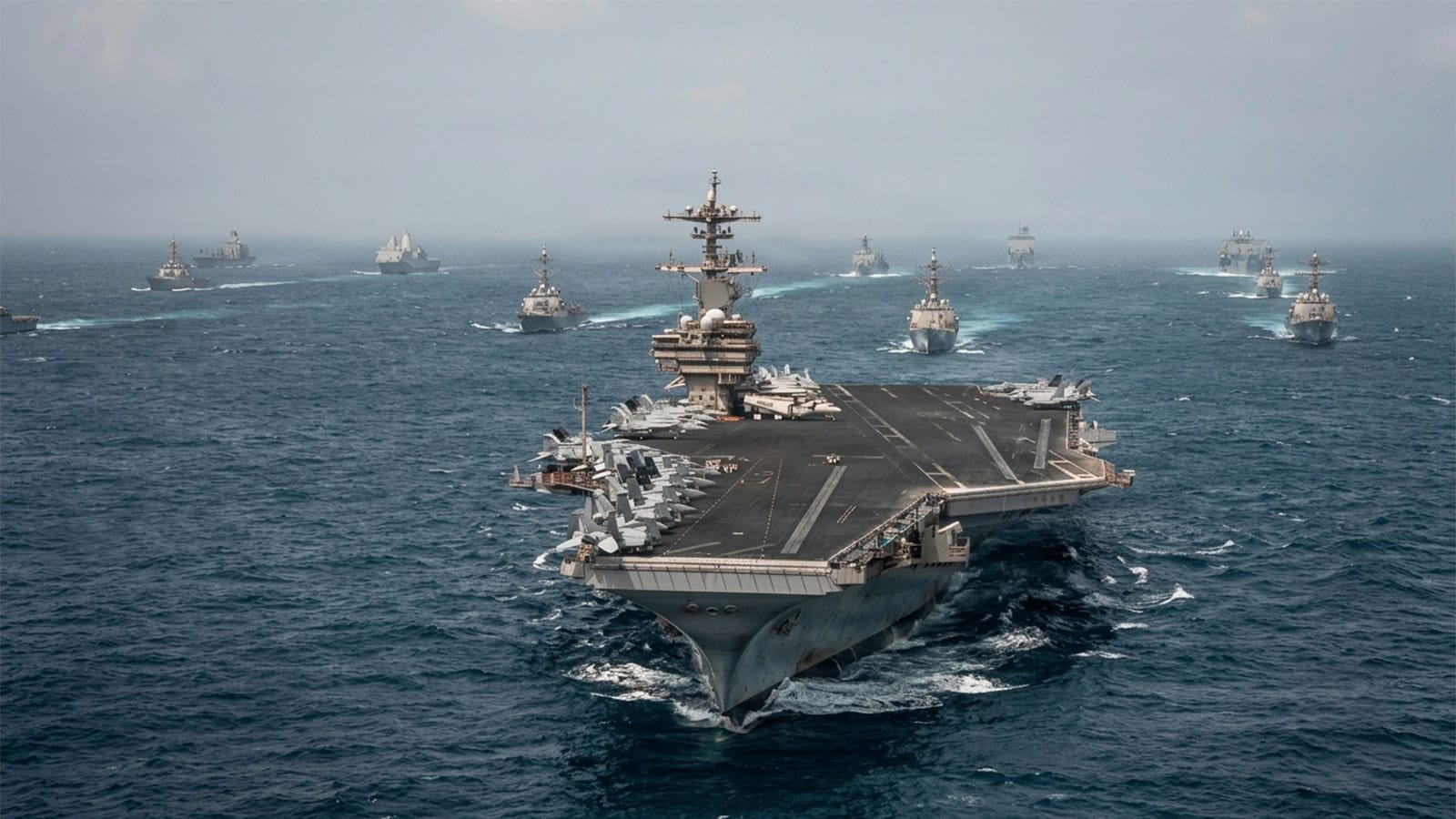
5:46am 15 July 2026 — Iran strikes Kuwait and wounds four sailors as US Patriots down the barrage
Iran has hit a Kuwaiti navy vessel and wounded four personnel, Kuwait's military said, one strike in an overnight barrage of ballistic and cruise missiles and drones aimed at Gulf states. US forces helped defend Kuwait, firing Patriot interceptors to knock the attack down, CNN reported, citing two US officials.
The pattern says everything. Tehran cannot reach the US directly, so it is lashing out at neutral Gulf neighbours who want no part of its war, and even those attacks are being swatted out of the sky by American air defence. Every missile wasted on Kuwait buys Iran nothing but more Gulf states lining up behind Washington.
5:08am 15 July 2026 — Iran's IRGC threatens to choke off the region's oil and gas exports
Iran's Islamic Revolutionary Guard Corps has threatened that no oil or gas will leave the region while US 'evil actions' continue, according to Iranian state media, and claimed American pressure will only delay any reopening of the Strait of Hormuz.
It is an empty threat from a regime that no longer controls the water it is bluffing about. Iran cannot keep its own ports open under the US blockade, and shutting the Gulf's exports would gut Tehran's last source of hard currency long before it hurt the West. The IRGC is threatening to torch a house it has already been locked out of.
3:31am 15 July 2026 — Trump hosts Iraq's Ali al-Zaidi and pulls Baghdad's oil out of Tehran's orbit
Trump welcomed Iraqi Prime Minister Ali al-Zaidi to the White House, calling the businessman turned leader ‘a fantastic champion, a new champion’ and promising ‘we're going to be doing a lot of deals’ on oil and gas. Al-Zaidi, who Trump backed earlier this year, said Baghdad's relationship with Washington was moving ‘from militaristic to economic’ and pledged to disarm Iraq's armed factions by 30 September. The Islamic Resistance in Iraq, the umbrella group for Iran's militias there, rejected the visit's outcomes before it even began.
Baghdad has spent 20 years as Tehran's back door, the place its sanctioned oil got laundered and its proxies got paid. Trump has just walked the Iraqi Prime Minister into the Oval Office and started buying that door off him with oil deals and jobs. Iran's own closure of Hormuz has strangled Iraq's exports and pushed al-Zaidi straight into American arms, which is the pattern of this whole campaign. The regime keeps reaching for leverage and keeps handing Washington another ally, while the country that actually needs that strait open is China.
2:17am 15 July 2026 — Trump scraps his 20% Hormuz toll and vows the US will guard the strait
Trump has dropped his proposed 20% fee on ships using the Strait of Hormuz, telling reporters that 'I don't think anybody should be able to charge a fee' for passage while insisting the US is the one 'protecting this Strait for the entire world'. Al Jazeera reported he is pivoting from the toll toward trade and investment deals with the Gulf states instead.
It is a shrewd move. Washington keeps the job of guarding the strait without handing Beijing a grievance about American tolls on the oil route that keeps China's economy running. The US provides the muscle and lets the Gulf monarchies pay for it in trade deals rather than transit fees.
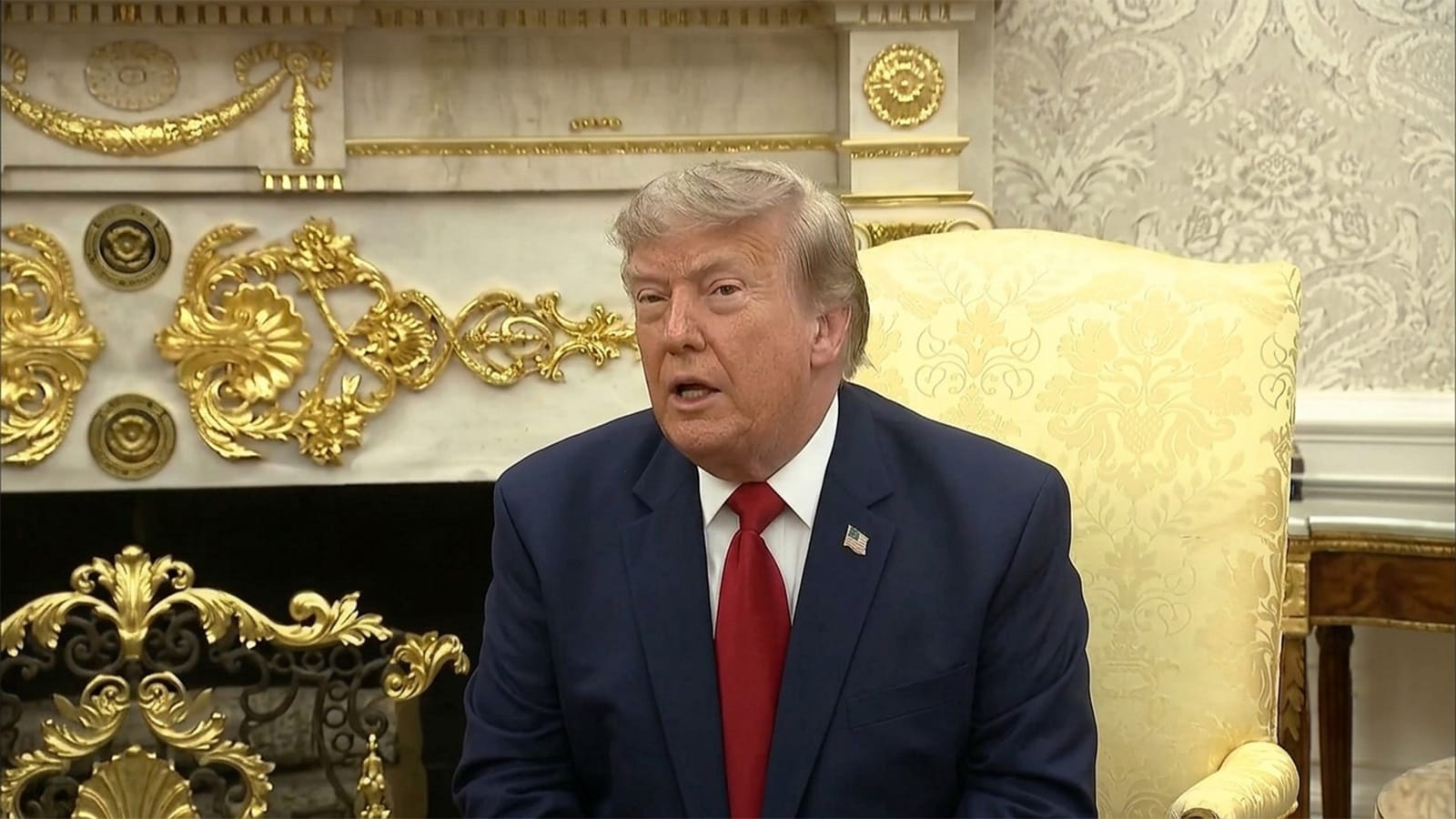
1:13am 15 July 2026 — Trump declares the Strait of Hormuz open to all shipping except Iran
US President Donald Trump has told the world the Strait of Hormuz is open to everyone but Iran, writing on Truth Social that the waterway stays shut only to a regime whose 'lying, violent, malicious leadership' is dragging it 'down the path of TOTAL DESTRUCTION'. He added that oil is 'flowing like never before' and that Iran will 'never have a nuclear weapon'.
That is the leash in one line. Trump holds the tap on Iran's oil and the gate on its only export route, and he gets to say who sails. Every other cargo moves while Tehran's stays stuck in port, a daily reminder of who now sets the terms in the Gulf.
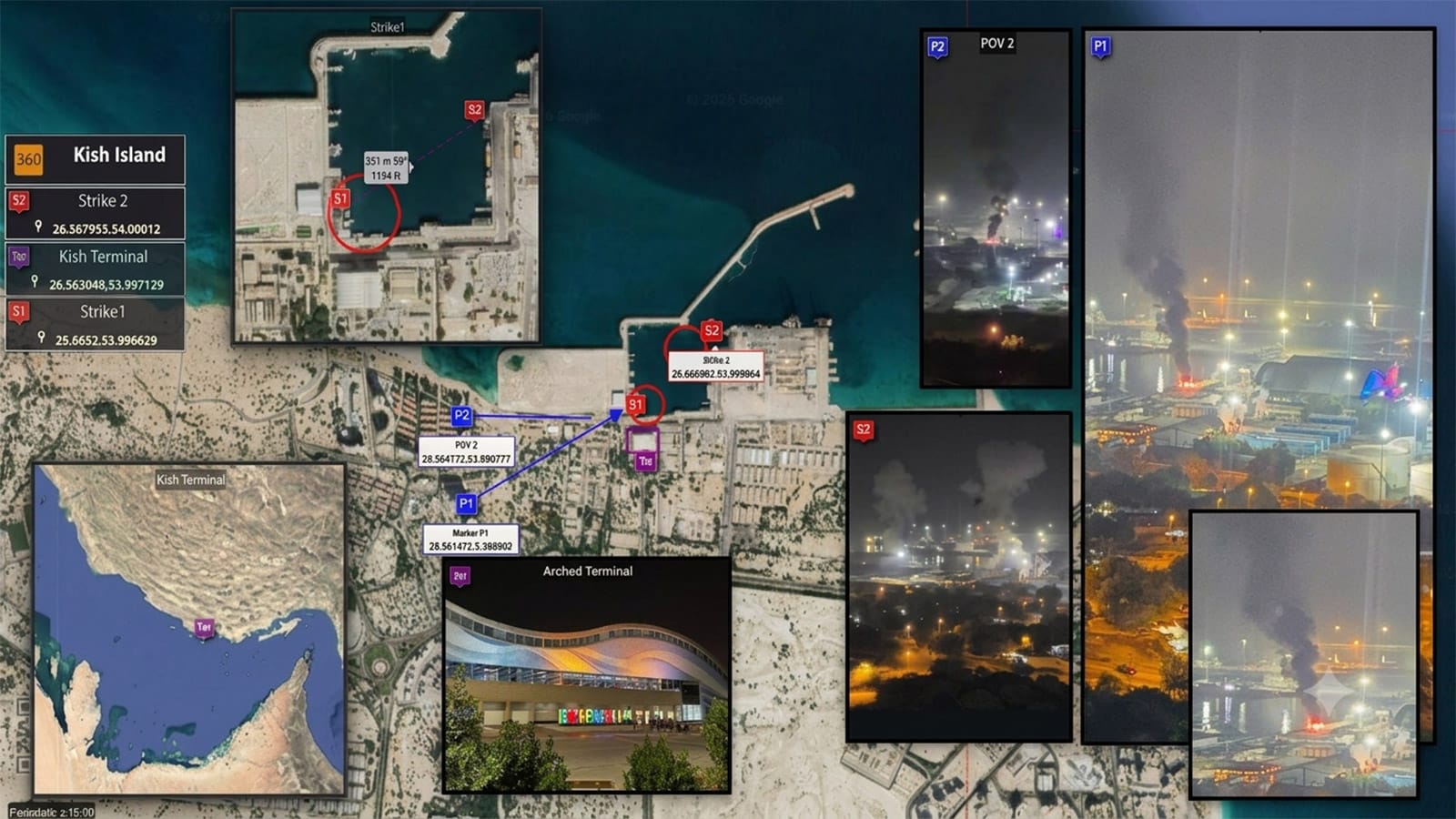
12:02am 15 July 2026 — Iran admits a US strike damaged part of the Kish Island power plant
Iran's own Kish Water and Power Company says part of the power plant on Kish Island, in the Gulf off Iran's southern coast, was damaged in a United States strike early on Tuesday. In the same statement the company told residents to use electricity sparingly, an admission that the hit is already biting.
This is Donald Trump making good on his threat. For days he warned Tehran he would finish the job and take down Iran's power grid if the deal collapsed, and now that Iran's parliament has torn up the memorandum, Iran's own utility is conceding a US strike has reached the lights on Kish. The leash Trump holds over Iran's oil, its dollars and the Strait of Hormuz just got shorter.
11:35pm 14 July 2026 — Netanyahu warns Iran any attack on Israel will be met with far greater force
Israeli Prime Minister Benjamin Netanyahu has warned Tehran that any fresh attack on Israel will be answered with far greater force, telling a security conference in the Negev city of Dimona not to expect a repeat of the last round. “Do not count on there being calm if you attack us,” he said, adding that Iran should “not expect a repeat of what happened before, because there will be no repeat.”
The warning fits the wider squeeze. Trump is holding Iran's oil, its dollars and the Strait of Hormuz on a short leash, and Netanyahu made clear Jerusalem will do the same on its own front. His own line said it plainly, that Iran's axis has never been weaker while Israel has never been stronger, and for all the regime's threats it is Washington and Jerusalem still setting the terms.
11:07pm 14 July 2026 — Iran's parliament declares the US deal dead and vows revenge for Khamenei's killing
Iran's parliament has removed any doubt about who blew up the ceasefire. Around 180 members signed a statement on Tuesday declaring the memorandum of understanding with Washington terminated, pledging to keep chasing revenge for the killing of former supreme leader Ali Khamenei, and demanding new laws to tighten Tehran's grip on the Strait of Hormuz, according to Iranian state media.
It is a confession dressed up as defiance. Donald Trump said for days that Tehran had a done deal and tore it up, and now Iran's own lawmakers have put that betrayal in writing. Every threat to choke Hormuz only sharpens the point of Trump's blockade, because the man holding Iran's oil, its dollars and its single shipping lane can let the regime rage while Beijing, the real customer at the end of that pipeline, watches its energy lifeline slowly tighten.
10:16pm 14 July 2026 — Oman breaks with Tehran and demands the Strait of Hormuz stay open under international law
Oman, the very mediator Iran has leaned on for years, has called on all parties to respect international law in the Strait of Hormuz and reaffirmed its commitment to restoring freedom of navigation, pointedly citing its obligations under the UN Convention on the Law of the Sea.
That's a body blow to Tehran's gambit. Iran has tried to paint its blockade as a lawful closure, but when even Muscat, its closest Arab friend and its back channel to Washington, insists the waterway stays open to the world's shipping, Iran stands exposed and alone. Every day of missiles and mines in Hormuz costs Tehran another friend, and hands Trump the argument that someone has to police this strait.
9:31pm 14 July 2026 — EASA warns airlines to stay out of Gulf airspace as Iran's attacks spread
Europe's aviation safety regulator has told airlines not to fly over Bahrain, Kuwait, Qatar, the United Arab Emirates or the waters of the Gulf of Oman. The European Union Aviation Safety Agency, known as EASA, warned that missiles, drones, combat aircraft and air defence systems now make civil flights unsafe at every altitude across the region.
This is the real price of Iran's tantrum. Tehran lashing out at tankers and Gulf capitals has now shut the skies over some of the busiest air corridors on earth, stranding travellers and freight far beyond the war zone. It's a reminder of who is escalating here, and why Trump's push to bottle up Iran's ability to strike is about protecting a lot more than oil.
9:20pm 14 July 2026 — Jordan condemns Iran's Hormuz tanker strike and backs the UAE
Jordan has condemned Iran's missile strike on two UAE oil tankers in the Strait of Hormuz, calling it a dangerous escalation and a violation of international law and declaring full solidarity with the Emirates. Amman's foreign ministry also sent condolences to India after an Indian crew member was killed and others were wounded when the tankers Al Bahyah and Mombasa were hit.
Every fresh attack on civilian shipping drags another Arab capital onto Washington's side of the ledger. Iran set out to choke the Strait and has instead killed a foreign sailor and pushed Jordan, the UAE and the Gulf into open opposition. That is the isolation Trump's blockade was built to exploit, and Tehran keeps handing him the case.
9:01pm 14 July 2026 — Iranian oil supertanker races to beat Trump's Hormuz blockade deadline
A supertanker loaded with about 2 million barrels of Iranian crude was racing to cross the American blockade line before Washington's 8pm UTC deadline on Tuesday, according to tanker tracking service TankerTrackers.com. The service said the giant carrier, which normally crawls at about 10 knots, was pushing hard to make the crossing before the cutoff sealed it out.
This is the leash tightening in real time. Trump has turned the Strait of Hormuz into a toll gate he controls, and Iran's crude now has to run for open water before the blockade line snaps shut behind it. Every barrel Tehran cannot move is money it cannot send to Beijing, which is the whole point of the squeeze.
9:00pm 14 July 2026 — Israel and Lebanon resume US brokered Rome talks to disarm Iran's Hezbollah
Israel and Lebanon have resumed US brokered talks in Rome, meeting at the American embassy to nail down the 14 point framework Donald Trump's negotiators sealed in Washington on 26 June, a deal that hands Israel a staged pullback only once Iran's Hezbollah proxy is disarmed and the Lebanese army moves into two pilot zones along the Litani.
It's the other half of the leash. While Tehran torches its credibility attacking tankers in Hormuz, Trump is quietly stripping Iran of its most valuable forward militia on Israel's border, and Lebanon's president Joseph Aoun flies to the White House on 21 July to press him to hold the line. Every card Iran throws away at sea, Washington banks on land.
8:55pm 14 July 2026 — CENTCOM reinstates the full naval blockade of Iran’s southern coastline
US Central Command announced today that American forces will resume blockading all maritime traffic entering and exiting Iranian ports from 4pm ET, covering Iran’s entire southern coastline and coastal terminals.
During the initial blockade between April and June, US forces redirected more than 140 compliant vessels, disabled nine non compliant ships and allowed over 50 humanitarian shipments through. Trump has defended the 20% levy on transiting cargo as necessary to cover the cost of securing the waterway.
The blockade formalises what three nights of strikes already made clear. Trump has snapped the leash shut, choking Iran’s oil exports and the strait that feeds China’s refineries in a single move. Tehran can posture about sovereignty over Hormuz, but the US Navy is now the gatekeeper, and every barrel Beijing needs runs through Washington’s checkpoint.
8:48pm 14 July 2026 — Trump threatens to put a ‘big fat shot’ through the door of Iran’s Pickaxe Mountain nuclear site
President Trump said the US could target Pickaxe Mountain, Iran’s most deeply fortified underground nuclear facility near Natanz, telling reporters it is a possible target.
Pickaxe is a possible target for a nice, big, fat shot right in the front door.
Pickaxe Mountain, known in Farsi as Kuh-e Kolang, sits up to 600 metres beneath solid granite in central Iran. Iran describes it as a centrifuge assembly plant, though UN inspectors have never been granted full access to verify its purpose.
The statement is vintage Trump, plain language aimed at Tehran’s decision makers. Whether the US can penetrate 600 metres of granite is an open question among defence analysts, but the signal is the point. Iran’s most protected asset is now on the table, and every day Tehran stalls on a deal, the case for striking it grows.
8:40pm 14 July 2026 — Strait of Hormuz shipping traffic plunges 52% in a week as Iran’s tanker war empties the waterway
Confirmed vessel crossings through the Strait of Hormuz fell approximately 52% between July 10 and 12 compared with the previous week, according to MarineTraffic data. The International Maritime Organisation said hundreds of vessels carrying around 6,000 seafarers remain stranded in the Persian Gulf.
Shipping operators have shifted to Iranian controlled and unmonitored ‘dark’ routes, while traffic on the IMO approved Omani corridors has fallen to minimal levels. The collapse in safe passage traffic hands Trump further justification for both the naval blockade and the 20% Hormuz toll.
The 52% drop proves what Trump has argued from the start. The regime that claims to be guardian of Hormuz is the reason nobody wants to sail through it. With the blockade restored and Iran’s coastal defences degraded by three nights of precision strikes, the strait is becoming Washington’s tollbooth. For Australia, every tanker rerouted around the Cape of Good Hope reprices the fuel supply chain that Pauline Hanson and One Nation have long warned is dangerously exposed to a single chokepoint controlled by a hostile power.
8:19pm 14 July 2026 — Iran's parliament ousts hardliners Nabavian and Rezaei from its security committee
Iran's parliament has stripped Mahmoud Nabavian and Ebrahim Rezaei, two of the chamber's loudest opponents of talks with Washington, of their leadership posts on its National Security and Foreign Policy Committee, according to Iranian state media. Nabavian, who branded any deal with the US an "absolute loss", lost the first deputy chairmanship, while Rezaei was dumped as committee spokesperson in the panel's annual leadership vote.
It is a quiet admission that Trump's blockade is working. Even as the regime postures defiance in Hormuz, Tehran is sidelining the very men who swore never to deal with Washington, clearing the way for the pragmatists who know Iran cannot survive a permanent siege of its oil, its dollars and its shipping lane. With China's cut price crude trapped behind that same strait, the pressure only builds for Iran to come back to the table on Trump's terms.
8:18pm 14 July 2026 — UAE condemns Iran's renewed missile and drone attacks on Bahrain and Jordan
The United Arab Emirates has strongly condemned Iran's renewed missile and drone attacks on Bahrain and Jordan, calling them a flagrant violation of both countries' sovereignty and a threat to regional stability. Abu Dhabi reaffirmed its full solidarity with both governments and backed every measure they take to defend themselves.
Every Iranian missile that lands on an Arab capital drives the Gulf further into Washington's arms, not Tehran's. The UAE, Saudi Arabia, Kuwait, Qatar and now Jordan are closing ranks behind the US security umbrella, leaving Iran isolated and China without a single reliable partner in the region it leans on for oil.
8:15pm 14 July 2026 — Trump to address the nation on Iran in a primetime speech Thursday
President Trump announced on Truth Social that he’ll deliver a “Speech to the Nation” on Thursday at 9pm ET, which is 11am AEST Friday. A senior White House adviser told Axios the address will cover the Iran war, election integrity and the SAVE America Act.
Trump will front the cameras with three nights of precision strikes behind him, Iran’s coastline blockaded and every Gulf state lined up with Washington. That’s the 60 day leash pulled tight. For Australia, Thursday matters because if he announces a permanent toll on Hormuz shipping, it reprices every barrel of crude flowing to China’s refineries and weakens Beijing’s grip on cheap Middle Eastern energy for good.
8:13pm 14 July 2026 — Bahrain jails three for life over Revolutionary Guard espionage plot
A Bahraini court has sentenced three people to life in prison across two separate spy cases, after finding they worked with Iran's Islamic Revolutionary Guard Corps to carry out hostile and terrorist acts against the kingdom, Bahrain's Public Prosecution said on Tuesday.
It is another Gulf door slamming shut on Tehran. As Iran's missiles rain on its neighbours and its agents burrow into their institutions, the Arab states Trump has spent months courting are lining up against the regime, not with it. The Islamic Republic is buying itself a region full of enemies at the exact moment it can least afford them.
8:10pm 14 July 2026 — Iran's tanker war widens as Stolt Magnesium is struck off the coast of Oman
Shipping group Stolt Tankers says its vessel Stolt Magnesium was hit by an unidentified external device off the coast of Oman, sparking a fire in the engine room, though it confirmed all crew are safe and accounted for. It is the latest ship struck as Iran widens its assault on Gulf shipping, after the UK Maritime Trade Operations logged a missile strike near Limah and Iranian cruise missiles hit two UAE oil tankers in the same waters, killing an Indian sailor and wounding eight more.
Every neutral tanker Tehran torches makes Trump's case for him. The regime is now mining and missiling the very shipping lane it claims to protect, which is exactly why Washington has reimposed the blockade and the 20% Hormuz toll. Iran, not America, is the outlaw menacing global trade, and the real squeeze lands on China, the biggest buyer of the oil now trapped behind Tehran's own recklessness.
7:42pm 14 July 2026 — New Zealand summons Iran's ambassador and condemns the IRGC over Hormuz
New Zealand's Ministry of Foreign Affairs and Trade has summoned Iran's ambassador to protest the escalation across the Strait of Hormuz and the wider Persian Gulf, and condemned the Revolutionary Guards' destabilising activities, including what it called operations reaching beyond the Middle East.
Another Western ally lines up against Tehran. Wellington joining Britain's fresh IRGC terror listing and Germany's spy-plot probe shows the democracies closing ranks around Trump's core demand, that Iran's Guards stop menacing shipping and stop exporting their violence, while Tehran is left isolated and reaching only for Moscow and Beijing.
7:45pm 14 July 2026 — Brent crude surges past $86 to a one month high as Iran’s tanker strikes rattle oil markets
Brent crude futures climbed above $86 a barrel on Tuesday after ADNOC confirmed Iran’s Revolutionary Guard struck two UAE tankers in the southern lane of the Strait of Hormuz, pushing the benchmark to its highest level in a month, with prices now up roughly 12% since Friday’s escalation.
Twelve percent in four trading days shows how much leverage Trump has pulled from the strait. Every dollar Brent climbs squeezes China’s refinery margins and turns the discounted Iranian crude Beijing once relied on into stranded cargo behind a naval blockade. For Australian motorists, the signal is blunt: higher Brent means higher bowser prices by month’s end.
7:31pm 14 July 2026 — Iran caught hacking Gulf phone networks to hunt US troops, Financial Times reports
Iran ran a coordinated campaign to track the phones of US military personnel and contractors across the Middle East before and during the war, the Financial Times reports, citing telecoms data and cybersecurity experts. Investigators say Iran abused roaming agreements with local carriers and even commercial advertising data to pinpoint the hotels and locations of American service members.
This is what Iran does while it cries victim over civilian casualties. A regime that paints every US strike as an atrocity was quietly hunting American troops through their mobile phones, hoping to kill them. It's the clearest answer yet to anyone still pretending Tehran wanted peace, and exactly why Trump refused to let the last deal tie his hands.
7:03pm 14 July 2026 — UK bans the IRGC as Germany probes an Iran-linked spy and attack plot
Germany has opened an investigation into a suspected Iran-linked spying and attack plot on its soil, days after Britain moved to proscribe the IRGC as a terror threat over a string of antisemitic attacks, piling fresh European pressure onto Tehran as its war with the US escalates.
This is the part of Iran's war that never makes the front page but proves Trump's point exactly. The same regime firing missiles at tankers and Arab capitals runs spy cells and hit squads across Europe, and now London and Berlin are treating the Revolutionary Guard for what it is, a terror outfit. Every Western capital that wakes up to that reality strengthens the case for keeping Tehran boxed in.
6:16pm 14 July 2026 — Gulf bloc condemns Iran-backed Houthi missile strike on Saudi Arabia
The Gulf Cooperation Council, the six-nation bloc of Gulf Arab states, condemned an Iran-backed Houthi ballistic missile strike on southern Saudi Arabia as a cowardly attack and a flagrant violation of international law, with Secretary-General Jasem Albudaiwi declaring the security of Saudi Arabia inseparable from the security of the Gulf. Qatar's foreign ministry echoed the bloc, pledging full solidarity with Riyadh and backing any measures the kingdom takes to defend itself.
Every missile Tehran's proxies fire at a Gulf capital does Trump's work for him. The Houthi militia that Iran arms and funds is now hitting the very Arab states Iran claims to lead, and one by one those capitals are lining up behind Washington. Trump has already backed a Saudi operation against the Houthis, and the Gulf's united condemnation shows how badly Tehran has isolated itself.
6:13pm 14 July 2026 — Iran vows to hold Hormuz and keep its oil flowing in defiance of Trump
Iran's military declared it would not back down in the Strait of Hormuz, and Tehran insisted its oil exports would keep flowing despite Washington revoking sanctions waivers and reimposing a full blockade, Iranian state media reported.
It's pure bluster from a regime with no cards left to play. Iran cannot hold the strait open against the US Fifth Fleet, cannot ship the oil it is boasting about while the Navy blockades its coast, and cannot dodge the 20% toll Trump has slapped on Hormuz traffic. The louder Tehran insists nothing has changed, the clearer it is that everything has, and that the waterway now runs on Trump's leash, not the ayatollahs'.
6:09pm 14 July 2026 — Gulf states and India turn on Tehran over the Hormuz tanker attacks
The Gulf Cooperation Council, Kuwait and Qatar all condemned Iran's attacks on UAE oil tankers in the Strait of Hormuz, as the wider region lined up against Tehran, and India summoned Iran's deputy ambassador after one of its nationals was killed in the strikes in Omani waters.
Every one of these condemnations is a gift to Washington. The Arab states Iran claims to lead, and even India, a major buyer of its crude, are pointing the finger at Tehran rather than at the US Navy now sitting off Iran's coast. Trump wanted the region to see Iran as the reckless party wrecking freedom of navigation, and Tehran has spent the day proving him right.
6:05pm 14 July 2026 — CENTCOM widens its strikes to Bushehr as Iran reports three dead in the south
US forces kept up their bombardment of Iran through the afternoon, with the Pentagon releasing fresh video of its latest strikes, while Iranian state media reported three people killed in a US strike in the country's south and smoke was seen rising over Bushehr Airport.
This is Trump keeping his boot on Tehran's throat rather than letting the regime catch its breath. The strikes are aimed squarely at the IRGC's ability to threaten shipping and hold Hormuz hostage, and every hour the pressure stays on is another hour Iran can't rebuild the launchers and fast boats it uses to menace the strait.
5:22pm 14 July 2026 — China pleads for calm in Hormuz as Trump's blockade squeezes its oil lifeline
China's foreign ministry called on Washington and Tehran to restore safe passage through the Strait of Hormuz, hours after Trump reimposed a full US Navy blockade of Iran's coastline. Beijing is by far the largest buyer of the discounted Iranian crude now bottled up behind that blockade.
Here is the real game beneath the missiles. Trump isn't only squeezing Tehran, he is turning off the tap on the cheap oil that keeps China's factories humming, and Beijing's sudden plea for calm shows exactly where the pressure is landing. The mullahs are the target on the surface, but the leash runs all the way back to China's energy lifeline, and Washington now holds the other end.
2:24pm 14 July 2026 — Jordan shoots down four Iranian missiles that breached its airspace
Jordan's armed forces intercepted and shot down four missiles fired from Iranian territory that crossed into Jordanian airspace on Tuesday, the kingdom's official Petra news agency reported, citing a military source who said the interceptions caused no casualties or damage.
It's another own goal from a regime lashing out in every direction at once. Iran can't dislodge the US Fifth Fleet or wrench Hormuz open on its own terms, so its missiles are now raining down on Jordan, a close American partner, and hardening the very Arab coalition Washington needs to keep the strait open. Every Iranian missile that Jordan's air defences knock out of the sky makes Trump's case that Tehran is the reckless actor destabilising the region.
1:41pm 14 July 2026 — Oman summons Iran's envoy over the Duqm strike as Tehran MPs threaten Muscat with missiles
Iran has plunged relations with Oman, its closest Arab partner and its long standing back channel to Washington, into their worst crisis in decades after the Revolutionary Guard struck US naval logistics and carrier refuelling sites at the Omani port of Duqm, just hours after Muscat had hosted Iranian foreign minister Abbas Araghchi for talks on the Strait of Hormuz. Oman condemned the assault as 'irresponsible', summoned Iran's ambassador in protest, and demanded Tehran respect its sovereignty and stop interfering in its affairs.
Rather than back down, Iranian hardliners turned on the very partner they had just bombed. National security committee member Ali Khezriyan declared Iran would control Hormuz 'with or without Oman' and warned that if Muscat helped Iran's enemies, 'its territory will not be safe from Iranian missiles'. Fellow MP Mahmoud Nabavian demanded the IRGC impose 'exclusive management' of the strait, while Tehran's foreign ministry blamed the collapse of the Hormuz talks on 'overt and covert US pressure on Oman'.
This is a regime setting fire to its own house. Oman spent years as Tehran's one reliable friend in the Gulf and its quiet line to Washington, and Iran has repaid it with cruise missiles and open threats because Muscat would not sign over a waterway that was never Iran's to give. Every ally Tehran torches pushes the Gulf further behind Trump's blockade and hands Washington the one thing Iran fears most, a permanent route through Hormuz that no longer runs on Iran's leash.
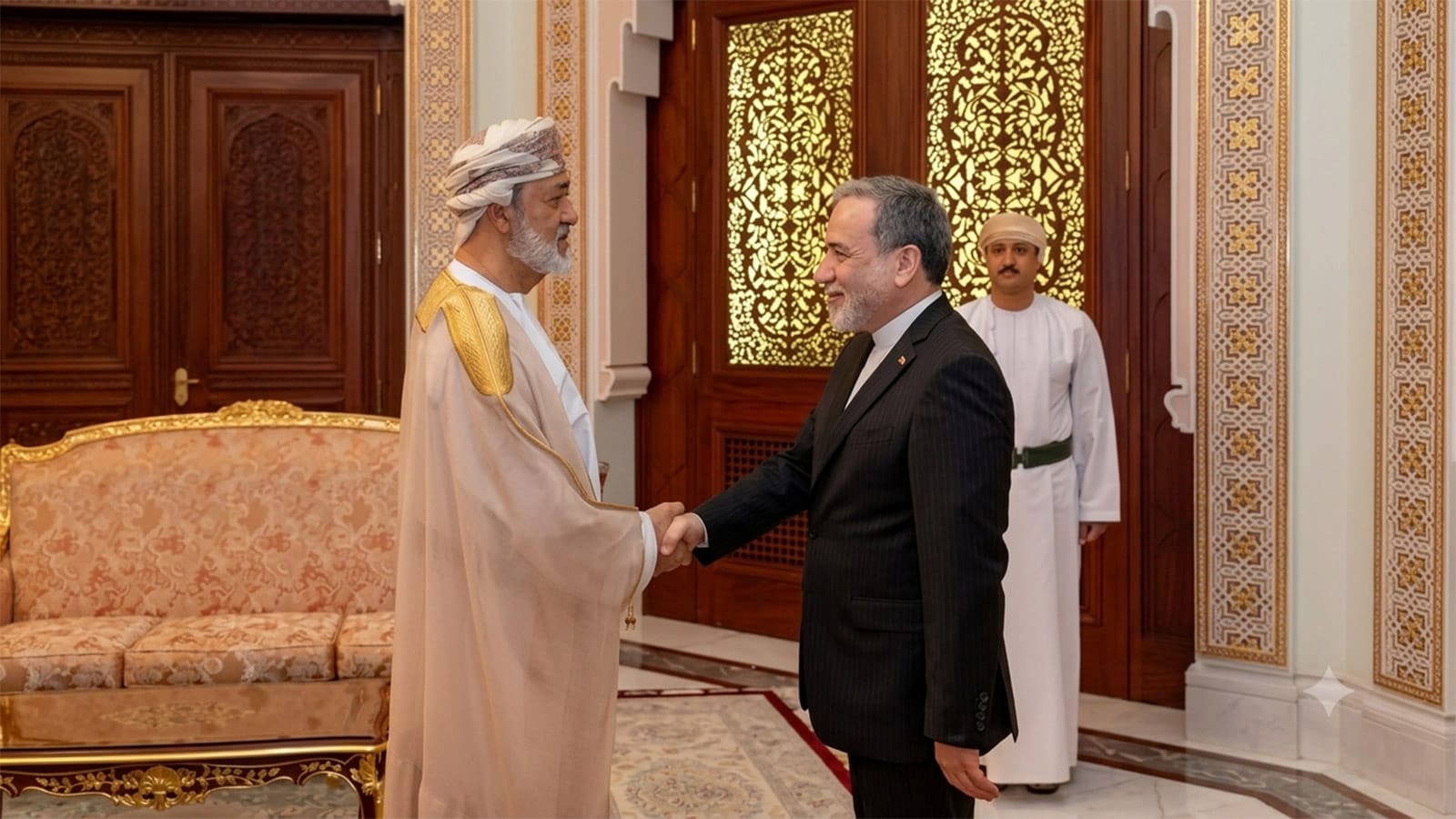
1:40pm 14 July 2026 — Missile hits an Iranian Kurdish opposition base near Erbil in northern Iraq
A missile has slammed into a base used by an Iranian Kurdish opposition group east of Erbil, in Iraq's Kurdistan region, with Iraqi outlet Shafaq News and Reuters citing security sources who reported no immediate casualties. No group has claimed the strike.
No one has claimed the strike, but Reuters notes Iran's Revolutionary Guards have hit these Kurdish opposition camps repeatedly in recent months, so the fingerprints are familiar. While CENTCOM methodically strips Iran's coast of the missiles and drones it uses to menace Gulf shipping, Tehran spends its firepower on exiles across a neighbour's border. A regime that is winning a war does not need to bomb opposition camps in another country, and every wild swing like this one pushes the Gulf further behind Trump's blockade of Hormuz.
12:39pm 14 July 2026 — Bahrain says it shot down Iran's attacks as the IRGC boasts it hit the US Fifth Fleet
Bahrain's Defence Force says its air defences have intercepted and destroyed several Iranian aerial attacks, calling them unlawful missile and drone strikes aimed at civilians and stressing that no American base in the kingdom took any major damage. Against that, Iran's Revolutionary Guard used the state-linked Tasnim agency to boast it had struck the US Fifth Fleet's Juffair headquarters, claiming hits on weapons warehouses, a satellite communications centre and a building housing American forces.
It is the same play every time. The Guard fires off a triumphant statement through Tasnim, while the reality on the ground is intercepted missiles, no dead Americans and a Gulf ally now openly branding Tehran a killer of civilians. The boasts only get louder as Iran's options run out, and every empty claim about the Fifth Fleet hands Trump another reason to keep the blockade clamped hard on its coast.
12:27pm 14 July 2026 — CENTCOM completes a five hour wave of strikes on six Iranian coastal sites
US Central Command says it has finished its latest five hour wave of strikes on Iran, completed at 10:15pm US Eastern time on Monday, hitting military sites at Bushehr, Chabahar, Jask, Konarak, Abu Musa and Bandar Abbas. CENTCOM said the precision strikes went after coastal defence systems, missile and drone sites and other maritime capabilities, all aimed at stripping Iran of its ability to attack commercial shipping in the Strait of Hormuz.
This is the leash doing exactly what it is built to do. Every wave shreds more of the regime's navy, its missile batteries and its drone launchers, so the moment Tehran tries to choke Hormuz again it has less and less left to do it with. Trump is not chasing a flag on a palace in Tehran, he is methodically dismantling Iran's capacity to threaten the world's oil, and with it the cheap energy lifeline that Beijing has been quietly banking on.
Following attacks on international shipping in the Strait of Hormuz, U.S. Central Command (CENTCOM) launched extensive strikes against 140+ Iranian military targets, heavily degrading Iran's command capabilities and central military infrastructure.
11:29am 14 July 2026 — Schumer and Schiff move to force a Senate vote to end Trump's Iran war
Democrat senator Adam Schiff says he will introduce a fresh War Powers Resolution this week to force another Senate vote on ending America's military campaign against Iran, branding Donald Trump's strikes 'unconstitutional and unlawful' and claiming the President acted with no imminent threat to justify them. Senate Democrat leader Chuck Schumer piled in on X, saying Trump's understanding with Tehran had collapsed and demanding, 'Enough is enough. End the war.'
The timing says everything. CENTCOM is into its third straight night of strikes, Iran's navy and air force are gone, and Tehran is on the phone to Moscow begging for an economic lifeline. This is the moment Schumer and Schiff pick to try to pull Trump off the throat of a regime that has broken ten deals and is still firing cruise missiles at civilian tankers in Hormuz. Republicans hold the numbers to keep the leash tight, and every Democrat vote to loosen it only buys the mullahs more time.
11:15am 14 July 2026 — Iran's IRGC boasts it crippled two UAE super tankers then blames the US
Iran's Revolutionary Guard Corps has claimed responsibility through the state outlets Tasnim and IRIB for disabling two UAE super tankers in the Strait of Hormuz, the same strike that killed an Indian crew member. It insists the tankers were deceived by the US into taking the southern Omani route by switching off their navigation systems, and were hit and disabled after ignoring warnings.
Read it plainly. Tehran is now bragging about torpedoing civilian shipping and killing a sailor, then pointing the finger at Washington rather than owning the crime. That is the bad faith Trump has been calling out, and it is why the US blockade and the 20% Hormuz toll are the consequence of Iran's aggression, not its cause.
10:47am 14 July 2026 — Oil pushes to a one-month high as renewed US strikes on Iran stoke Hormuz supply fears
Brent crude and US West Texas Intermediate both climbed more than 2% in early Tuesday trade to their highest level since mid June, extending a rally of more than 9% the day before, as the renewed fighting between the United States and Iran sharpened fears over supply through the Strait of Hormuz. Traders are weighing the escalating strikes and the competing claims over the waterway ahead of closely watched US inflation data.
The pain is Tehran's own handiwork. Iran is the side firing cruise missiles at tankers and threatening to choke the strait, and the only reason the spike is still measured in single digit percentages rather than a full blown oil shock is that Trump has kept Hormuz open and parked the US Navy on the toll gate. For Australian drivers it means a nervous few weeks at the bowser, with petrol prices tracking every barrel while the President squeezes the regime's oil revenue at the source.
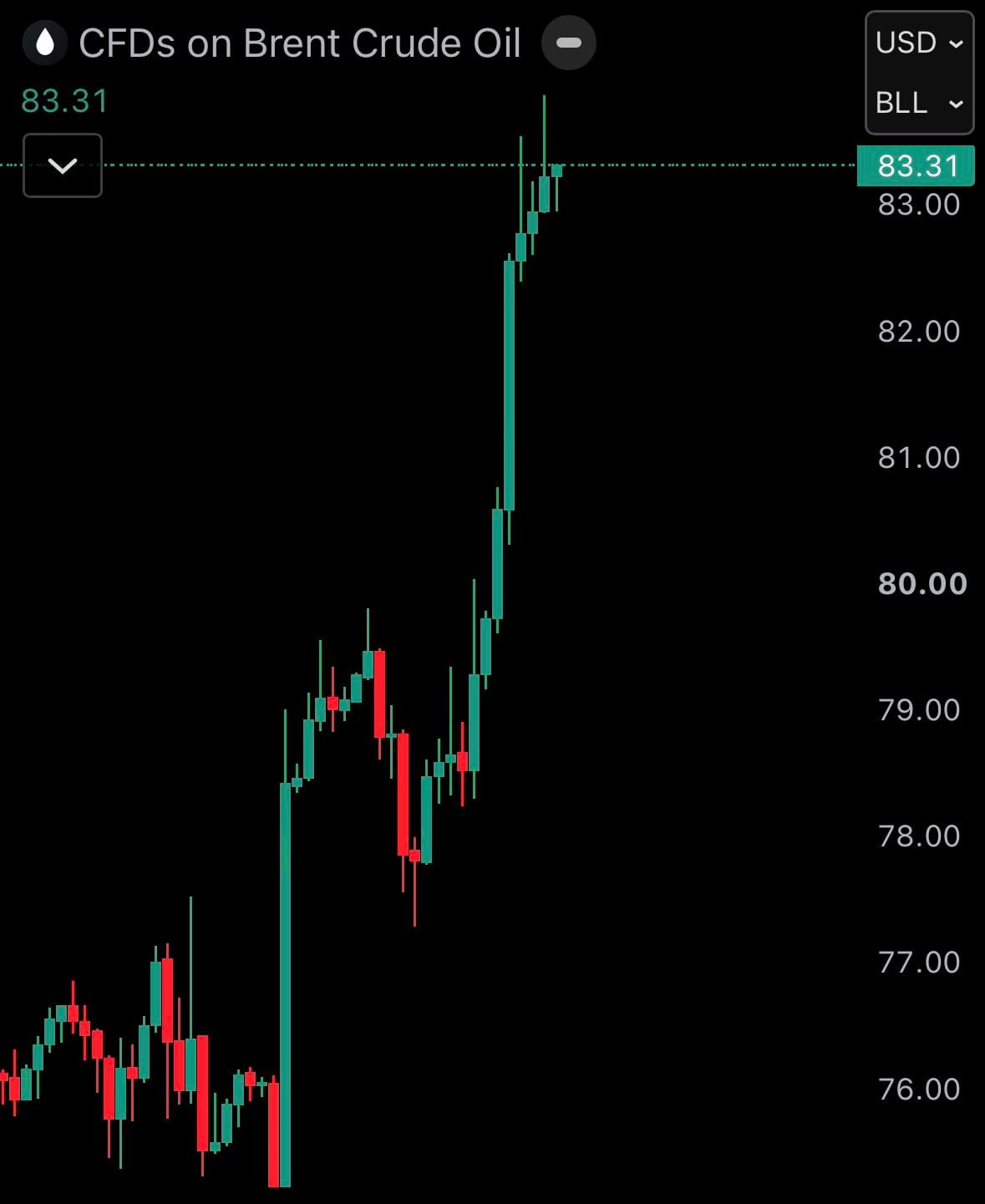
9:52am 14 July 2026 — Bahrain sirens wail as Iran claims an unverified hit on the US Fifth Fleet
Bahrain's Interior Ministry sounded air raid sirens across the kingdom on Monday and told residents to seek shelter, as Iranian state media pushed unverified claims that a missile had struck the US Fifth Fleet's headquarters at Juffair. Neither the US Navy nor Bahrain has reported any hit, and the Fifth Fleet, America's main naval command in the Gulf, has shown no sign it was touched.
It is the same script Tehran has run all week, trumpeting spectacular strikes that never turn up on the ground while its own coastline burns under CENTCOM's third straight night of bombing. Iran can set off Bahrain's sirens, but it cannot dent the fleet now tightening the blockade on its oil and its dollars, and every hollow boast only shows how little the regime has left to actually fire.
تم إطلاق صافرة الإنذار ، نرجو من المواطنين والمقيمين الهدوء والتوجه لأقرب مكان آمن ومتابعة الأخبار عبر القنوات الرسمية.
— Ministry of Interior (@moi_bahrain) July 13, 2026
9:01am 14 July 2026 — Trump says the US had a done deal with Iran before Tehran broke it again
US President Donald Trump told Fox News that US negotiators believed they had sealed a long term peace deal with Iran after an 11 hour meeting on 12 July, only for the regime to phone back and pile on fresh demands. 'We had a deal. It was a done deal, and then they broke it,' Trump said. 'They always break it. We've had 10 deals with these people, and so we're just going to hit them very hard.'
It is the clearest sign yet that Trump has stopped bargaining and started squeezing. Every round of talks has ended with Tehran pocketing the concessions and then tearing up the terms, so the President is now leaning on the three levers he has held all along, Iran's oil, its dollars and the Strait of Hormuz. Beijing is watching closest of all, because it needs those same tankers moving to keep its own economy fed.
8:50am 14 July 2026 — Iran's tanker strike in Hormuz kills an Indian crew member as the UAE condemns Tehran
The UAE Defence Ministry says one Indian crew member was killed and eight other sailors wounded when two Iranian cruise missiles struck the Emirati tankers Mombasa and Al Bahiyah in the southern Strait of Hormuz. Abu Dhabi condemned the 'brazen attack' as a breach of international law and said it retains its full right to respond.
This is the attack Washington has pointed to all along. Tehran claims it is only defending itself, yet here it is putting cruise missiles into civilian oil tankers and killing a merchant sailor in a neighbour's waters. Every strike like this hands Trump the case for seizing the Strait of Hormuz and blockading Iran's coast, and it pushes the Gulf states the regime hoped to intimidate further into Washington's corner.
The Ministry of Defence announces that the national tankers Mombasa and Al Bahiyah were targeted by two Iranian cruise missiles while transiting the southern shipping lane of the Strait of Hormuz, within Omani territorial waters.
— وزارة الدفاع |MOD UAE (@modgovae) July 13, 2026
The attack resulted in the death of one Indian… pic.twitter.com/i1HrXY0fKP
9:08am 14 July 2026 — Trump backs Saudi Arabia's military strikes on the Houthis in Yemen
US President Donald Trump gave Saudi Crown Prince Mohammed bin Salman his personal backing for a military operation against Yemen's Houthis, the militia armed and funded by Tehran, Axios reported, citing a US official, after the two leaders spoke by phone on Friday. The green light came just before Saudi jets bombed the runway at Sanaa airport on Monday to stop an Iranian plane collecting a Houthi delegation, an escalation the Houthis answered by firing ballistic missiles and drones at Saudi Arabia's Abha airport.
It is another sign that Iran's proxy network is being pulled apart from every direction while Trump holds the whip hand. Tehran spent years using the Houthis to hold Red Sea and Gulf shipping hostage, and now even Riyadh has Washington's blessing to hit them at will. With the US already policing the Strait of Hormuz and choking the oil routes that keep China's economy fed, the regime is watching its last cards taken from its hands one by one.
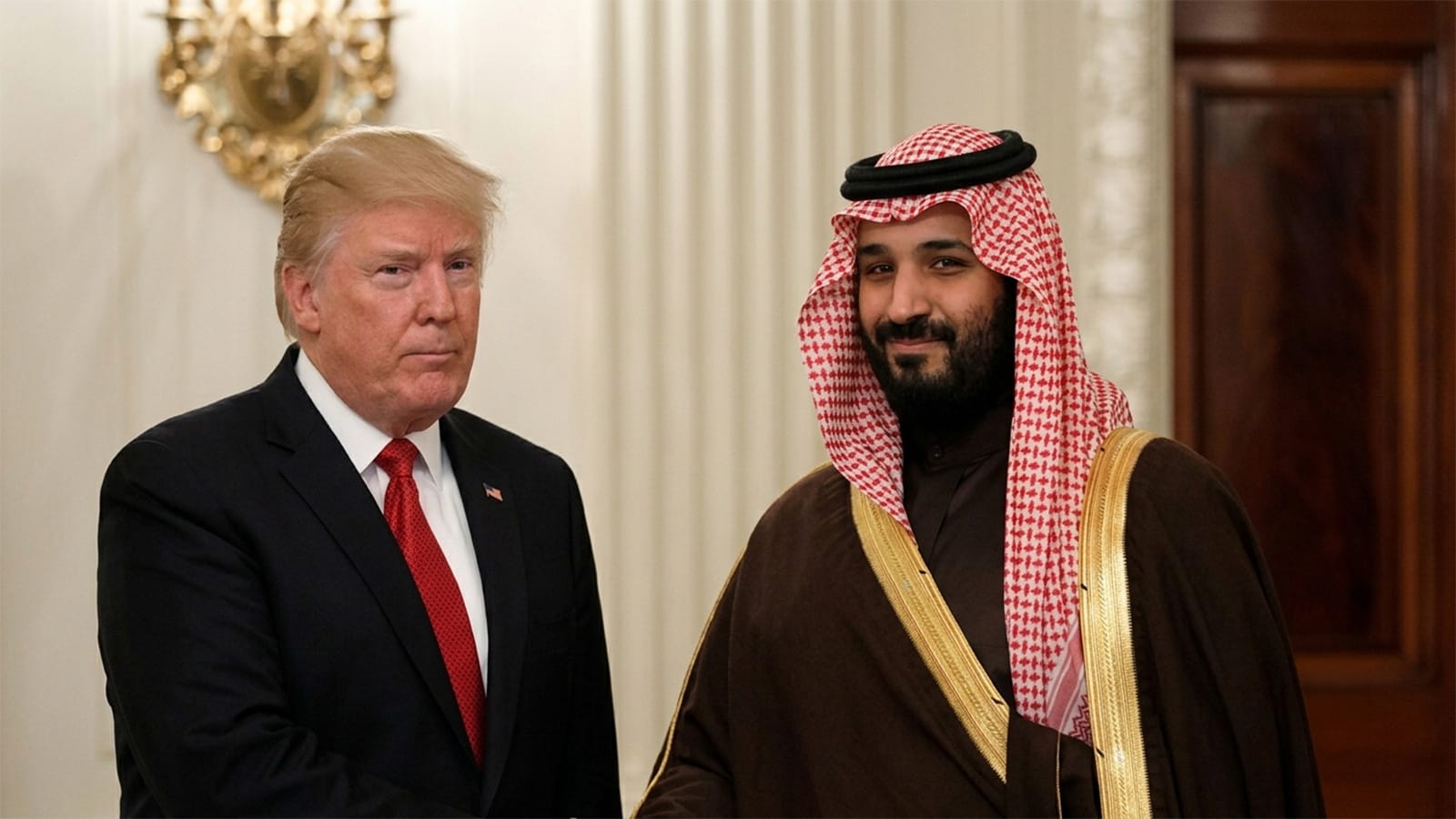
8:26am 14 July 2026 — Iran fires two cruise missiles at UAE tankers in the Strait of Hormuz
The United Arab Emirates defence ministry says Iran fired two cruise missiles at two Emirati oil tankers in the southern Strait of Hormuz, the narrow channel at the mouth of the Gulf that carries around 20% of the world's oil. The ministry gave no immediate word on damage or casualties, and the attack came as the US and Iran traded fresh strikes across the waterway.
It is exactly the kind of reckless strike on a neighbour's civilian shipping that hands Washington its argument on a plate. Trump has already declared the US the guardian of Hormuz and reimposed a blockade on Iran alone, and every missile Tehran throws at a Gulf tanker only strengthens the case that someone other than the regime should be policing the strait. Most of the oil still moving through it is bound for China, which is the leverage Washington is really playing for.
7:32am 14 July 2026 — CENTCOM launches a third straight night of strikes as blasts hit southern Iran
US Central Command says it has begun a third consecutive night of strikes on Iran, opening fire at 4:45pm US eastern time at President Donald Trump's direction to keep imposing a heavy cost on the regime and to strip its ability to menace commercial shipping in the Strait of Hormuz. Within the hour Iranian state media reported fresh explosions across the southern port cities of Bandar Abbas, Chabahar and Konarak and on Kish Island, though Tehran's own broadcaster gave conflicting accounts of what had actually been hit.
At 4:45 p.m. ET today, U.S. Central Command began launching the third consecutive night of strikes against Iran, at the Commander in Chief's direction. These strikes will continue imposing a heavy cost on Iranian forces and degrade their ability to attack innocent civilians and commercial shipping in the Strait of Hormuz.
— U.S. Central Command (@CENTCOM) July 14, 2026
The message from Washington is that the pressure does not ease until Tehran backs down. Every night of strikes tightens Trump's grip on Iran's coastline, its oil routes and the strait its economy depends on, and every blast over Bandar Abbas underlines that the regime has no answer left beyond bluster.
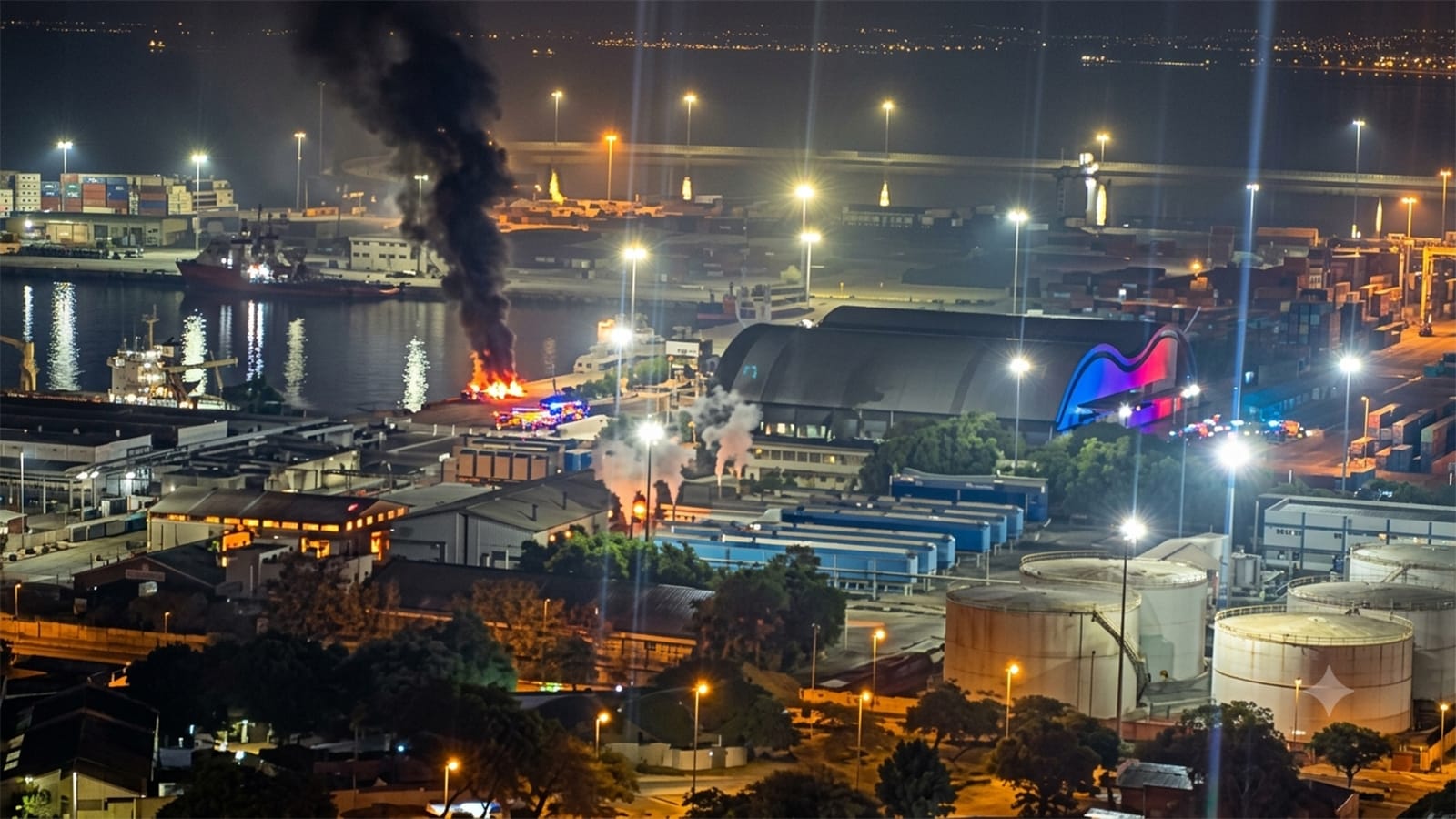
6:58am 14 July 2026 — Trump vows to keep hitting Iran hard and threatens to take out Pickaxe Mountain
President Donald Trump has promised to keep pounding Iran, telling conservative radio host Hugh Hewitt the United States would hit the regime 'very hard tonight' and again tomorrow, adding there was 'not a damn thing they can do about it'. He brushed off the collapsed memorandum of understanding as a 'test' Tehran had failed, saying such deals mean little 'when you're dealing with sleazebags', and named Iran's deeply buried Pickaxe Mountain nuclear site near Natanz as a target, saying the US would 'probably give Pickaxe a shot relatively soon'.
It is the language of a president who holds every card. With Iran's air defences gutted and its navy in ruins, Trump can pick the time and the target at will, and by naming Pickaxe he is signalling that the one thing Tehran has left to guard, its buried nuclear ambition, is now squarely in the crosshairs.
Video: US Navy. Warships and aircraft in close formation in the Arabian Sea, where American naval forces stand ready for ongoing strikes on Iran. Footage released 30 June 2026.
5:59am 14 July 2026 — US shuts consular services across the UAE as it locks down the Gulf
The US Embassy in Abu Dhabi and the US Consulate General in Dubai have cancelled all consular appointments from 13 to 15 July, citing the regional security situation, the US Mission to the United Arab Emirates said in a statement.
Read it as control, not retreat. With CENTCOM's blockade of Iran's ports taking effect and Washington now policing who moves through Hormuz, the US is battening down its diplomatic posture across the Gulf while it tightens the screws on Tehran. The Gulf states that condemned Iran's attacks on their own soil this week are lining up behind that stance, not against it.
5:26am 14 July 2026 — CENTCOM pounds Bandar Abbas and Qeshm to strip Iran's grip on Hormuz
The United States has launched a fresh overnight wave of strikes on southern Iran, with explosions reported across the port city of Bandar Abbas, Qeshm Island and Sirik overlooking the Strait of Hormuz, in an operation Washington says is aimed at degrading Tehran's ability to threaten shipping. Iran's state broadcaster IRIB reported the blasts, and the Hormozgan governor's office said no civilian casualties had been recorded.
The strikes are Trump making good on his pledge to hold Hormuz open and dismantle the IRGC's power to choke it, one radar and missile site at a time, even as Tehran's own boast that it had closed the strait keeps collapsing. The real prize sits further east, in the oil lifeline Iran runs to China.
Video: US Central Command. Aircraft and cruise missile strikes on Iranian military targets, launched in response to Iran's attacks on commercial ships in the Strait of Hormuz. Footage released 12 July 2026.
4:41am 14 July 2026 — Trump formally notifies Congress that US forces have resumed the Iran war
President Donald Trump has formally notified Congress that US military action against Iran has resumed, satisfying the War Powers Act requirement to inform lawmakers within 48 hours of a strike, days after he declared the ceasefire over and ordered CENTCOM back into action over Iran's attacks on Gulf shipping.
Trump is prosecuting this campaign by the book, handing Congress the formal notice the law demands while the critics who spent weeks predicting a quagmire scramble to catch up. The 60 day War Powers clock now runs on the President's terms, not Tehran's, giving Washington a free hand to keep the strait open and the pressure on.
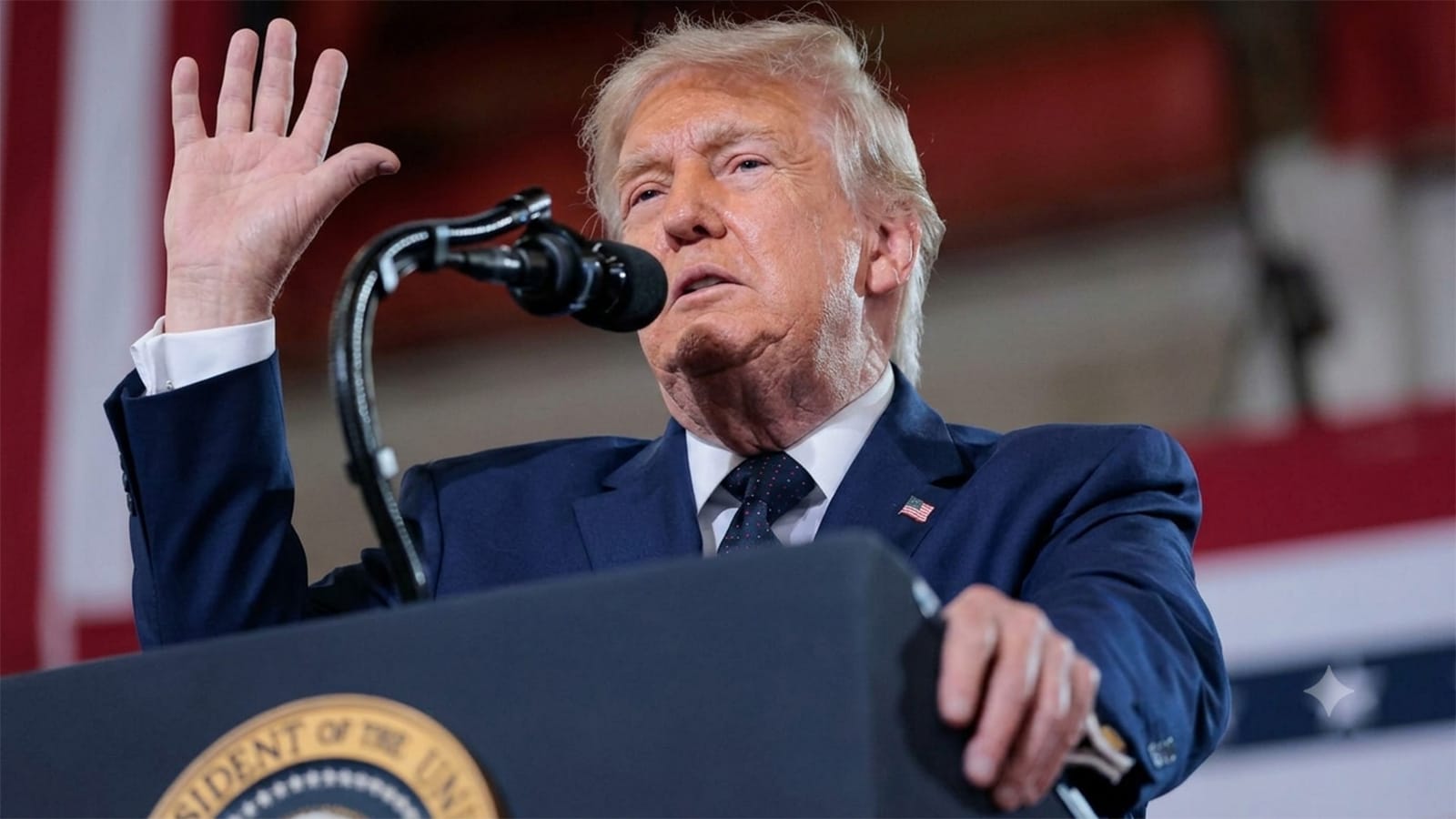
4:17am 14 July 2026 — Iran's Araghchi admits Trump is 'absolutely right' that Hormuz guardian gets paid
Iran's foreign minister Abbas Araghchi has quietly conceded the heart of Donald Trump's Hormuz plan. Responding on X to Trump's move to make the United States the 'Guardian of the Hormuz Strait' and charge a 20% cargo fee, Araghchi wrote that 'POTUS is absolutely right' that whoever secures safe passage through the strait should be paid for it. He still insisted that Iran remains that guardian and haggled that the 20% is 'too much', promising Tehran would 'be fair'.
The 'guardian forever' bluster is theatre. Iran's own top diplomat has just accepted Trump's premise that control of Hormuz is a paid service, and after CENTCOM's strikes stripped out Tehran's navy, air defences and coastal radar, the regime is in no position to collect. Trump holds Iran's oil, its dollars and its one maritime lifeline on a short leash, and every barrel that moves through Hormuz only on American terms tightens the real squeeze on Beijing's energy supply.
POTUS is absolutely right. Whoever provides secure and safe passage of commercial vessels through the Strait of Hormuz should be compensated for this service. Iran has always been the GUARDIAN of the Strait and will remain so FOREVER. 20% is of course too much. We will be fair
— Seyed Abbas Araghchi (@araghchi) July 14, 2026
4:01am 14 July 2026 — US Navy orders blockade of Iran's entire coastline as enforcement begins
The US Navy-led Joint Maritime Information Center has ordered a full blockade of Iran's entire coastline, set to take effect from 2000 GMT on 14 July. The order covers every Iranian port and oil terminal, while neutral ships bound for non-Iranian destinations can still cross the Strait of Hormuz, and humanitarian cargo is allowed through subject to inspection.
This is the leash tightening. Trump keeps Hormuz open for the world while choking off Iran's own oil exports, the lifeline that funds the regime and flows east to China. Tehran can shout about sovereignty, but it is the US 5th Fleet that now decides which Iranian barrels ever reach a buyer.
2:36am 14 July 2026 — Pezeshkian rushes to Russia for energy deals as US blockade bites
Iranian President Masoud Pezeshkian told Russia's visiting energy minister Sergei Tsivilev that Tehran is ready to clear every obstacle and fast-track joint projects across oil, gas, petrochemicals and transit corridors, Iranian state media reported. Pezeshkian pointed to BRICS, the Shanghai Cooperation Organisation and Eurasian frameworks as Tehran's way around Western pressure.
Read it for what it is. With Trump's blockade sealing off Iran's ports, the regime is scrambling east for a lifeline, and Moscow is the middleman to the real prize, Beijing. China buys the bulk of Iran's sanctioned crude, and every grid link and gas deal Tehran signs with Russia is aimed at keeping that pipeline to China alive while Washington squeezes.
8:20am 14 July 2026 — Saudi jets bomb Sanaa runway to block Iranian plane as Houthis declare truce dead
Saudi warplanes struck the runways at Sanaa International Airport on Monday to prevent an Iranian Mahan Air flight from landing, NBC News reported. The plane was carrying a Houthi delegation returning from the funeral of Iran’s Supreme Leader Ayatollah Khamenei. It was safely diverted to Hodeidah.
The Saudi aggression against Sanaa airport has ended the phase of de-escalation, and it must bear the consequences of its aggression.
Riyadh acted because the flight was a regime logistics run dressed up as diplomacy. With the strait crisis live and Trump’s 60 day leash tightening, Saudi Arabia just signalled it won’t let Tehran resupply its proxy network through Yemeni airspace.
7:50am 14 July 2026 — Iran drone hits Kuwait Oil Company drilling platform as regime widens Gulf attacks
Kuwait’s defence ministry confirmed an Iranian drone struck an offshore drilling platform operated by the state owned Kuwait Oil Company, injuring one worker, Arab News reported. Three Kuwaiti border posts were also hit during the same wave of retaliatory strikes after CENTCOM’s 140 target bombardment of Iran.
Tehran has moved from firing at warships and merchant vessels to hitting a neighbour’s energy infrastructure. That escalation puts every Gulf oil asset inside Trump’s protection calculus and strengthens Washington’s argument that the region should pay for US security through the 20% Hormuz toll.
2:12am 14 July 2026 — US court convicts Mahdi Sadeghi over exports to Iran's Revolutionary Guard drone program
A federal jury in Massachusetts has convicted Mahdi Mohammad Sadeghi, a naturalised US citizen aged 43 and a former Analog Devices engineer, of conspiring to illegally export electronic components to Iran in breach of US sanctions. Prosecutors said he helped Iranian associate Mohammad Abedini evade export controls through a front company in Switzerland, feeding a Tehran firm that builds navigation systems for the Revolutionary Guard's drone program. "You cannot send goods, especially the goods at issue in this case, to Iran. Period. Full stop," Assistant US Attorney Alathea Porter told jurors. Sadeghi was convicted on three of five charges and will be sentenced on 13 October.
It's the other end of Trump's leash. While the US Navy chokes Iran's oil at Hormuz, American courts are shutting down the smuggling networks that arm the regime's drones, squeezing Tehran's war machine from both ends.
1:30am 14 July 2026 — Iran’s military warns allied cooperation with US on Hormuz is an act of war
Iran’s Khatam al-Anbiya Central Headquarters, the regime’s joint military command, warned Washington and its regional allies that any nation cooperating with the US to enforce Trump’s Hormuz takeover would face military consequences.
"We will not, under any circumstances, allow the US to interfere in the management of the Strait of Hormuz."
The statement amounts to a threat against Bahrain, Kuwait and the UAE, the same countries hosting the bases Trump’s strikes launch from. Tehran is trying to peel away the coalition by making the cost of cooperation explicit. It won’t work while the 60 day leash holds, because every Gulf state knows Trump can close Iran’s oil tap entirely the moment he chooses to.
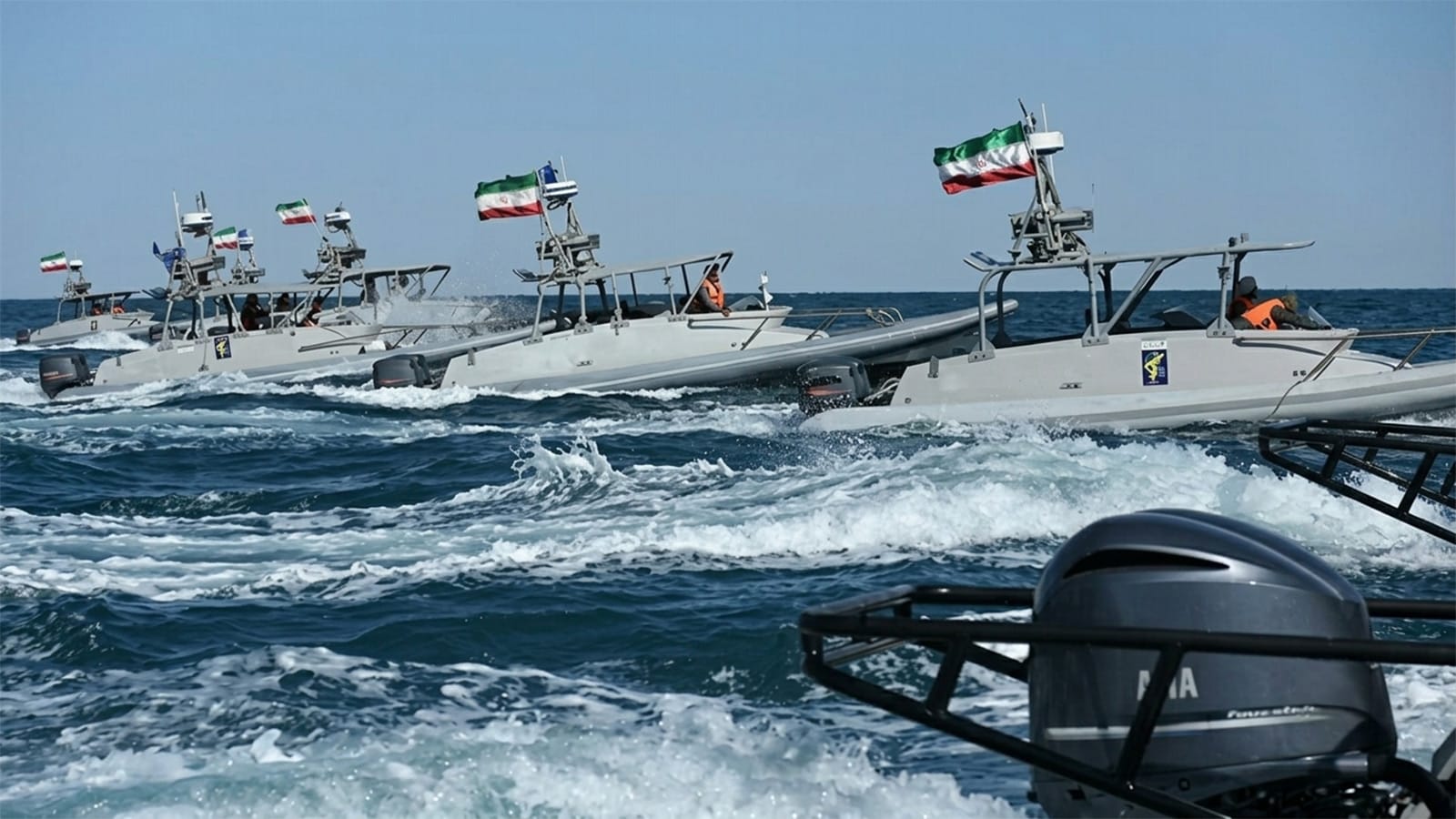
1:13am 14 July 2026 — CENTCOM debuts combat sea drones on Iran's Bandar Abbas naval base
US Central Command says it struck a submarine yard and ship maintenance base at Iran's Bandar Abbas naval port with three Corsair attack drones, the first time American forces have sent unmanned boats into combat. CENTCOM said the raid further stripped Iran of the means to threaten commercial shipping in the Strait of Hormuz.
The sea drone debut drives home the line Washington keeps repeating, that Iran does not control the strait and never will. Every US wave is tuned to keep the oil moving while Tehran's generals run out of hardware to lose at their main Gulf port. Iranian officials said the wider strikes killed and wounded several people inland, but had no answer for the losses stacking up on the coast.
Video: U.S. Central Command. Corsair unmanned surface vessels strike the ship and submarine maintenance facility at Iran's Bandar Abbas Naval Base, the first US use of sea drones in combat.
12:15am 14 July 2026 — Trump reinstates Iran blockade, demands 20% toll on all Hormuz cargo
President Trump declared on Truth Social that the US is reinstating its naval blockade of Iranian ships in the Strait of Hormuz, branding the country the "Guardian of the Hormuz Strait" and demanding a 20% fee on all cargo transiting the waterway. Bloomberg reports oil markets responded instantly, with Brent crude climbing above $78.80 a barrel.
The announcement turns Hormuz from a contested chokepoint into a toll road controlled by Washington. The 20% levy hits every barrel of crude China imports through the strait, which means Beijing now pays Trump for the privilege of keeping its refineries running. That’s the leash in dollar terms.
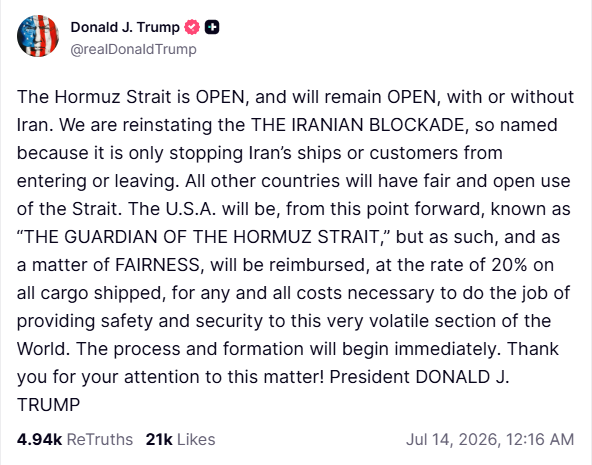
11:10pm 13 July 2026 — Trump says Iran's military is gutted and Mojtaba Khamenei is 90% gone
Trump says Iran's armed forces have been hollowed out, telling Fox News the regime has no navy and no air force left and that its air defences and senior commanders are gone. He claimed Mojtaba Khamenei, son of slain supreme leader Ali Khamenei, was 90% gone.
The boast lands as Iran's own commanders keep declaring victories that Gulf air defences and satellite imagery refuse to confirm. Whatever the precise tally, the fight is not close, and Tehran's threats now travel a great deal further than its missiles.
11:03pm 13 July 2026 — Britain, France and Germany condemn Iran's attacks on shipping and Gulf states
The foreign ministers of Britain, France and Germany have jointly condemned Iran's heinous attacks on merchant ships in the Strait of Hormuz and on Qatar, Kuwait, Oman and Jordan, and called for a return to the ceasefire Tehran shattered. France's foreign minister separately ruled out lifting any sanctions until Iran gives up its nuclear program.
Europe spent years handing Tehran the benefit of the doubt. That era is over. With the E3, the Gulf monarchies and Washington now singing from one sheet, Iran's hunt for a sympathetic mediator is running short of volunteers.
9:39pm 13 July 2026 — Britain outlaws the IRGC as a terror group and summons Tehran's ambassador
Britain has outlawed Iran's Islamic Revolutionary Guard Corps under new state threat laws, making it a criminal offence to back the force, and summoned Tehran's ambassador over a run of antisemitic attacks London blames on an IRGC linked group.
It's a milestone Westminster hawks have chased for years, and it puts Britain shoulder to shoulder with Washington in calling the IRGC what it is, the armed wing of Iran's export of violence. Foreign Secretary Yvette Cooper says more measures are coming.
5:40pm 13 July 2026 — Iran blames Washington for the 'crisis' its own Hormuz attacks set off
Iran's foreign ministry spokesman Esmaeil Baghaei declared on Monday that the memorandum of understanding Tehran signed with the United States, the deal meant to keep the Strait of Hormuz open, had entered a 'crisis', and insisted Iran had not broken it first. The timeline says otherwise: the current round of fighting began when Iran's own forces attacked commercial ships in the strait, and the US struck back only after an Iranian drone set a Cyprus flagged container ship ablaze and forced its crew to abandon it.
Baghaei even blamed 'US pressure on Oman' for scuttling a joint Hormuz mechanism, the tell of a regime hunting for someone else to carry the blame. The deal is only in 'crisis' because Iran fired on the very ships it had promised to leave alone, and Washington answered. Trump still holds Tehran's oil, its dollars and its single shipping lane on a 60 day leash, and every time Iran oversteps he pulls it tighter. The louder the foreign ministry protests, the clearer it is who is setting the terms, and that the real prize over Hormuz is China's energy lifeline, not America's.
5:15pm 13 July 2026 — France rules out sanctions relief for Iran until it drops its nuclear program
France has slammed the door on any easing of sanctions while Iran keeps its nuclear program, stiffening the Western line just as Tehran pushes for relief. French Foreign Minister Jean-Noel Barrot told French broadcaster BFM TV on Monday there would be "no lifting of sanctions as long as Iran does not renounce its nuclear program", and said France stood ready to help clear mines from the Strait of Hormuz once calm returned, though its navy had held off because Iran had reignited the fighting.
As a permanent member of the UN Security Council, France can veto any sanctions relief on its own, which gives Barrot's warning real teeth. It leaves Iran boxed in on every side: Washington holds its oil, its dollars and the Strait of Hormuz on a short leash, and now Europe is refusing to fund the regime back to health while its centrifuges keep spinning. Tehran wanted the strikes to crack the Western front and buy it a way out of sanctions. Instead Paris has lined up beside Trump, and the squeeze that is really aimed at choking off China's energy route through Hormuz only grows.
4:18pm 13 July 2026 — Iran's army claims it downed a US drone over Bandar Abbas as its boasts pile up
Iran's army announced on Monday afternoon, through Iranian state media, that its air defences had shot down a United States drone over the southern port city of Bandar Abbas, the same stretch of coast that US Central Command, the American military headquarters for the Middle East, says its warplanes struck over the weekend. No wreckage, no footage and no US confirmation has surfaced, and the Pentagon has not reported the loss of any aircraft.
This is the same army that spent the weekend announcing dead US soldiers who never turned up and destroyed Patriot batteries that keep intercepting, so the latest claim earns the same scepticism. A regime that could genuinely reach US forces would show the debris, not just read out a bulletin. The pattern is a Tehran that keeps declaring victories it cannot produce while its oil, its dollars and its only shipping lane stay on Trump's 60 day leash, and the real prize, China's energy route through Hormuz, stays firmly in Washington's grip.
3:48pm 13 July 2026 — Ships keep slipping through Hormuz with transponders off as Iran's closure boast fails
Fresh shipping data has punctured Tehran's boast that it has closed the Strait of Hormuz, the narrow channel that carries roughly a fifth of the world's seaborne oil. Reuters reported that only six vessels crossed the strait on Sunday, the fewest in five weeks, and that most of the tankers switched off their transponders as they passed, according to tracking data from the maritime intelligence firm Kpler. A transponder is the automatic signal that lets the world see where a ship is, so switching it off means the vessel keeps moving but stops showing up on the map.
The detail Tehran doesn't want examined is that the ships are still sailing. Iran hasn't closed the strait. It's only made the crossing darker and more dangerous, and that's a very different thing. President Trump said on Sunday the waterway is open to commercial traffic, and US Central Command, the American military headquarters for the Middle East, keeps repeating that Iran does not control it and that US forces are in place to keep it open. Every tanker that slips through with its transponder off is another quiet rebuttal of the regime's claim, and another reminder that the country with the most to lose if Hormuz ever truly closed is not the United States but China, whose energy lifeline runs through these same waters.
3:31pm 13 July 2026 — IRGC claims hits on a US base in Bahrain and radars in Oman as its boasts outrun facts
Iran's Revolutionary Guard Corps announced on Monday afternoon that it had struck United States military facilities in Juffair, Bahrain, the home base of the US Fifth Fleet, and destroyed two radar systems in Oman. It was the latest in a run of Iranian claims after US bases across Bahrain, Kuwait and Jordan came under missile and drone fire. The Guards again tied any reopening of the Strait of Hormuz to an end of US military activity in the waterway.
As with every Iranian bulletin this week, the boast is doing the work the missiles cannot. Jordan shot four of Tehran's rockets out of the sky, Kuwait and Bahrain lit up their air defences, and not one of the regime's grander strike claims has been independently confirmed. The tell sits in the same statement: Iran says it will let Hormuz reopen once Washington stops. That is the language of a regime that knows Donald Trump holds its oil, its dollars and its only shipping lane on a short leash, and is now reduced to narrating victories it cannot deliver while it waits to see how hard the US, with an eye fixed on China's energy lifeline, will let it push.
3:11pm 13 July 2026 — Iran's foreign ministry warns Gulf neighbours their soil could become a target
Iran's foreign ministry, quoted by Iranian state media, warned neighbouring countries on Monday that any territory or facility used to launch American attacks could itself be turned into a target, saying the origin of any assault was fair game. The ministry branded the US strikes of the past 24 hours a breach of the UN Charter and claimed they had hit Iran's transport infrastructure.
It is a threat that gives the game away. Having failed to land a single blow on an American warship in the strait, Tehran is now menacing the very Gulf states, Jordan, Kuwait and Bahrain among them, that spent Monday knocking its missiles out of the sky. The message to the neighbours is that hosting the Americans invites punishment, yet the past day shows the regime cannot make good on it. Washington keeps the strait open and holds Iran's oil, its banks and its shipping lane on a short leash, and every wild warning aimed at the neighbours only advertises how little Tehran has left while Beijing, the one buyer that truly needs this water, watches the bill climb.
2:25pm 13 July 2026 — Jordan shoots down four Iranian missiles as Tehran's barrage misses again
Jordan's armed forces said they intercepted and shot down four missiles that crossed into the kingdom's airspace from Iran on Monday, reporting no casualties or damage. It is the same US aligned neighbour the Revolutionary Guards had bragged about hitting only an hour earlier, and Amman's air defences quietly turned that boast into falling wreckage.
This is what Iran's promised revenge keeps looking like. Unable to lay a glove on the American warships holding the Strait of Hormuz, Tehran hurls missiles at Arab neighbours who calmly knock them out of the sky, handing Washington another partner with every stray shot. Trump keeps his grip on Iran's oil, its banks and its access to the strait, and the real account being settled runs through Beijing, the one buyer that actually needs the water Iran cannot close.
2:06pm 13 July 2026 — Kuwait fires its air defences at incoming as Iran boasts of destroying US Patriots
Kuwait's armed forces intercepted hostile aerial targets over the country on Monday, its general staff said, telling residents that any explosions they heard were its own air defence systems firing back at the incoming. It is the clearest sign yet that Iran is now lobbing drones and missiles at a neighbouring Gulf state rather than landing blows on the US forces it keeps threatening. The Revolutionary Guards, Iran's ideological military arm, separately claimed they had "completely destroyed" Patriot air defence batteries and fuel tanks at Kuwait's Ali Al Salem Air Base, a boast neither Kuwait nor Washington has confirmed and which sits oddly next to Kuwait shooting the projectiles out of its own sky.
This is what a cornered regime looks like. Unable to touch American warships in the strait, Tehran fires at the smaller Gulf states and then inflates the results for a home audience, while every stray drone into a US partner like Kuwait pushes the region further into Washington's arms. Trump still holds Iran's oil, its dollars and its access to Hormuz on a short leash, and the real ledger being run here is China's, because Beijing is the one that needs the strait Iran cannot close.
1:49pm 13 July 2026 — Iran's army vows to keep droning US bases as its strike claims outrun the facts
Iran's army said drone attacks on US forces across the region would continue, in a statement carried by the state news agency IRNA, claiming it had launched "destructive drone" strikes on air defence and missile systems, bunkers and shelters used by US troops in Kuwait. The Revolutionary Guards added a parallel claim that they had hit Jordan's Prince Hassan Air Base, long used by US and allied forces, with missiles and drones. None of it has been independently verified, and neither the US nor the host governments have confirmed a single strike.
It is worth remembering who is talking. This is the same army whose media claimed three American service members were killed in Kuwait only hours earlier, a claim US Central Command flatly branded FALSE with all personnel accounted for. The threats are aimed at a domestic audience that needs to believe Iran is winning, not at the battlefield, where the leash on Tehran's oil, banks and strait access only keeps tightening.
12:51pm 13 July 2026 — CENTCOM says its fresh wave hit dozens of Iranian targets to keep Hormuz open
US Central Command said it completed a new wave of strikes on Iran on 12 July, hitting dozens of targets across multiple locations to strip Tehran of its ability to menace shipping in the Strait of Hormuz. The targets included Iranian air defence systems, coastal radar sites, missile and drone capabilities and small boats, CENTCOM said, struck by fighter aircraft, warships and one-way attack drones.
"The Strait of Hormuz is a vital maritime corridor for global trade. Iran does not control it."
This is the leash tightening on schedule. Rather than seize the strait outright, Washington is methodically dismantling the radars, missiles and boats Iran would need to close it, keeping the oil flowing while it does. Iran claims to have shut Hormuz, yet CENTCOM says traffic keeps moving through an international waterway it insists Tehran does not own. The audience that matters is not in Tehran but in Beijing, whose energy lifeline runs straight through the water Iran keeps failing to choke.
11:55am 13 July 2026 — Bahrain sounds air raid sirens as Iran claims a missile barrage on US forces
Bahrain's Interior Ministry activated air raid sirens across the island and told residents to stay off the main roads, moments after Iranian state media claimed a fresh missile and drone salvo on US forces in the region. Bahrain hosts the US Navy's Fifth Fleet, the command that anchors American power in the Gulf, so Manama routinely sounds the alarm the instant Tehran makes a threat. No strike has been confirmed, and the sirens are a precaution, not proof that anything landed.
This is not the first time in this war that Manama has hit the alarm on the back of an Iranian threat, and each earlier scare has ended with the all clear. Iran can rattle its Gulf neighbours and spook the markets, but it has yet to land the blow on the Fifth Fleet that would actually change the picture. Every reckless salvo only hands Trump more reason to keep the leash tight on Iran's oil, its dollars and the strait, and to take Hormuz outright the moment Tehran pushes too far. Beijing, whose tankers need that water open more than anyone, keeps paying for Iran's recklessness.
11:26am 13 July 2026 — Iran's state media claim a fresh missile and drone barrage on US forces
Iranian outlets tied to the state, led by Nour News, an arm of the Supreme National Security Council, and the Sabereen News Telegram channel, claim Iran has begun 'extensive' missile and drone attacks on US bases and ships across the region. No evidence has been offered, the US military has not confirmed a single hit, and neither outlet has produced anything to back the boast, according to Iranian state media.
It is the same script that had Tehran claiming three dead US troops in Kuwait only hours earlier, a claim CENTCOM branded 'FALSE' with every American accounted for. A regime that could actually hurt US forces would not need a Telegram channel to announce it. The barrage that counts is the one running the other way, as CENTCOM methodically strips Iran of the launchers and radars it uses to threaten Hormuz. Trump still holds Iran's oil, its dollars and the strait on a short leash, and a propaganda blast does nothing to loosen his grip. Beijing, which needs the strait open more than anyone, keeps watching the meter run.
11:05am 13 July 2026 — Oil jumps and Asian shares slip as Iran's Hormuz gamble spooks markets
Oil prices climbed sharply and Asian shares slipped on Monday as fighting in the Persian Gulf intensified and Iran claimed to have shut the Strait of Hormuz, with Brent crude rising 3.3% to $78.50 a barrel and US crude up 3.4% to $73.83, Bloomberg reports. The US dollar and bond yields firmed as investors bet the disruption could keep inflation, and interest rates, higher for longer.
The spike is the market pricing in exactly the fear Tehran wants to sell, yet Iran is the one that bleeds first from a closed strait. Almost all of Iran's own oil exports, and its lifeline to China, run through Hormuz, so every day the IRGC rattles the waterway it chokes its own revenue. Trump has kept the strait open, with CENTCOM escorting more than 800 ships and over 400 million barrels of crude through in two months, and every barrel that moves is a reminder of who controls the tap. The real audience is Beijing, whose energy security Trump now keeps a hand on.
9:47am 13 July 2026 — Iranian media report US widened its strikes across Iran's southern ports
Iranian outlets, led by the Eskan News Telegram channel, claim the latest US wave struck a far wider spread of targets than earlier rounds, naming Qeshm, Bandar Abbas, Bushehr, Ahvaz, Abadan and Khorramshahr among more than a dozen sites across the south and west. Neither Washington nor Tehran has confirmed the full list, and the report has not been independently verified, according to Iranian media.
If the map is real, it tracks with exactly what CENTCOM said it would do, methodically stripping Iran of the coastal launchers, radars and port infrastructure it uses to menace Hormuz. Tehran wants these strikes read as an assault on civilians, but the bill only started running when the IRGC opened fire on tankers. Trump holds Iran's oil, its dollars and the strait on a short leash, and every city on that list is a reminder of who decides when the pressure eases. Beijing, which needs Hormuz open more than anyone, is watching the meter run.
9:22am 13 July 2026 — Mojtaba Khamenei demands revenge for his father even as Tehran talks up diplomacy
Supreme Leader Mojtaba Khamenei has called retaliation for his father's killing in the February 28 airstrike 'a national demand' that 'will most certainly be carried out', and judiciary chief Gholamhossein Mohseni-Ejei quickly backed him on X, vowing to 'pursue and punish' those responsible, according to Iranian state media.
This is the tell. A regime that spent the weekend insisting it wants talks and blaming Washington for the fighting is, in the same breath, promising fresh attacks and cheering threats against Trump's life. You cannot negotiate in good faith while your judiciary chief pledges vengeance and your MPs praise strikes on US bases. The revenge talk is not a bargaining posture, it is the reason the strikes keep coming, and the reason Trump keeps the leash short until Tehran drops the act.
8:47am 13 July 2026 — Iran's foreign ministry accuses the US of violating the ceasefire
Iran's Foreign Ministry has accused the United States of flagrantly violating the ceasefire and the UN Charter, claiming Washington's strikes over the past day hit Iranian shipping, cargo and aviation sites and warning that any country hosting US operations becomes a legitimate target. The ministry says only 25 days have passed since the truce and casts Tehran as the aggrieved party, according to Iranian state media.
The sequence Tehran leaves out is the whole story. Iran broke the ceasefire first when the IRGC declared Hormuz closed and opened fire on civilian tankers, and every US strike since has been the bill for that choice. A regime that shoots at cargo ships and then cries war crime when its launchers are flattened is testing how far Trump will let it push before he tightens the leash again. The one capital that needs Hormuz open even more than Tehran does sits in Beijing.
8:16am 13 July 2026 — Gharibabadi wants Tehran's revenge for any strike on its leaders locked in early
Iran's deputy foreign minister Kazem Gharibabadi has urged the Supreme National Security Council or parliament to decide in advance exactly how Tehran would answer any assassination attempt on Supreme Leader Mojtaba Khamenei or senior officials, according to Iranian state media. He argued the response should be set before an attack rather than improvised afterwards.
Read plainly, this is a regime bracing to be decapitated again. Iran only elevated Mojtaba Khamenei after his father was killed earlier in the war, and now its officials are drafting the revenge for the next strike before it has even landed. A government that plans its retaliation for a blow still to come has already handed the initiative to Washington. Trump sets the tempo, and Tehran is left bracing for the next hit.
8:01am 13 July 2026 — US warplanes down an Iranian cruise missile and drone over Hormuz
US aircraft have shot down an Iranian cruise missile and a one way attack drone over the Strait of Hormuz after the IRGC opened fire on a commercial ship within the past hour, a CENTCOM spokesperson told CNN. The Jerusalem Post reports the interceptions came as US forces ran another round of strikes to strip Iran of its ability to threaten civilian mariners and vessels moving through the waterway.
This is the leash working exactly as designed. Iran fires at a tanker, American jets knock its missile and drone out of the sky, and the lane stays open despite Tehran's boast that it had closed the strait. Every failed shot shows the IRGC cannot make good on its own threats, and every safe transit tells Beijing that the artery feeding Chinese refineries runs on Washington's sufferance rather than Iran's.
7:30am 13 July 2026 — CENTCOM launches fresh strikes on Iran over Hormuz shipping attacks
US Central Command has opened another round of strikes on Iran, saying it began the operation at 5pm Eastern on Sunday to further degrade Tehran's ability to target civilian mariners and commercial vessels moving through the Strait of Hormuz. CENTCOM confirmed the strikes as witnesses in Bandar Abbas, Iran's largest commercial port and a key Hormuz hub, reported multiple explosions around the same time.
Every strike lands on the same message Trump has sent from the start. Iran keeps its oil, its dollars and the strait only so long as it lets shipping move, and the moment the IRGC fires on a tanker Washington tightens the leash and answers with force. Tehran's real patron is watching too, because a strait Iran cannot close is a lifeline China cannot count on.
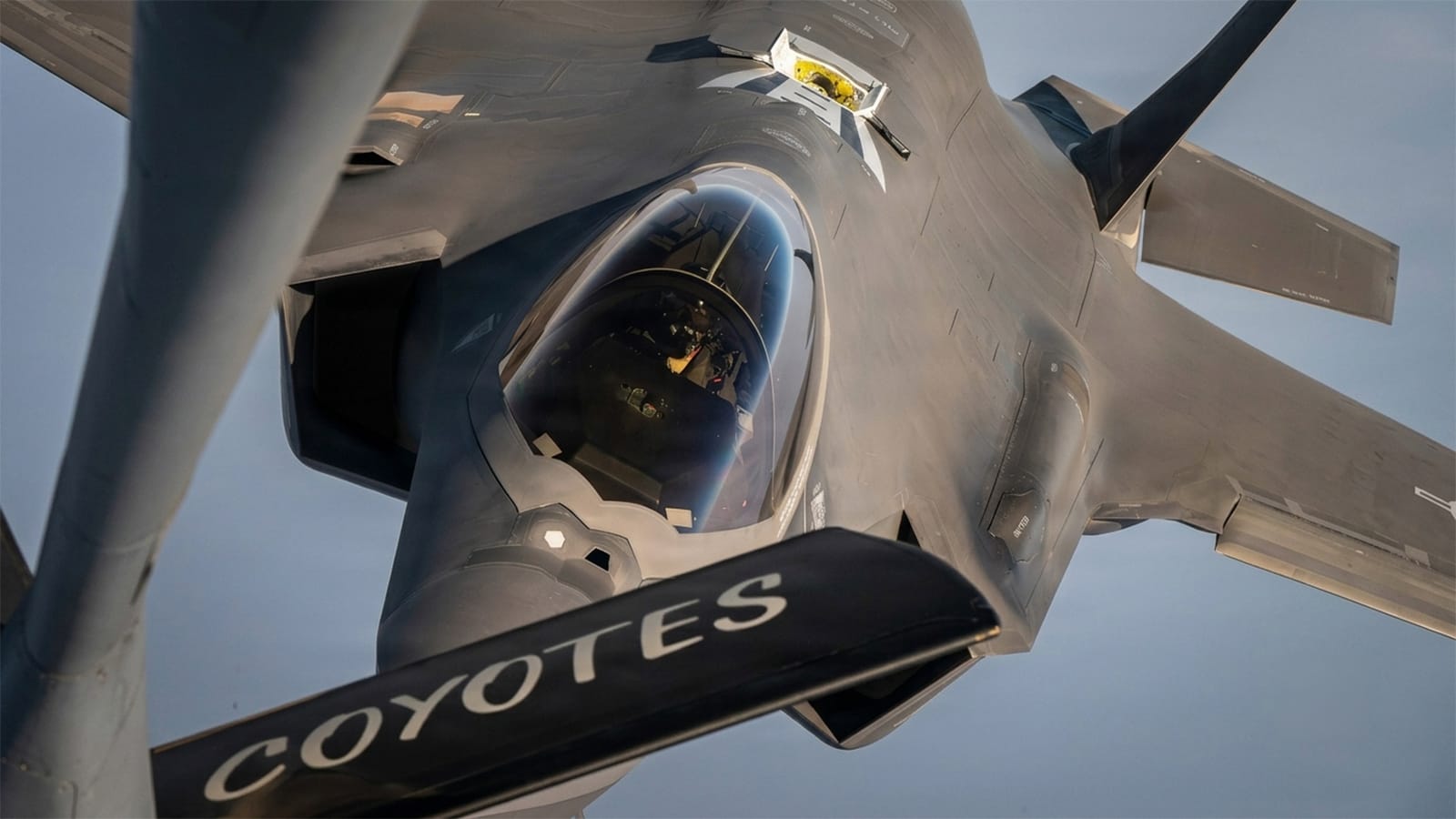
7:06am 13 July 2026 — IRGC's Azmaei boasts no foreign ship breached Iran's Hormuz waters
The commander of Iran's IRGC Navy, Ali Azmaei, told Iranian state media that no foreign vessel has entered the country's territorial waters in the Strait of Hormuz without permission, claiming his patrols track every ship in the waterway and warn off any that stray too close.
It's a bold claim to broadcast while US bombs are landing on Iran's own coast. UKMTO reports the strait's southern lane is open to two-way traffic, tankers are still sailing, and CENTCOM has said flatly that Iran does not control Hormuz. The IRGC can declare ownership of the waterway as often as it likes. The ships passing through it answer to Washington's guns, not Tehran's warnings.
6:34am 13 July 2026 — CENTCOM brands Iran's claim of three dead US troops in Kuwait false
US Central Command has branded as false Iranian propaganda that three American service members were killed by Iranian strikes in Kuwait. In a statement on X, CENTCOM said there were zero reports of US deaths or injuries anywhere in the region and that all personnel are accounted for.
It fits a familiar pattern. Tehran manufactures a battlefield win for its domestic audience, and the facts erase it within hours. The same regime that told its people it had destroyed US HIMARS launchers in Kuwait can't get its own state outlets to agree on the weapon it supposedly used. Iran is losing the shooting war, so it has turned to an information war, and it's losing that one too.
6:20am 13 July 2026 — Iraq's foreign ministry urges restraint on Hormuz and calls for safe shipping
Iraq's Foreign Ministry has waded into the Hormuz standoff, voicing concern over maritime security and urging all sides to avoid any move that could escalate tensions or put commercial shipping at risk. Baghdad called for refraining from any actions that could jeopardise the safety and security of maritime navigation, and said it backs all efforts aimed at de-escalation, as alarm grows over the security of one of the world's most important energy routes.
The subtext matters. Iraq sits closer to Tehran than almost any other Arab capital, yet even Baghdad won't echo Iran's boast that it has closed the strait, and instead wants the lane kept open and the crews kept safe. That is the tell of a regime running short of friends. Every neighbour Iran has rocketed or rattled this week is now lining up behind open water, while Washington keeps the strait moving and holds Iran's oil, its dollars and its one waterway on a short leash.
5:51am 13 July 2026 — Iran's Baghaei rebrands its Gulf missile barrage as lawful self-defence
Iran's foreign ministry spokesman Esmaeil Baghaei has tried to recast Tehran's missile and drone attacks on Kuwait, Qatar, Bahrain, Oman, Jordan and the UAE as a 'lawful exercise of self-defence', rejecting the UN's account of the conflict and pinning it on an 'unprovoked act of aggression' by the United States and Israel. He posted the claim on X in reply to the UN Secretary-General's office.
The self-defence line falls apart on the timeline. It was Iran that fired on civilian shipping in the Strait of Hormuz and rained missiles and drones on six neighbouring states, the very states now queuing up to condemn it, while CENTCOM keeps the waterway open to traffic. Washington's strikes answer that aggression, they did not start it. Trump still holds Iran's oil, its dollars and its one strait on a short leash, and dressing up the regime's provocations as victimhood only shows how little leverage Tehran has left.
5:43am 13 July 2026 — Netanyahu says Israel is crushing Iran's axis of evil as US piles on
Israeli Prime Minister Benjamin Netanyahu has declared that Israel is 'systematically crushing the Iranian axis of evil', telling US media his forces have hit Tehran's proxies 'from Gaza to Yemen, from Lebanon to Iran' and removed the immediate danger of an Iranian bomb.
The declaration lands as the United States runs its third round of strikes on Iranian targets and Gulf states round on Tehran, leaving the regime's proxy network battered and its patrons in Beijing watching their energy lifeline sit exposed. With Israel pressing from the west and Trump holding the strait, Iran's oil and its cash on a short leash from the other side, the axis Netanyahu is describing has never looked more cornered.
5:00am 13 July 2026 — IRGC claims it destroyed US HIMARS launchers in Kuwait drone strike
Iran's Revolutionary Guard claimed it destroyed American HIMARS batteries in Kuwait in what Fars News Agency reported was a 'precise drone operation', while IRGC affiliated Tasnim separately claimed three ballistic missiles were fired at a US base near the Iraqi border.
Kuwait confirmed damage to three northern border posts and an oil platform with one worker injured but has not verified any hit on US military hardware. Two IRGC affiliated outlets cannot even agree on whether the weapon was a drone or a ballistic missile. The escalation in intent is what counts: Tehran is openly targeting American force posture in allied Gulf states, pushing at Trump's 60 day leash while the forward deployed kit sits precisely where it was placed to hold the strait.
12:10am 13 July 2026 — Trump tells Sunday shows Iran agreed to everything then attacked a ship
President Trump told NBC's Meet the Press and CNN's State of the Union that Iran had agreed to a deal covering nuclear weapons, the strait and sanctions before attacking a commercial vessel in the Strait of Hormuz two hours later.
"These people, there's something wrong with them. We had a deal with them yesterday. They were giving up everything."
Trump confirmed the US hit Iran 'very hard' overnight and insisted the strait remains open for commercial traffic. The pattern tracks the leash thesis exactly: Trump offers terms, Tehran takes them, the IRGC breaks the deal within hours, and Washington collects the justification for the next round of strikes. Each time the regime overplays, Trump gets another turn of the ratchet on Iran's oil, dollars and strait access, with China's energy supply chain absorbing the cost.
8:56pm 12 July 2026 — Oman says all 23 crew rescued from the GFS Galaxy after the IRGC attack
Oman says all 23 crew of the Cyprus flagged container ship GFS Galaxy have been rescued off the Musandam peninsula after the IRGC set the vessel ablaze in the Strait of Hormuz, confirming earlier reports that the mariners had abandoned ship for a lifeboat.
Every one of those 23 sailors was pulled from a ship the IRGC set alight in the very waterway Tehran claims to have closed. It is the clearest picture yet of who is actually endangering Gulf shipping, and CENTCOM has pointed to this attack as a trigger for its strikes. Washington keeps stripping out Iran's naval reach while commercial crews still sail through, a reminder that the US, not Tehran, decides when the lane opens, with China's oil route through the strait the real prize.
8:30pm 12 July 2026 — Jordan, Bahrain and Lebanon pile onto Iran over its strikes on the Gulf
Jordan has branded Iran's strikes on its Gulf neighbours a 'blatant violation' of their sovereignty and a 'dangerous escalation', Bahrain's military accused Iran of continuing its 'systematic aggression' against civilians, and even Lebanon, home to Iran's ally Hezbollah, declared full solidarity with the states Iran has hit.
When even Beirut is lining up to condemn Tehran, the regime's claim to be the shield of the region is in tatters. Iran has managed to turn Jordan, Bahrain, Kuwait, Egypt, Qatar, the UAE and now Lebanon into a wall of condemnation, handing Trump the regional coalition he needs while the US keeps stripping out the IRGC's ability to make good on its threats. Every capital it alienates pulls the leash tighter around Iran's oil and the Strait of Hormuz.
8:08pm 12 July 2026 — Qatar condemns Iran's renewed attacks after debris injures a child
Qatar has condemned Iran's renewed attacks on its territory, after its Ministry of Interior confirmed that three people, including a child, were injured by falling debris from intercepting the strikes, and said the injured are receiving medical care.
Ministry of Interior statement: three people, including a child, injured by falling debris from interception operations following the Iranian attacks. The injured are receiving the necessary care.
— Ministry of Interior - Qatar (@MOI_QatarEn) July 12, 2026
Qatar hosts the largest American airbase in the region, and Iran has now managed to rain debris on it and wound a child. Tehran is turning the very Gulf states it claims to lead into a wall of condemnation, and every statement like this hands Trump a firmer regional coalition while the US dismantles the regime's ability to strike. The leash on Iran's oil, its dollars and the Strait of Hormuz only pulls tighter, with China's energy lifeline the target underneath it all.
7:24pm 12 July 2026 — Qatar halts ship departures as Iran's Gulf barrage rattles Hormuz shipping
Qatar has suspended the departure of maritime vessels from its ports as a public safety measure after Iran's attacks across the Gulf, its authorities said, even as regional maritime monitors report that the southern shipping route through the Strait of Hormuz remains open to commercial traffic.
This is the leash tightening on Tehran, not loosening. Iran wanted the world to believe it had shut the Strait of Hormuz, yet the only harbour actually closing is Qatar's own, spooked by Iran's reckless missile and drone barrage, while the strait itself stays open because Washington says it stays open. Trump is holding Iran's oil, its dollars and the waterway on a short leash, with China's energy lifeline through the Gulf the prize he is really guarding.
7:20pm 12 July 2026 — Hormuz southern lane opens to two-way traffic as Iran's closure claim collapses
The UK Maritime Trade Operations agency says that despite Iran's proclamation that the Strait of Hormuz is closed, the southern route through the strait remains open and has now been expanded to carry two-way traffic, while the agency keeps the maritime threat level at its highest grade, 'severe'.
This is the leash thesis proven in black and white. Tehran staged a closure of the Strait of Hormuz, and within hours the West is not just keeping the lane open, it is widening it to run both ways. Iran can announce whatever it likes, but the traffic through the world's most important oil chokepoint moves on Washington's say-so, not Tehran's, and the real stake underneath it all is China's energy lifeline through the Gulf.
Today, more than 20 U.S. Navy warships are patrolling waters across the Middle East as CENTCOM forces continue promoting regional security and stability. Last month, U.S. naval warships and aircraft transited the Arabian Sea in close formation, demonstrating unmatched American… pic.twitter.com/gnfRIKAYJl
— U.S. Central Command (@CENTCOM) July 8, 2026
7:10pm 12 July 2026 — Lindsey Graham, hawkish backer of the Iran campaign, dies at 71
US Senator Lindsey Graham, 71, one of the most hawkish backers of the American and Israeli campaign against Iran, has died after what his office described as a brief and sudden illness.
President Trump led the tributes on Truth Social, calling Graham "one of the greatest people and senators I have ever known", "a true American patriot" who "will be greatly missed". Israeli Prime Minister Benjamin Netanyahu said Graham understood that the security of Israel and America are inseparable.
Graham spent his career pressing for maximum pressure on Tehran and full backing for Israel, and he goes out as the campaign he championed is grinding down the regime's air defences and naval reach night after night. His allies will read his loss as one more reason to finish the job Washington has started.
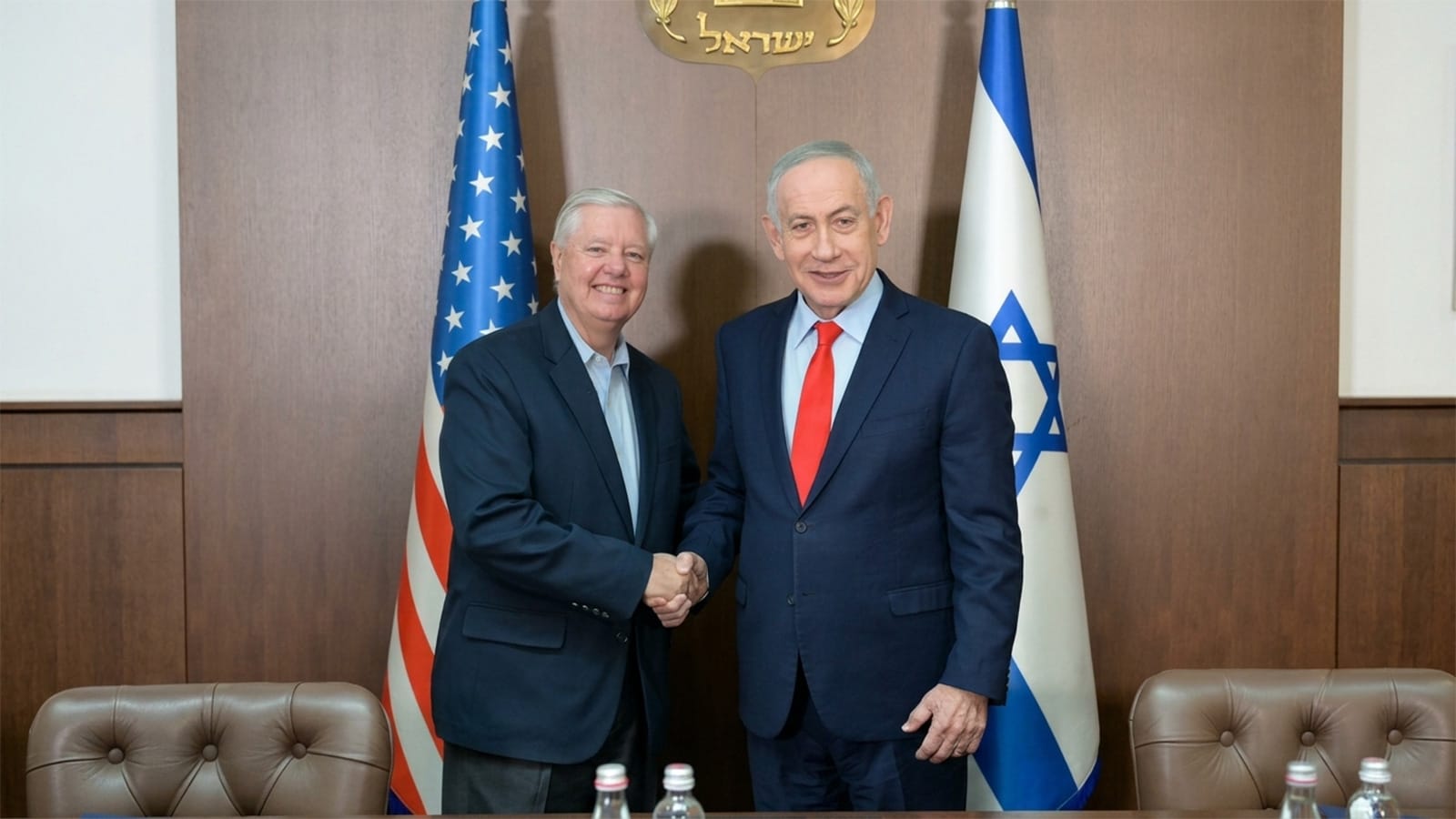
6:50pm 12 July 2026 — Saudi Arabia, Kuwait, Egypt and the UAE round on Iran over its Gulf attacks
Saudi Arabia, Kuwait and Egypt have condemned Iran's attacks on Persian Gulf states and on commercial shipping, with Kuwait saying its sovereignty had been violated, while the United Arab Emirates said it had detected missile threats outside its borders.
Tehran is managing the rare feat of uniting the Arab world against itself. The same Gulf capitals Iran claims to be defending are now lining up to denounce it, and every condemnation makes it easier for Trump to hold a regional coalition together while the US keeps stripping out the IRGC's ability to make good on its threats. Iran is burning what few friends it had left, and the isolation only tightens the leash around its oil and the strait.
6:15pm 12 July 2026 — Iran threatens the White House 'will no longer be safe' for Trump
An Iranian lawmaker declared that the White House 'will no longer be safe' for President Trump, while an adviser to Iran's leadership called the Strait of Hormuz a key deterrent, the latest in a run of regime threats as the third round of US strikes hammers Iranian targets.
Threats like this are exactly why the leash stays tight. A regime that answers American restraint by openly menacing the US president has told the world what it is, and it is doing so while its air defences are dismantled night after night. Tehran can bluster about the White House and boast about the Strait of Hormuz, but Trump holds its oil, its dollars and that waterway, and the real target of the squeeze is China's energy route through the Gulf.
5:05pm 12 July 2026 — Araghchi meets Oman’s FM in Muscat but refuses to declare strait open as Trump’s deadline passes
Iran’s Foreign Minister Abbas Araghchi held talks with Omani counterpart Badr al-Busaidi in Muscat on Saturday, even as Trump’s Saturday deadline for Tehran to publicly renounce its strait attacks expired without concession. Oman tabled a proposal for two separately controlled shipping lanes through the Strait of Hormuz, but Tehran pushed back, with both sides agreeing only to continue technical and political talks. The US demanded Iran explicitly state the strait is open and toll free or face further consequences.
Both the American delegation (Vance, Rubio, Kushner) and Iran’s top diplomat are now in the same city, with Oman playing go between. Tehran sent Araghchi to talk, which tells you the 300 strike sorties got their attention, but it will not publicly back down while the IRGC still claims sovereignty over the waterway. Trump holds the escalation lever: every hour Iran stalls is another hour the leash tightens on its oil exports and China’s energy supply chain.
5:00pm 12 July 2026 — British military rescues container ship crew near Oman after IRGC attack
The UK Maritime Trade Operations centre confirmed that the crew of a container ship attacked near the Strait of Hormuz abandoned the vessel after sustaining fire damage and were rescued in lifeboats by the British military off Oman’s coast. The Cyprus flagged vessel was struck by the IRGC, which claimed the ship was transiting an “unapproved route.” One crew member remains missing.
That is a civilian crew, on a commercial ship, in an international waterway, fired on by a regime that claims the right to toll the world’s oil supply. Every rescued sailor and every burning hull reinforces the case Trump is making to the Gulf states and to NATO: Iran cannot be trusted to keep the strait open voluntarily. The only language Tehran respects is the one CENTCOM is speaking.
4:20pm 12 July 2026 — Vance, Rubio and Kushner head to Muscat as Trump runs strikes and talks in parallel
Vice President JD Vance, Secretary of State Marco Rubio, envoy Steve Witkoff and Jared Kushner are heading to Muscat to meet mediators, even as the third round of US airstrikes on Iran wraps up overnight. The Trump administration gave Tehran a Saturday deadline to publicly renounce its attacks on strait shipping or face further consequences, then dispatched its most senior negotiating team to Oman within hours of the strikes landing.
Trump is playing this exactly as advertised. He will level Iran’s military infrastructure every time it touches a ship, then send his top people to the table the next morning. It is maximum pressure distilled into a 48 hour cycle: destroy, then negotiate from a position of total dominance. The message to Tehran and to Beijing is that Washington controls both the tempo of war and the terms of peace.
4:15pm 12 July 2026 — Qatar and Kuwait confirm intercepting Iranian ballistic missiles as retaliation spreads
Qatar’s Ministry of Defence confirmed intercepting a number of ballistic missile attacks while Kuwait’s military said explosions heard across the country were its air defence systems engaging hostile aerial targets. The US Embassy in Bahrain delayed its Sunday opening and advised Americans to seek shelter.
Iran’s retaliation is spreading the pain across every Gulf state that hosts American bases, which is precisely how Trump builds the coalition he needs. Every Iranian missile that lands on a Gulf ally’s air defences turns a fence sitter into a willing partner. The regime is doing Washington’s work for it.
3:10pm 12 July 2026 — CENTCOM finishes its third round of strikes on about 140 Iranian targets
US Central Command said it had finished a third round of strikes on Iran this week, hitting about 140 military targets across missile and drone sites, naval assets, ammunition depots, communication networks and coastal surveillance posts. CENTCOM put the launch down to the IRGC attack on the Cyprus flagged container ship M/V GFS Galaxy in the Strait of Hormuz, said more than 300 sites had now been struck across three nights, and stressed that commercial vessels are still transiting the waterway.
That last line is the whole game. Tehran can declare the Strait of Hormuz closed, but CENTCOM is telling the world that ships are still sailing through it while the US methodically strips out the radars, launchers and naval assets Iran would need to make the closure real. Trump is holding Iran's oil, its dollars and the strait on a short leash, and every one of those 140 targets is another reminder that Washington decides when the lane opens, with China's energy lifeline through the Gulf the prize he is really playing for.
🚨🇺🇸 CENTCOM RELEASES STRIKE FOOTAGE: CARRIER LAUNCHES & IRANIAN TARGETS HIT🚨
— And We Know©🇺🇸 (@andweknow) July 12, 2026
CENTCOM just dropped the footage:
- F/A-18F Super Hornet and F-35C stealth fighters launching from carriers
- Tomahawk cruise missiles firing from Arleigh Burke destroyers
- Direct hits on missile… pic.twitter.com/hww5czMkzt
3:05pm 12 July 2026 — IRGC claims it struck a US air base in Jordan, targeting MQ-9 drone hangars
Iran's Revolutionary Guard Corps claimed it struck Prince Hassan Air Base in Jordan, CBS News reported, saying its missiles demolished the base's command and control centre and MQ-9 Reaper drone hangars. The IRGC called the attack the first phase of a retaliatory operation and said it also fired ballistic missiles at Al Udeid Air Base in Qatar.
Tehran is now firing on American bases in three allied countries at once. Each strike adds another partner to the coalition that will back Trump when he keeps Iran's oil and the strait on a short leash.
2:55pm 12 July 2026 — IRGC claims it stopped a second vessel in the Strait of Hormuz
Iran's Revolutionary Guard Corps announced it targeted and stopped a second vessel in the Strait of Hormuz, Middle East Eye reported, warning that continued US and Israeli aggression would trigger responses that are "even more devastating."
Two vessels hit in one day turns the IRGC's closed strait declaration into something insurance markets will have to price in. Every ship Tehran fires on is another argument for the permanent US naval presence that puts China's energy corridor through Hormuz under American control.
3:06pm 12 July 2026 — US strikes pound Bushehr province as Iran reports hits on Asaluyeh
Iranian state media reported a fresh wave of US strikes tearing across Bushehr province on Sunday afternoon, with state broadcaster IRIB and the IRNA agency claiming seven projectiles hit Bushehr city, five struck Dayyer county and four landed at Asaluyeh. Al Jazeera reported American forces had launched the new strikes as Tehran declared the Strait of Hormuz closed. Officials in Bushehr again claimed no casualties.
The map tells the story. Bushehr is home to Iran's only nuclear plant and Asaluyeh anchors the South Pars gas field, the beating heart of the regime's energy wealth. Washington is working methodically down Iran's most prized targets, keeping Tehran's oil, dollars and the strait on a short leash while the real message travels to Beijing, whose refineries depend on every barrel now sitting under American guns.
2:18pm 12 July 2026 — IRGC claims missile strike on US logistics hub at Oman's Duqm port
Iran's Revolutionary Guard Corps claimed it hit US carrier logistics and refuelling facilities at Duqm port in Oman with ballistic missiles, in what Gulf News reported as a strike on the Omani port and a tanker that widens Iran's retaliation to a third Gulf country. The Guard called it the third phase of its response to the US strikes and its first attack on Oman.
Firing on Oman, a quiet neutral that has spent weeks trying to broker calm, is the act of a regime lashing out at anyone within reach. Every missile Tehran burns on a logistics dock it barely dents is a missile it cannot fire when it matters, and each one drags another Gulf state further onto Washington's side of the ledger.
12:41pm 12 July 2026 — Iran's retaliation hits the Gulf as the UAE and Bahrain scramble air defences
Iran's promised revenge for the third round of US strikes is now landing on its neighbours. Abu Dhabi's Ministry of Defence said its air defences were engaging Iranian missiles and drones over the UAE, Bahrain's Interior Ministry sounded sirens across Manama and told residents to shelter, and Qatar pushed an emergency alert to phones in Doha as explosions were heard in the capital. Iranian state media claimed further blasts in Kuwait and Jordan.
Firing on the very Gulf states that host American air power is the act of a regime with no cards left, and it makes Trump's case for him. Every missile Tehran throws at Manama or Doha is another reason to keep Iran's oil, its dollars and the Strait of Hormuz on a short leash, and a reminder that the real prize behind this waterway is the energy lifeline it feeds to Beijing.
11:47am 12 July 2026 — IRGC fire leaves a Hormuz container ship ablaze and its crew in a lifeboat
The crew of a container ship hit about 17km east of Oman have abandoned it to a lifeboat after a fire broke out, Britain's UK Maritime Trade Operations reported, in an attack Washington blames on Iran. The Wall Street Journal said the IRGC fired missiles and drones at several vessels crossing the Strait of Hormuz, setting one ablaze, and a US account of the strike says one crew member is missing and the ship took significant damage.
Setting merchant crews adrift to force the world to pay attention is exactly the reckless behaviour that hands Trump the whip hand. Tehran can declare the strait closed on paper, but it cannot feed its own economy or China's refineries without it, so the moment Iran pushes too far the US takes the waterway back and the leash tightens.
10:52am 12 July 2026 — Bushehr governor claims no casualties as Iran plays down the US strikes
The deputy governor of Bushehr province told Iranian state broadcaster IRIB on Sunday that the third round of US strikes on Bushehr, Asaluyeh and Dayyer caused no casualties, a line Tehran pushed out fast and offered no evidence for.
A no casualties statement is the first thing a regime reaches for when it has been hit and wants the world to look away, and it says nothing about the military sites Washington actually flattened. The US struck radar, missile and drone infrastructure down this coast, not apartment blocks, so Iran gets to claim a clean casualty sheet precisely because the targeting was surgical. Either way the message lands. Tehran can spin the body count, but it cannot spin the fact that America now decides when its coastline is safe, and Trump is holding the oil, the dollars and the strait on a short leash while China's energy lifeline stays the real prize.
10:42am 12 July 2026 — Iranian state media reports more than 10 explosions at the port of Jask
Iran's state run IRNA news agency reported more than 10 explosions at Jask on Sunday morning, the port and IRGC naval base at the mouth of the Gulf of Oman just east of the Strait of Hormuz. IRNA gave no clear cause and there is no independent confirmation, so for now the account rests on Iranian state media, but it fits the pattern of Washington's third round of strikes marching down Iran's southern coast.
Jask is not a random dot on the map. It sits at the eastern gate of Hormuz, home to an IRGC naval base and an oil export terminal Tehran built to move crude around the strait, so blasts there hit exactly the assets Iran is counting on if the waterway shuts. That is the whole point of the leash. Trump has left Iran no safe corner of its own coast to run oil through, and every fresh explosion down the Gulf of Oman shows how completely the US now controls the tap, with China's energy network the prize Washington is really squeezing.
10:22am 12 July 2026 — Iran activates air defences over the Bandar Mahshahr petrochemical port
Iran's state Mehr news agency claimed air defences opened up over Bandar Mahshahr, the oil and petrochemical export hub at the head of the Gulf in Khuzestan province, early on Sunday. Tehran offered no evidence of what its gunners were firing at and there is no independent confirmation of any strike on the town, so the claim rests on Iranian state media alone.
The detail that matters is the map. Bandar Mahshahr sits at the top of Iran's oil and petrochemical belt, and Iranian batteries lighting up the sky there, in the same hours as Washington's third round of strikes down the coast, shows how far west the pressure has crept from the Strait of Hormuz. Whether the town was hit or Tehran's gunners were firing at shadows, the takeaway holds: Iran no longer feels safe over its own export terminals. Trump is keeping the oil, the dollars and the strait on a short leash, and every panicked salvo over a petrochemical port is a fresh reminder of who now decides when Iran's crude moves, with China's energy lifeline the real prize.
10:02am 12 July 2026 — US officials spell out what the third round of strikes hit across Iran
A clearer picture of what Washington's third round of strikes actually hit firmed up on Sunday morning. A US official told Axios the barrage was aimed at Iranian air surveillance radars, missile and drone storage sites and other military infrastructure along the Hormuz coast, while The War Zone reported US forces struck Iran's air defence systems, coastal radar sites and anti ship missile capability in and around the strait.
The target list is the strategy in plain sight. Washington is methodically pulling out the radars, missiles and launchers Tehran would need to actually close the Strait of Hormuz, which leaves the IRGC's grand closure as a slogan the US Fifth Fleet can sail straight through. Trump is holding Iran's oil, its dollars and the strait itself on a short leash, and every battery taken offline brings the day he simply forces the lane open that much closer, with China's energy lifeline the real prize.
9:53am 12 July 2026 — Defense Secretary Hegseth says Iran made a poor choice and will pay
US Defense Secretary Pete Hegseth put his name to the retaliation within the hour, posting a blunt verdict on X that Iran had brought this on itself by firing a missile into a civilian cargo ship in the Strait of Hormuz. His message followed US Central Command confirming the third round of American strikes on Iran, launched after the IRGC attack on the Cyprus flagged M/V GFS Galaxy left one crew member missing and the vessel ablaze.
Iran made a poor choice. Now they pay.
— Pete Hegseth (@PeteHegseth) July 11, 2026
This is the leash tightening exactly as Trump drew it up. Iran took the shot at civilian shipping and Washington answered almost at once, so the cost of the escalation lands on Tehran, not on America. Hegseth's message was aimed squarely at a regime that keeps mistaking Trump's patience for weakness, while the president keeps Iran's oil, its dollars and the strait itself on a short leash, with China's energy lifeline through the Gulf the real prize he is playing for.
9:50am 12 July 2026 — Iran's IRIB reports fresh explosions at the Hormuz port of Bandar Abbas
Iran's state broadcaster IRIB and Press TV reported fresh explosions across southern Iran on Sunday morning, three blasts at the Hormuz port of Bandar Abbas and two at nearby Sirik, without giving a cause. The reports landed within minutes of US Central Command confirming a third round of strikes on Iran as the IRGC declared the Strait of Hormuz closed, and neither Washington nor Tehran has yet tied the strikes to these specific sites.
Bandar Abbas is not just another target. It is home to Iran's main naval base and sits at the mouth of the very strait Tehran keeps threatening to shut, so explosions on that coastline land the pressure exactly where the regime chose to make its stand. This is the leash doing its work. Trump is holding Iran's oil, its dollars and its one waterway at once, and every strike on the Hormuz shore reminds Tehran that the passage it wants to weaponise can be reached far more easily by the US than the other way around. The regime can close the lane on paper, but it cannot keep the Fifth Fleet off its own beach, and the audience that matters is Beijing, whose crude still rides through the water Iran is gambling with.
9:49am 12 July 2026 — US launches a third round of strikes on Iran after the IRGC hits a container ship
US Central Command said in a statement on X that it had begun a third round of strikes against Iran this week, in response to the IRGC attacking the M/V GFS Galaxy, a Cyprus-flagged container ship transiting the Strait of Hormuz. A civilian crew member is missing and the ship is disabled by an onboard fire and heavy engine-room damage, CENTCOM said, and Axios, citing a US official, reported American forces were striking Iranian targets near the strait.
In response, the United States is imposing a heavy cost by continuing to degrade Iran's ability to attack civilian mariners and commercial ships freely transiting the strait. The strikes are being carried out at the direction of the Commander in Chief.
This is the leash snapping tight. Iran fired a missile into a civilian ship and left one of its crew missing, and within hours Trump answered with a third wave of strikes at his own direction, aimed squarely at Iran's power to menace the strait. Tehran set out to prove it could shut Hormuz. It has handed the Commander in Chief the cleanest reason yet to prise it back open by force.
9:29am 12 July 2026 — Iranian state media reports explosions in Bushehr and Asaluyeh
Iran's Press TV reported explosions in Bushehr and Asaluyeh in southern Iran on Saturday, without giving a cause or the extent of any damage. Bushehr is home to Iran's only nuclear power plant, and Asaluyeh sits at the heart of the South Pars gas field.
Blasts at these two sites matter more than most. Iran's only nuclear plant and the South Pars gas hub that underpins its energy economy are the very infrastructure this standoff turns on. Tehran named no cause, but the fact its energy heartland is taking hits again shows how exposed the regime's most vital assets have become.
9:10am 12 July 2026 — Explainer: why the Strait of Hormuz keeps opening and closing, and who really controls it
If you have watched Hormuz look open, half open and then shut again over the past month, that is Iran testing how far it can push. This time it has pushed hardest of all. After Trump's warning shots turned into a shooting match, tankers have refused the run and traffic has fallen to a near standstill. Yet an empty strait flatters Tehran. Iran has no power to hold the lane against the US Fifth Fleet in Bahrain, it has only made the crossing too dangerous to chance, which is why it keeps announcing closures it cannot enforce beyond scaring shippers off. When Tehran says the strait is closed, what it means is that any ship ignoring the order will be menaced, mostly with anti-ship missiles dug in along Iran's coast and on the islands it holds inside the strait, swarms of IRGC speedboats, and the standing threat of mines.
Physical control of whether ships move sits with the United States. The Fifth Fleet can escort convoys, fly cover and flatten Iran's launch sites the moment Tehran tries to make a threat real, and it can put those escorts back on the water and force the lane open the day Washington decides the risk is worth it, the same way Trump lifted the US naval blockade to let the oil flow once the deal was signed. Iran can raise the danger and the insurance bill, but it cannot stop a US convoy without starting a war it has already been losing.
Strip away the theatre and Tehran's two-track line, diplomacy and escalation at once, is just leverage. Iran wants a new arrangement where it licenses who sails through and pockets the tolls, sold to its own people as keeping the strait out of foreign hands. The on-again off-again closures are the pressure it applies to get there, and a way for a battered, leaderless regime to look defiant to its hardliners after Ali Khamenei's death.
The giveaway is that Iran needs the strait open more than anyone. Almost all of the oil that leaves the Gulf, the bulk of it bound for China and the rest of Asia, sails out through the very lane Tehran keeps threatening to shut, and Iran's own crude rides with it. Actually sealing Hormuz would strangle Tehran, not the West. So Iran declares closures and fires the odd warning shot, but stops short of the one move, sinking a ship or mining the channel, that would hand Trump the clean pretext to take the strait outright and choke that oil to China. That is the leash. Trump holds Iran's oil, its dollars and the strait, and the decision to pull it tight is his, not Tehran's.
9:02am 12 July 2026 — US official says an IRGC missile hit a cargo ship in the Strait of Hormuz
A United States official has told Axios that an Islamic Revolutionary Guard Corps missile struck a commercial cargo ship trying to pass through the Strait of Hormuz on Saturday, causing heavy damage to the vessel.
This is the line Iran had so far stopped short of crossing, a missile fired straight into civilian shipping rather than a warning shot across the bow. Every hit like it strengthens Trump's hand to stop indulging the standoff and force the strait open, and it is Iran wrecking the very lane its own oil depends on.
8:24am 12 July 2026 — Iran's IRGC Navy declares the Strait of Hormuz closed and fires on a cargo ship
Iran's IRGC Navy announced on Saturday night that it had closed the Strait of Hormuz until further notice and fired a warning shot at a cargo ship that ignored orders to change course, according to Iranian state media. The declaration came only hours after the Trump administration gave Tehran until Saturday to publicly declare the strait open and stop attacking shipping.
Tehran can freeze the strait with fear, but it cannot hold it, and it has strangled its own oil in the process, since almost all of it sails out through the same lane, mostly to China. Forcing the crossing back open, or dismantling Iran until it reopens the lane itself, is Trump's call now, not Tehran's.
7:28am 12 July 2026 — IRGC releases a health photo of Mojtaba Khamenei to quash doubts over his condition
Iran's Revolutionary Guard resorted to publishing what it billed as a proof of life photograph of its new supreme leader Mojtaba Khamenei on Saturday, insisting he is in 'complete health' and blaming unnamed 'adversaries' for spreading concern about his condition. State channels ran the image on the IRGC's account after weeks in which Khamenei, elevated to the top job only after his father was killed, was barely seen in public.
A theocracy confident in its own succession does not need to circulate snapshots to prove its leader is still breathing. The Guard is scrambling to project strength while it hides how badly the February strike rattled the family and the chain of command, and every staged photo is a tell that the regime is weaker than it wants Tehran, and Washington, to believe. Trump keeps Iran's oil, its dollars and the Strait of Hormuz on a leash while its rulers argue over who is even in charge.
7:14am 12 July 2026 — Iran MP Zohourian admits the sanctions relief Tehran gambled on is an illusion
Iranian lawmaker Meisam Zohourian warned on Saturday that Tehran should stop banking on sanctions being lifted or on a windfall reconstruction fund, conceding the push for quick relief had been a 'failed project' built on 'selling illusions', from a $1.5 trillion rebuild to the complete removal of sanctions, according to Iranian state media. He urged the government to make real economic reforms instead of waiting for a payout that is not coming.
It is a rare admission from inside the regime that Trump's grip is holding. He has kept Iran's oil boxed in, its reserves frozen and Hormuz under American watch, and now even Tehran's own MPs are telling their people the relief they were promised will not arrive. The illusions were sold at home, not in Washington, and the bill is landing on ordinary Iranians while the leadership blames everyone but itself.
6:04am 12 July 2026 — Iran's Araghchi cannot approve Oman's Hormuz plan and takes it to Tehran
Iran's foreign minister Abbas Araghchi flew home from Muscat on Saturday unable to sign off on Oman's plan to reopen the Strait of Hormuz, carrying the draft back to Tehran for the country's leadership to weigh, according to Axios and CNN, as Donald Trump's Saturday deadline for Iran to declare the strait open ran out.
The stall plays straight into Trump's hand. He holds Iran's oil, its dollars and the strait itself on a 60 day leash, and every day Tehran spends haggling over Oman's map is another day its tankers sit idle and its own hardliners turn on each other. IRGC linked channels are already accusing insiders of chasing a deal with Washington, a sign the pressure is fracturing the regime while the real prize, China's energy lifeline through Hormuz, stays firmly under American watch.
5:17am 12 July 2026 — IEA says oil demand will fall for first time since 2020 as Gulf strikes shatter recovery
The International Energy Agency warned in its monthly oil market report released on Friday that world oil demand is on track for its first annual decline since the pandemic, with renewed US strikes on Iran and this week’s flare up around the Strait of Hormuz reversing the supply recovery that followed June’s memorandum of understanding. Global supply climbed 4.1 million barrels per day in June once the strait reopened but remained 9.4 million bpd below pre war levels. Brent crude settled at US6.37 on Friday, up more than from a week earlier.
Renewed exchanges of fire in the Gulf this week highlight the risks of not reaching a lasting peace agreement, which is a must for the normalisation in oil markets.
The numbers confirm who holds the leverage. Iran’s crude can only reach its one big buyer through the strait, and every barrel that stays off the market is one Beijing scrambles to replace at a premium. The IEA just told every trading desk that the supply recovery sits in Trump’s hands.
5:07am 12 July 2026 — Oman drafts a two route Hormuz plan that leaves the free lane in Omani waters
Oman has drafted a proposal to run shipping through the Strait of Hormuz along two separately controlled routes, CNN reported citing a source close to the Muscat talks, and both lanes would stay open. The Southern Corridor through Omani waters would allow free navigation under the pre war rules, while the Northern Corridor through Iranian waters would need prior approval from Tehran, though no tolls would be charged. The plan is not yet finalised and lands as Iran's Abbas Araghchi shuttles between Omani and Qatari officials trying to lock in a passage deal before Trump's Saturday deadline bites.
Read the map and the leash is obvious. The lane that actually carries the traffic, the southern one, sits in Omani waters and stays free under Western friendly rules, while the lane Tehran gets to gate with its permission slips is the one nobody has to use. Iran can wave the northern corridor around as proof of sovereignty, but a chokepoint you only hold when ships choose to sail through it is barely a chokepoint at all. Trump reopened Hormuz so Iran's crude could keep reaching China, then set the terms, and now the regime is bargaining over a strait it no longer runs while its one big customer counts every barrel.
2:50am 12 July 2026 — Iran's Araghchi meets Oman's al Busaidi in Muscat to bargain over the Strait of Hormuz
Iran's Foreign Minister Abbas Araghchi met his Omani counterpart Badr al Busaidi in Muscat on Saturday and the two discussed mechanisms for the safe passage of commercial ships through the Strait of Hormuz, with the arrangement built around Article 5 of the Islamabad memorandum of understanding that Tehran signed with Washington last month. The sit down came as Trump's Saturday deadline for Iran to publicly declare the strait open and stop firing on shipping ran out, with US officials saying they expected a public statement from Tehran once the talks wrapped.
This is the leash doing its work. Trump reopened the strait so Iran's oil and dollars could keep moving, then dared Tehran to abuse it, and the moment he set a hard deadline the regime was on a plane to Muscat looking to talk rather than test him. Iran needs Hormuz open far more than Washington does, because the strait is the only road its crude has to its one big buyer, China. Every hour Araghchi spends bargaining over safe passage is another hour Tehran spends confirming who really holds the chokepoint.
10:00pm 11 July 2026 — Mojtaba Khamenei vows revenge for his father in first message since funeral
Iran’s new Supreme Leader Mojtaba Khamenei issued a written statement saying the killing of his father demands retaliation, the Times of Israel reported on Friday. Mojtaba, who hasn’t appeared publicly since the February strikes that killed Ayatollah Ali Khamenei and are believed to have wounded his son, posted the message to his Telegram channel as his father’s funeral ceremonies concluded.
We pledge to avenge the blood of the martyred leader and all the martyrs of these two wars from the criminal and disgraced killers.
The statement landed hours after Trump warned 1000 missiles were locked and loaded if Iran tried to assassinate him. Mojtaba communicates only through written messages and can’t show his face. The IRGC hardliners are setting Iran’s pace, not Araghchi’s diplomatic track through Oman, and they’re doing it on the eve of Trump’s Saturday Hormuz deadline.
7:30pm 11 July 2026 — Iran's Mohseni-Ejei demands war crimes trials and compensation over the strikes
Iran's judiciary chief Gholamhossein Mohseni-Ejei says Tehran will hunt down those it accuses of war crimes in the recent conflict and bill them for the damage, telling a gathering of international lawyers that his prosecutors are already building cases against the United States and Israel over the strikes and the death of Ali Khamenei, according to Iranian state media.
If we don’t get the dust, we do not have a deal with Iran.
It's a bold play from the regime that lit the fuse. Iran broke its own ceasefire by firing on tankers in the Strait of Hormuz, and every strike it now brands a war crime was the answer to that. Tehran even admitted in private to Trump's advisers that the Hormuz attacks were a mistake. With Trump's Saturday deadline to declare the strait open now hours away and 1000 missiles said to be locked and loaded, the mullahs are reaching for lawyers because the leash on their oil, their shipping lane and their dollars is pulled tight, and Beijing is watching who really sets the terms.
5:29pm 11 July 2026 — Trump gives Iran a Saturday deadline to declare the Strait of Hormuz open
The Trump administration has given Iran until Saturday to publicly declare the Strait of Hormuz fully open and pledge to stop firing on commercial ships, US officials told Axios. Foreign Minister Abbas Araghchi is flying to Oman to meet his counterpart Badr al Busaidi in Muscat, where Washington expects Tehran to make the declaration. One US official warned that if Iran refuses, it “is not gonna be a great day for them”.
This is the leash pulled tight. Trump reopened the strait so Iran's oil and dollars could flow, and now he is setting the terms out loud: say the words, stop the attacks, or wear what comes next. Tehran has already admitted in private that its forces “screwed up” in Hormuz, which is why Araghchi is on a plane to Muscat instead of firing back. The real audience is Beijing, which needs that chokepoint open far more than Washington ever will.
4:21pm 11 July 2026 — Iran downplays fresh explosions near Parchin and Khojir as a routine controlled disposal
Residents in eastern Tehran province reported a string of explosions near the Parchin and Khojir military complexes on Saturday, sites tied to Iran's missile and nuclear weapons work that have already been hit repeatedly in this war. The governor of Pakdasht, quoted by Iranian state media, insisted the blasts were nothing more than a controlled operation to dispose of old explosive materials.
Tehran has run this line all year, calling every mysterious fire at a weapons site an accident or a routine disposal rather than admit its defences are being picked apart. Whether Saturday's blasts were housekeeping or another hit, the pattern holds. The regime's most sensitive facilities keep going up in smoke while Trump keeps the Strait, the oil money and Iran's lifeline to Beijing on a short leash, ready to pull it the moment Tehran hands him the reason.
3:28pm 11 July 2026 — Iran's Fars and Kayhan call for missile strikes on Haifa, Jebel Ali and the Saudi causeway
The IRGC linked Fars news agency and the hardline Kayhan newspaper, both Iranian state aligned outlets, called on Friday for missile strikes on the ports of Haifa in Israel and Jebel Ali in the United Arab Emirates, and on the King Fahd Causeway linking Saudi Arabia and Bahrain. Fars framed the demand as revenge for what it described as a US strike on a railway bridge in northern Iran, while Kayhan argued any country hosting American forces should be treated as a legitimate target.
This is the tell. Every time Tehran feels the pressure it reaches for the same threat, widening the war to drag in the Gulf states that have quietly backed Washington. It is exactly the overreach Trump has been waiting for. The moment Iran makes good on any of it, he has the pretext to take the Strait of Hormuz outright and choke the oil route that keeps the regime, and its buyer in Beijing, in business.
3:22pm 11 July 2026 — US upgrades the UAE's export status and opens AI chip access for backing the Iran campaign
The US Commerce Department's Bureau of Industry and Security announced it is significantly upgrading the United Arab Emirates under American export rules, rewarding Abu Dhabi for its role in Operation Epic Fury, the campaign against Iran. The reclassification gives the UAE far easier access to US military hardware, commercial satellites, advanced AI chips and dual use technology, and lifts restrictions on its drone program.
The message to the region could not be clearer. Stand with Washington when it moves on Tehran and you are brought inside the tent on the technology that matters, including the Nvidia chips Beijing has spent years trying to corner. Iran's deputy foreign minister called the upgrade proof the Emirates helped attack it, which rather makes Washington's point. Trump is stacking the Gulf on his side of the ledger while he keeps Iran's oil, dollars and the Strait of Hormuz on a short leash, with China the real prize.
3:16pm 11 July 2026 — Iran's Araghchi claims Tehran kept its word after its tanker attacks broke the truce
Iran's Foreign Minister Abbas Araghchi posted on X that Tehran has "kept its word" and accused US Treasury Secretary Scott Bessent of breaking the ceasefire deal by imposing fresh sanctions. It is a remarkable claim from the government that shattered the truce in the first place by attacking commercial tankers in the Strait of Hormuz, the very move that brought US strikes and sanctions down on it.
Iran has so far kept its word, unlike the so-called U.S. Treasury Secretary who is violating Para 9 of the MoU.
— Seyed Abbas Araghchi (@araghchi) July 11, 2026
That violation follows other violations and missteps by the United States.
Reality check: There can only be mutual compliance.
Araghchi has the sequence backwards. Iran broke the ceasefire when it sent its forces after tankers in the strait, and Tehran's own officials have since admitted privately to Trump's team that those attacks were a mistake. Bessent's sanctions on Mojtaba Khamenei's financial network came after all of that, as the price for the regime's bad faith. Trump holds the leverage. Every dollar squeezed out of the regime's accounts tightens the 60 day leash, and no amount of wounded posturing from Araghchi changes who is holding the whip. Iran can protest the terms all it likes. It cannot rewrite who drew first.
2:51pm 11 July 2026 — US officials say there is no Iran deal without the enriched uranium from bombed nuclear sites
A senior US official told ABC News that Washington’s position heading into Saturday’s Oman talks is absolute: Iran must surrender the highly enriched uranium buried in the rubble of its bombed nuclear facilities or there will be no final agreement.
If we don’t get the dust, we do not have a deal with Iran.
The demand puts Tehran in a bind. Surrendering the material means accepting permanent nuclear disarmament. Refusing it means the US retains a low cost military option to bomb the sites again, keeping the uranium entombed in rubble indefinitely. Either path ends Iran’s weapons programme, which is the point of Trump’s 60 day framework and the reason Beijing’s long term energy bet on Tehran looks worse by the week.
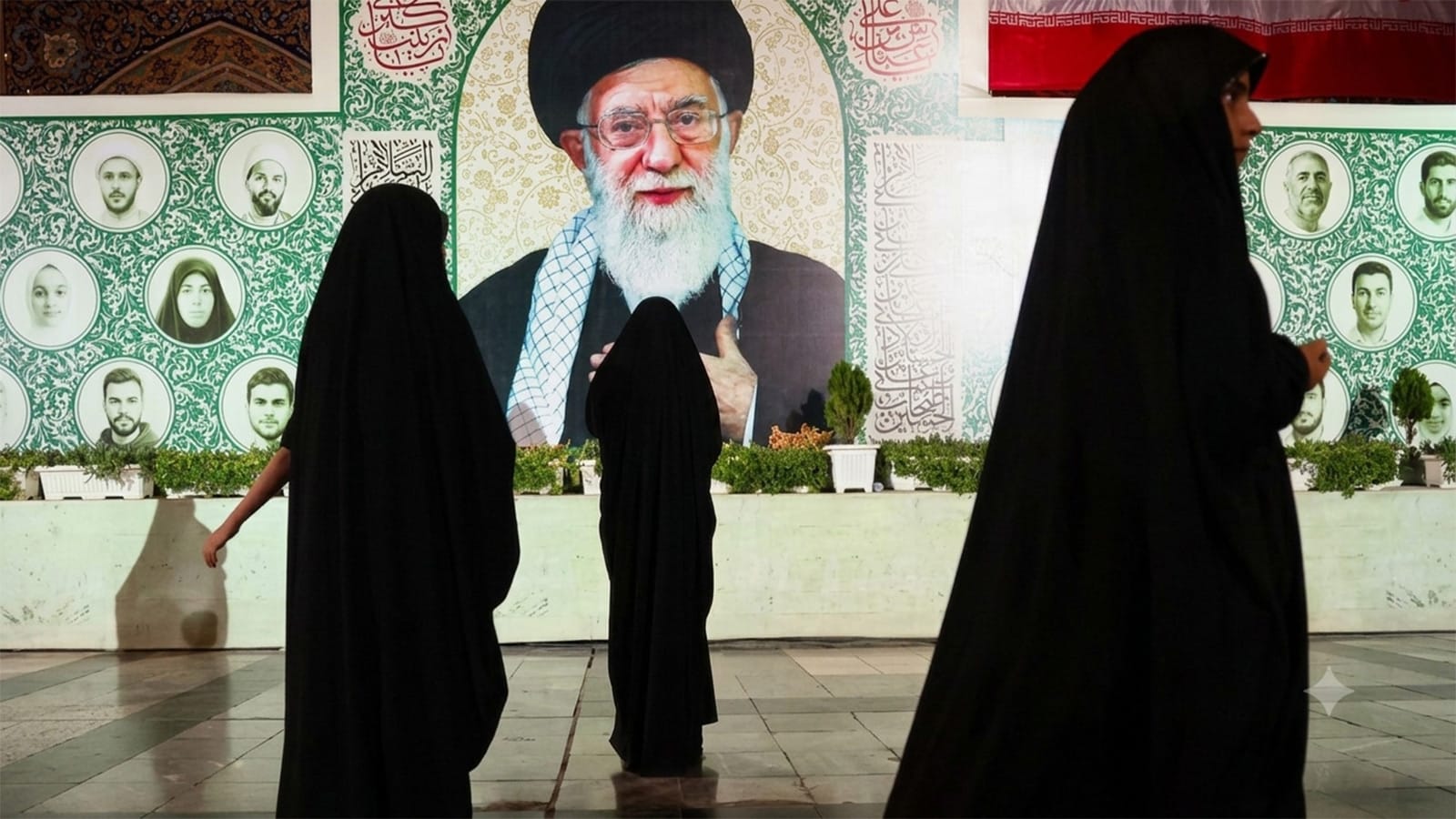
1:20pm 11 July 2026 — Trump warns 1000 missiles are locked and loaded if Iran tries to assassinate him
President Trump posted on Truth Social late Friday that the US military has 1000 missiles aimed at Iran "with thousands of more to immediately follow" if Tehran acts on threats to assassinate him, adding that standing orders authorise the military to "completely decimate and destroy all areas of Iran" for one year. Trump signed off the threat with the words "Praise be to Allah!", flinging the regime's own invocation back at Tehran, and posted it after Iran's Friday Prayer Policy Council issued an official call for revenge over the killing of Ali Khamenei.
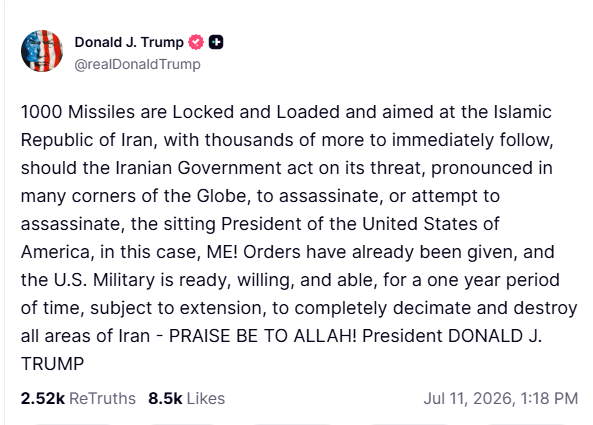
The post landed hours after clerics at Khamenei’s funeral in Mashhad openly called for Trump’s assassination. Trump’s response is a standing destruction order that runs on autopilot for a full year. Iran’s oil, its dollars and the strait stay in Washington’s hands, and the 60 day leash just got tighter. Beijing’s energy lifeline through Hormuz narrows every time Trump reminds the world he can shut the whole corridor down.
10:30am 11 July 2026 — Saudi Crown Prince and Trump coordinate on Strait of Hormuz security
Crown Prince Mohammed bin Salman and President Trump discussed Strait of Hormuz security and US Saudi defence cooperation in a phone call on Friday, Fox News reported, citing a readout from Saudi Arabia’s state news agency SPA. The call covered freedom of navigation and broader regional coordination as the Saturday deadline for Iran’s public commitment to keep the Strait open approaches.
Riyadh and Washington are moving in lockstep on the chokepoint. Saudi Arabia has the most to gain from a strait that stays open under American escort and the most to lose if Iran shuts it. Trump’s 60 day leash on Tehran’s oil runs through the same waters that carry Saudi crude to China’s refineries, and MBS wants that leverage kept tight.
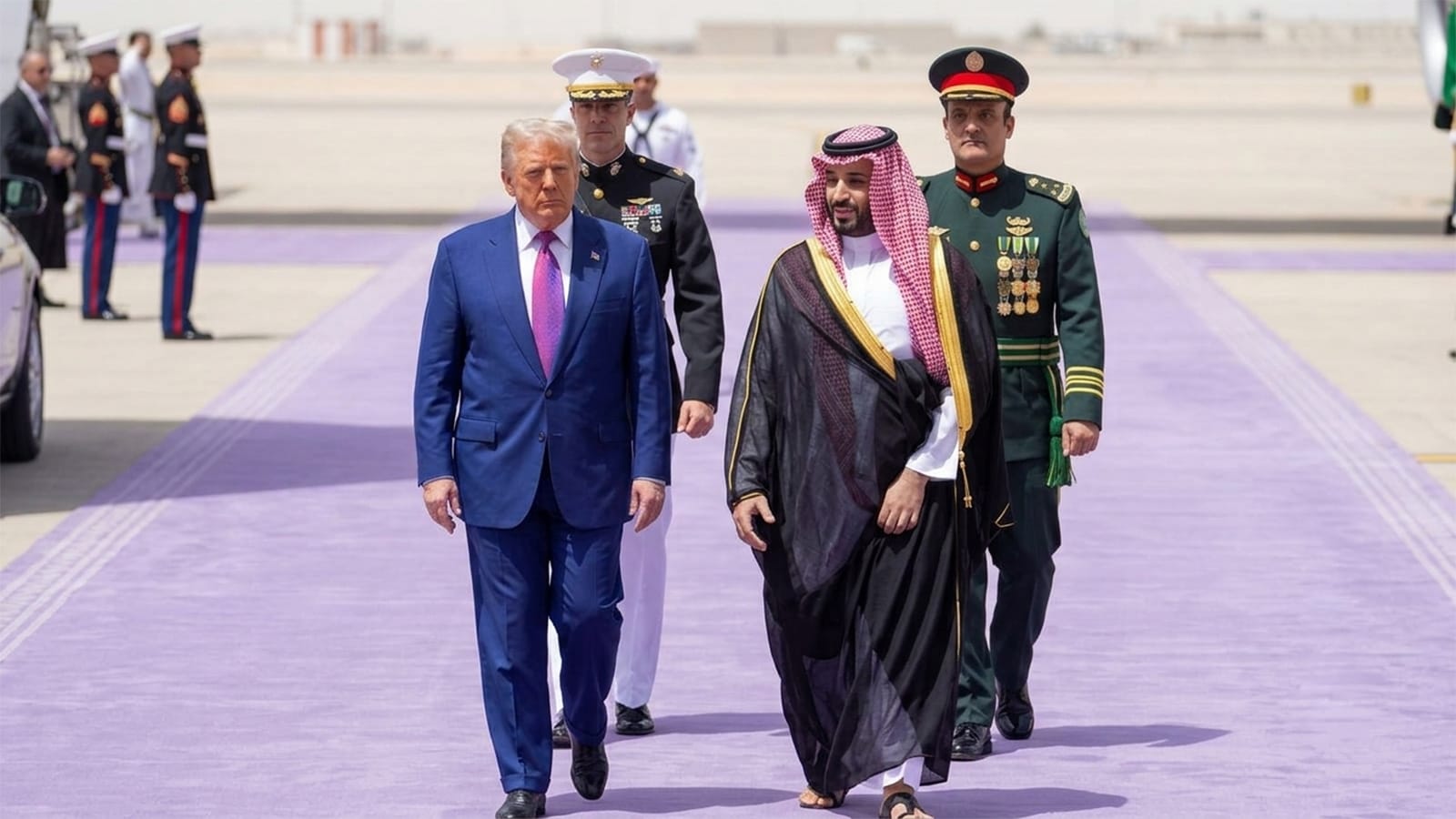
9:10am 11 July 2026 — Israel’s Katz says IDF is prepared to strike Iran for a third time
Israeli Defence Minister Israel Katz said the IDF remains "fully prepared" to resume operations against Iran, including a third strike "if necessary" and with greater force, speaking at an Israeli Air Force ceremony, Fox News reported. Prime Minister Netanyahu reinforced the posture, saying the campaign "is not over."
The Iranian axis is weaker than ever before, while Israel is stronger than ever before.
Israel can hit Iran independently of Washington. The third strike warning stacks on top of Trump’s 60 day leash, giving Tehran two separate militaries ready to flatten its remaining capacity the moment talks stall. For Beijing, the calculus worsens: every independent Israeli escalation makes the strait less predictable and China’s Iranian oil discount less bankable.
9:30am 8 July 2026 — France and Britain to launch Hormuz mine clearing mission with up to 19 NATO allies
France and Britain will lead a multinational naval force of up to 19 NATO countries to clear roughly 80 Iranian mines from the Strait of Hormuz and escort commercial shipping through the chokepoint, Gulf News reported. NATO foreign ministers from Germany, Belgium, the Netherlands, Norway, Italy, Denmark and Canada are expected to contribute warships, minehunters and personnel. The announcement came after NATO foreign ministers met their Gulf counterparts from Bahrain, Kuwait, Qatar and the UAE on the sidelines of the Ankara summit.
Iran’s deputy foreign minister Kazem Gharibabadi warned against the deployment, saying Iran, "as the responsible power and guarantor of the Strait’s security, warns with sensitivity to any military movement in this waterway." Britain’s Royal Fleet Auxiliary Lyme Bay and HMS Dragon are among the assets earmarked for the operation.
This is exactly the burden sharing Trump demanded when he called out NATO allies for letting America patrol Hormuz alone. Paris and London are now putting hulls in the water, and 17 more allies are lining up behind them. The mission starts in the Gulf of Oman, just outside the strait, because Iran still claims sovereignty over the narrows. Trump’s pressure worked. The question now is whether Tehran treats a European minesweeper the way it treated the Qatari LNG tanker.
9:15am 8 July 2026 — GCC condemns tanker attacks as Qatar holds Iran fully legally responsible
The Gulf Cooperation Council’s Secretary General Jasem Albudaiwi has condemned Iran’s attacks on the Saudi crude tanker Wedyan and the Qatari LNG carrier Al Rekayyat as a "dangerous escalation that threatens the security and stability of the region," Asharq Al Awsat reported. He called on the international community to take a "firm and deterrent stance" against repeated Iranian attacks on commercial shipping.
Qatar’s foreign ministry spokesman Majed Al Ansari separately held Iran "fully legally responsible" for the Al Rekayyat strike, calling it an "unacceptable assault on the security and safety of international navigation and global energy supplies." Saudi Arabia issued a parallel condemnation over the Wedyan.
The Gulf states that hosted and mediated Iran’s peace talks are now publicly branding Tehran a rogue actor in their own waterway. Qatar bankrolled the Doha talks. Saudi Arabia kept back channel lines open. Both just watched the IRGC fire on their tankers. That collective response, six sovereign Gulf governments calling for a deterrent stance, strips Iran of the regional cover it relied on to frame itself as a defensive power. The strait is Trump’s lever, and Iran just handed him the Gulf’s backing to pull it harder.
8:17am 11 July 2026 — US officials say they can bomb Iran's nuclear sites again to keep them unusable
Senior US officials have told CNN that Washington keeps a full set of military options to make sure Iran's bombed nuclear sites stay unusable, and would strike again if Tehran tries to dig out the buried enriched uranium. Satellites are watching the sites around the clock, and one official said any move on the stockpile means the US will hit the facilities very hard again.
This is the leash tightening. Trump's message to Tehran is simple: the ruins of its program stay ruins, the satellites never blink, and any excavator near the buried uranium buys another round of American missiles. Iran gets to keep talking only while it keeps still. The oil, the dollars and the strait stay in Washington's hands, and the real audience is in Beijing, watching how firmly America can hold the tap that feeds China's economy.
7:28am 11 July 2026 — Iran privately tells Trump advisers the Strait of Hormuz attacks were a mistake
Iranian officials have privately told Donald Trump's advisers they ‘made a mistake’ by shooting at commercial ships in the Strait of Hormuz, blaming an errant sect of hardliners trying to sabotage the negotiations, CBS News reported. Tehran told Washington it wants to keep talking and that the strikes came from a faction working against its own pragmatists, and the White House is now demanding Iran say so publicly and confirm the waterway is open.
It's a revealing climbdown. A week of American strikes has Tehran scrambling to explain away its own aggression and pleading to stay at the table, exactly the posture Trump wanted. He still holds Iran's oil, its dollars and the strait on a 60 day leash, ready to take the waterway the moment the regime oversteps again. The hardliners can bluster all they like. The real prize sits further east, in Beijing's energy lifeline that runs through the same water.
7:08am 11 July 2026 — US intelligence finds no fresh Iranian plot to kill Trump as Israel pushes to steer him
US intelligence assessments show no sign of a new, specific Iranian plot to assassinate President Trump, only a steady background of threat chatter, two US sources told CNN. The same officials said Israel has been feeding Washington intelligence, including the recent plot claim, in a bid to shape how Trump weighs deeper strikes on Iran.
Trump keeps his own counsel here. He acts on hard US intelligence while Jerusalem lobbies for a wider war, and he still holds Iran's oil, its shipping and its access to the dollar on a short leash as the talks grind on. The pressure that matters stays economic, pointed at Tehran and, through Tehran, at Beijing.
7:02am 11 July 2026 — Trump administration gives Iran until Saturday to declare the Strait of Hormuz open
The White House has told Iran, directly and through regional mediators, that it must publicly declare every channel in the Strait of Hormuz open and toll-free and pledge to stop firing on commercial ships, three US officials told Axios. Washington has set a Saturday deadline and warned of consequences if Tehran refuses, with one official saying it would not be 'a great day' for Iran.
This is the leash drawn tight. Trump is making Tehran say out loud that the waterway stays open to shipping and putting a clock on it. Iran can keep its oil flowing and its terminals earning only for as long as it leaves the strait alone, and the moment it reaches for the chokepoint again Washington has shown it will take the strait itself. Beijing, which needs that lane open for its refineries, is the audience that really counts.
6:52am 11 July 2026 — Iran says Araghchi will fly to Oman for Strait of Hormuz talks
Iran's foreign ministry spokesman Esmail Baghaei said Foreign Minister Abbas Araghchi will travel to Oman to continue consultations on managing shipping through the Strait of Hormuz under the memorandum of understanding struck with Washington, according to Iranian state media. Tehran says the Muscat channel will settle who administers the waterway and what it charges the tankers passing through it.
The strait is the one lever Tehran keeps grabbing for, and it's the one Trump has made clear he'll take the moment Iran moves to close it. Every session in Muscat only underlines that Iran's oil, its shipping lane and its access to the dollar now run on Washington's clock, not Tehran's. The real audience is Beijing, watching whether the route that feeds its refineries stays open on American terms.
6:44am 11 July 2026 — Iran's UN envoy Iravani threatens to abandon the US memorandum
Iran's ambassador to the United Nations, Amir Saeid Iravani, warned that Tehran may no longer consider itself bound by the memorandum of understanding with the United States if American strikes on Iranian targets continue, Iranian state media reported. The threat lands as Iran's foreign ministry insists it never requested the renewed talks now being brokered by Qatar and Pakistan.
It's the familiar bluff from a regime that only signed after American bombs left it no better option. Iran can threaten to tear up the paper, but it can't restart its oil sales, unfreeze its assets or push a tanker through Hormuz without the terms Trump set, and Washington knows it. The louder Tehran complains about the leash, the tighter it shows the leash has been pulled.
6:15am 11 July 2026 — Trump tells the New York Post he left instructions to bomb Iran if he is assassinated
President Trump told the New York Post aboard Air Force One that he has left standing instructions for the US military to strike Iran “at levels that they’ve never seen before” if Tehran succeeds in killing him. He brushed off reports that Israel had shared intelligence about a fresh assassination plot, saying “Israel came up with nothing,” and noted he’s been Iran’s number one target “for a long time.”
I’ve left instructions, if anything happens, to just literally bomb them at levels that they’ve never seen before.
It’s the sharpest deterrence signal since the ceasefire collapsed. Trump is telling Tehran that killing him only escalates the war beyond anything the regime survives. He still holds Iran’s oil revenue, its dollar access and the strait on a short leash, and the standing orders guarantee that leash outlives him.
6:10am 11 July 2026 — Qatari mediators land in Mashhad to try to salvage the US Iran deal
A Qatari diplomatic delegation arrived in the Iranian city of Mashhad to restart negotiations between Tehran and Washington, UPI reported, with the trip coordinated with the United States. Vice President JD Vance, Jared Kushner and special envoy Steve Witkoff all worked the phones to Doha through the day as Qatar’s foreign ministry said diplomacy remains “the only option capable of ending crises.”
The mediators touched down while Khamenei’s funeral was still fresh in the ground and both sides were still claiming the other broke the deal. Trump’s pattern is consistent: smash the IRGC’s Hormuz assets, tighten the oil leash, then let Qatar ferry the regime back to the table. Every time Tehran overplays its hand, it loses leverage and comes back with less.
5:22am 11 July 2026 — Iran's Gharibabadi demands UAE be held accountable for backing US strikes
Iran's deputy foreign minister for legal and international affairs, Kazem Gharibabadi, told Iranian state media the United Arab Emirates must be held accountable for backing the US strikes on Iran, pointing to a US Commerce Department document that he says credits the Emirates for aiding American security interests. He offered no legal mechanism for the claim, which lands as Tehran scrambles to shift blame after two days of American strikes battered its air defences.
The threat says more about Iran than the Emirates. Cornered, sanctioned and leaderless after Khamenei's death, the regime is now lashing out at the very Gulf neighbours who sided with Washington, and the UAE made its choice plainly. Trump still holds Iran's oil, its dollars and the Strait of Hormuz on a short leash, ready to tighten it the moment Tehran oversteps. Every threat like this only isolates Iran further from the Arab states and closer to its last real backer, Beijing.
5:20am 11 July 2026 — CNN satellite imagery shows Iran rebuilding bombed nuclear sites in apparent MOU breach
New satellite imagery obtained by CNN shows Iran may be repairing nuclear and missile sites hit in last month’s US and Israeli strikes. Photos taken on 22 June and 7 July capture reconstruction work on impact holes at the Taleghan 2 building inside the Parchin military complex, where analysts working with the Institute for Science and International Security believe explosive material for a weapon is stored. Separate imagery from 21 June showed vehicles moving in and out of tunnels at Pickaxe Mountain, a suspected underground nuclear site, while the 17 June memorandum was still in force.
The pictures land as Trump tears up the ceasefire, and they hand him the cleanest justification yet. Tehran signed the deal on 17 June and already appears to be rebuilding the very sites it promised to abandon, the clearest sign yet that the mullahs treat every pause as cover to reload. It is exactly why Trump keeps Iran’s oil, its dollars and the strait on a short leash, and why he is ready to tighten it the moment the regime oversteps. The real prize sitting behind all of it remains Beijing, the buyer that keeps the regime breathing.
3:34am 11 July 2026 — Iran's Ghalibaf says only those prepared for war can negotiate with the US
Iran's parliament speaker and lead negotiator Mohammad Bagher Ghalibaf said Tehran stays ready for war if Washington betrays last month's memorandum, telling reporters that only those prepared for war can negotiate with the United States. He said he'd warned US Vice President JD Vance during the talks that Iran doesn't trust Washington, while still calling diplomacy Tehran's priority.
The tough talk costs Tehran nothing and changes nothing on the ground. Trump still holds Iran's oil revenue, its access to dollars and the Strait of Hormuz on a short leash, and the regime knows another overstep brings back the strikes that hit its bases this week. Bluster is what's left once the cards are gone.
2:22am 11 July 2026 — Tammy Bruce tells the UN Security Council the US won't talk while Iran hits civilians
US Deputy Ambassador to the UN Tammy Bruce told the Security Council that Washington can't negotiate while Iran reneges on basic obligations, in her words “simple obligations such as don't shoot at civilian objects”. Bruce said the US still prefers a diplomatic solution and stands ready to hold Tehran to account for acts that defy international peace and security.
It's the line Trump has held from the first strike. Talks stay open, but only while Iran keeps its hands off tankers and civilians, and the moment Tehran fires the diplomacy stops and the bombs resume. Iran's oil, its dollars and the strait all sit under Washington's thumb, and Beijing, the regime's real lifeline, is watching how far that leash stretches.
5:05am 11 July 2026 — Treasury sanctions financier managing assets for new Supreme Leader Mojtaba Khamenei
The US Treasury Department sanctioned Dubai based financier Ali Ansari for managing assets on behalf of Iran’s new Supreme Leader Mojtaba Khamenei, alongside multiple Iranian exchange houses designated for moving billions through shell companies, Fox News reported.
The so-called Supreme Leader is hiding in seclusion while his regime crumbles.
Treasury Secretary Scott Bessent’s language is pointed and deliberate. Ansari’s designation strips the financial plumbing that props up Mojtaba Khamenei barely a week after his father’s burial. Trump’s sanctions machine keeps running on the 60 day leash timeline, targeting the money before it targets the man, and every dollar frozen tightens Beijing’s calculation about the cost of bankrolling Tehran’s new supreme leader.
12:50am 11 July 2026 — IMO Council tells nations to reject Iran’s sovereignty claim over Strait of Hormuz
The governing council of the UN’s International Maritime Organisation voted on Friday to reject Iran’s claim of sovereignty over the Strait of Hormuz and called on member states to refuse recognition of Tehran’s newly created Persian Gulf Strait Authority, Al-Monitor reported. The non binding resolution condemned Iran’s "unilateral decision" to establish a body controlling vessel traffic through the strait and urged nations to reject any actions aimed at restricting the internationally recognised right of transit passage. Iran’s delegation rejected the resolution as "selective, politically motivated and legally unfound." Tehran does not hold a seat on the IMO Council.
The vote hands Trump and CENTCOM a multilateral stamp on the position they’ve enforced with warships since April. Iran’s Persian Gulf Strait Authority is now an entity the world’s maritime regulator has told every flag state to ignore, and that strips Tehran’s last institutional lever over the 21 million barrels a day that flow past its coastline. The real audience is Beijing, which buys more of that crude than anyone and now has one fewer diplomatic fig leaf for backing Iran’s chokepoint claims.
12:35am 11 July 2026 — Trump declares ceasefire with Iran over, agrees to continue talks
President Trump posted on Truth Social that Iran had asked to continue negotiations and the US had agreed, but declared in capital letters that the ceasefire is finished.
The Islamic Republic of Iran has asked us to continue ‘talks.’ We have agreed to do so, but the United States has stated to them, in no uncertain terms, that the Cease Fire is OVER!
The post locks in Trump’s dual track. By killing the ceasefire while keeping the table open, he strips Tehran of the pause it used to rearm IRGC coastal units and probe Hormuz transits, while daring the regime to walk away from the only channel that can unfreeze its oil revenue. Qatar is already in Tehran trying to hold the thread together. Every hour without a restored ceasefire is another hour American strike packages remain loaded and Beijing’s tanker insurance premiums climb.
1:15pm 10 July 2026 — Qatar freezes Ras Laffan LNG expansion after Hormuz tanker strike
QatarEnergy has paused plans to ramp up output at the world’s largest liquefied natural gas complex after the IRGC’s attack on the Al Rekayat tanker made Strait of Hormuz transits too dangerous, Bloomberg reported on Thursday.
CEO Saad Al Kaabi ordered Ras Laffan to hold at minimum operating levels and cut the number of vessels scheduled to dock. Qatar had been pushing to restore most of its LNG production within two months of the June ceasefire, but the string of IRGC Hormuz attacks has gutted that timeline. European benchmark gas prices climbed above €50 per megawatt hour for the first time since the June deal, and Asian spot LNG prices sit more than 80% above pre-war levels.
Every tanker that doesn’t sail tightens the global LNG market heading into northern winter and sharpens the contest between Asian and European buyers for cargoes that Australia, among others, supplies. Trump’s 60-day leash on Tehran controls more than Iranian compliance. It controls the energy map every net importer is drawing for the fourth quarter, and Beijing’s exposure is the largest of all.
1:05pm 10 July 2026 — State Department kills Mamdani aide's meeting with Iran's UN envoy
New York Mayor Zohran Mamdani's commissioner for international affairs, Ana Maria Archila, had scheduled a meeting this week with Iran's permanent representative to the United Nations, Amir Saeid Iravani, at Two United Nations Plaza in Manhattan, before the State Department intervened and the meeting was called off, the Washington Examiner reported. Administration officials met Mamdani's office to make sure it did not go ahead, and Archila was reprimanded. A spokesperson for the Mayor's Office for International Affairs said “this meeting did not and will not take place”. City Journal, which first reported the plan, said neither Mamdani nor the State Department was told about it beforehand.
An official of America's largest city was booking a sit down with Tehran's man at the UN in the same week Iranian missiles were falling on Gulf capitals and American bases, and Washington shut it down inside a day. The leash runs through New York too. Trump holds Iran's oil, its dollars and its strait, and he isn't about to let a mayor's staffer hand Tehran a photo op while Beijing watches for any soft edge in American resolve.
12:45pm 10 July 2026 — Israel warns US of a fresh Iranian plot to assassinate Trump
Israel shared intelligence with Washington this week warning of a new Iranian plan to assassinate President Trump, Fox News reported, citing a Wall Street Journal investigation published on Wednesday.
American officials said the intelligence had not been independently vetted by US agencies before the Israeli warning arrived. The US government has tracked a steady stream of threat reporting about possible Iranian plots against Trump since the 2020 killing of IRGC commander Qasem Soleimani, and the latest warning adds a specific data point to that pattern.
The regime has tried to kill Trump before and has every reason to try again now that its military infrastructure sits in ruins. The timing reinforces the case Trump and Netanyahu have both made: the war is not finished until the threat is neutralised, and any deal with Tehran is only as good as the deterrent standing behind it.
12:40pm 10 July 2026 — US confirms technical talks with Iran continue despite two days of strikes
A US official confirmed that technical negotiations between Washington and Tehran are still under way, telling ABC News that "the United States is still committed to finding a resolution, and technical talks continue."
The confirmation sits alongside Trump’s declaration that the memorandum of understanding is "over" and his order for fresh strikes. Trump has kept the military pressure maximal while leaving a channel open for Tehran to come back with something real. The strikes tighten the collar, the talks give the regime a way out, and the clock runs on Trump’s terms. That is how a 60 day leash works, and Beijing, which needs the strait open far more than Iran needs the bluff, is watching every turn of it.
7:11am 10 July 2026 — CENTCOM rejects Iran’s claim to control Hormuz and says the strait is open
US Central Command has hit back at Tehran’s claim that it controls the Strait of Hormuz, saying in a public release headed Commercial Vessels Flow Through Open Strait of Hormuz that merchant ships and crude oil are still moving through the waterway under American coordination. CENTCOM casts the strait as an international trade corridor its forces have kept open since early May, and disputes any suggestion Iran can shut it at will. The command’s own tally of vessels and barrels could not be independently confirmed, and it lands hours after tanker crossings on the American escorted route collapsed to a trickle.
This is the leash made plain. Iran’s parliament can vote to close the strait and Ghalibaf can promise transit fees, but the ships move when Washington says they move, and CENTCOM is content to publish the receipts. Whatever leverage Tehran holds over the waterway exists only on the days America allows it. The real audience sits in Beijing, which takes about 80% of Iran’s crude through this channel and needs the corridor open far more than the regime needs the bluff.
7:03am 10 July 2026 — Two Basij militiamen shot dead in Mashhad as Khamenei is buried
Two members of Iran’s Basij militia have been shot dead in Mashhad, the city where Ali Khamenei was buried on Thursday, according to the IRGC linked Sabereen News agency. Two unidentified men in military clothing opened fire with handguns on Fakouri Boulevard, killing one Basij member at the scene and wounding a second who later died in hospital, with gunfire also reported near the Imam Reza shrine where the supreme leader was laid to rest. The gunmen fled and security forces are still searching for them. The account rests on Iranian sources alone and no Western outlet has confirmed it.
Take the regime’s own account at face value and it is damning. Armed men picked off the militia that exists to police Iran’s streets, in the regime’s holiest city, on the day it buried its supreme leader, and walked away. Tehran can’t hold order at Khamenei’s graveside while Trump keeps its oil, its dollars and the Strait of Hormuz on a 60 day leash. A government losing its grip at home has even less room to bluff at the strait, and Beijing, which needs that crude moving, is watching the regime it bet on struggle to hold its own ground.
6:47am 10 July 2026 — Araghchi phones Oman, Turkey and Pakistan’s army chief as Iran scrambles for support
Iran’s Foreign Minister Abbas Araghchi called Omani Foreign Minister Badr Al-Busaidi, Turkish Foreign Minister Hakan Fidan and Pakistan’s army chief Field Marshal Asim Munir on Thursday, Xinhua reported. Araghchi accused Washington of “flagrant violations” of the UN Charter and the ceasefire memorandum, and warned against further American military “adventurism” while reaffirming Iran’s commitment to defending its sovereignty.
Tehran is calling every regional capital it can reach, but the call sheets tell you who isn’t on the line. Beijing buys 80% of Iran’s crude and stands to lose the most if the Strait closes for good, yet China’s name hasn’t surfaced in any of Araghchi’s disclosed conversations. Trump holds Iran’s oil, its dollars and the Strait on a 60 day leash. Every barrel that doesn’t flow is a barrel China’s refiners have to source from somewhere friendlier.
6:45am 10 July 2026 — Qatar’s PM tells Araghchi Iran’s Hormuz ship attacks undermine confidence in the deal
Qatar’s Prime Minister Sheikh Mohammed bin Abdulrahman Al Thani told Iran’s Foreign Minister Abbas Araghchi that attacks on commercial vessels in the Strait of Hormuz “undermine confidence” and “threaten the security of international navigation,” Qatar Tribune reported. Al Thani stressed that all parties must honour their commitments under the interim US-Iran deal.
Qatar co-hosted the memorandum negotiations and gave Tehran its most sympathetic Gulf hearing throughout the war. When even Doha publicly tells Iran its Hormuz provocations are wrecking the deal framework, Tehran’s diplomatic runway is shrinking fast. Trump designed the 60 day leash on Iran’s oil, dollars and strait access for exactly this moment. Beijing, whose refiners depend on that waterway, is watching its energy lifeline get tested with each Iranian provocation.
6:40am 10 July 2026 — Iran says fighter jets hit its Konarak naval base in two waves
The governor of Konarak has confirmed that the naval military area at the southern port was “targeted in two waves of airstrikes by fighter jets”, after Iranian media reported three explosions over the coastal city. Iran’s official news agency described the base as struck by an “enemy” attack, Haaretz reported.
Konarak is where Iran keeps much of the fast attack boat fleet it uses to menace shipping at the mouth of the Strait of Hormuz. Washington has spent two days taking apart the tools Tehran needs to close the strait, and the leash tightens every time the regime reaches for them. Beijing, which buys most of the crude that sails through it, is watching the same footage.
6:21am 10 July 2026 — Iran’s embassy in Ankara calls NATO’s Hormuz and nuclear warnings baseless
Iran’s embassy in Turkey has rejected the NATO summit declaration’s findings on Strait of Hormuz navigation and on Tehran’s nuclear program as “baseless, politically motivated and unacceptable”, insisting Iran has played a responsible role in maritime security. The statement was carried by Iranian state media and has not been reported independently by a Western outlet.
The embassy issued that defence from the very capital where NATO leaders had just signed a communique ordering Iran to respect passage through the strait. Tehran calls the charge baseless while its own parliament speaker, Mohammad Bagher Ghalibaf, says the strait will reopen on Iran’s terms and at Iran’s transit fees. Both of those things cannot be true at once.
6:15am 10 July 2026 — Netanyahu phones Trump over US moves in the Gulf and Erdogan’s remarks
Israeli Prime Minister Benjamin Netanyahu spoke with President Donald Trump about “US moves in the Gulf” and about Turkish President Recep Tayyip Erdogan’s comments on the war, Haaretz reported, as explosions rolled across Iran’s southern coast from Bushehr to Bandar Abbas.
Trump is running this campaign on his own clock, and the call reads as Jerusalem checking the timetable rather than setting it. That is the point of the leash. The President holds Iran’s oil, its dollars and its strait, and he decides when to pull.
5:32am 10 July 2026 — Bushehr official concedes a military site was hit as Iran claims it downed US drones
Bushehr's deputy governor has told Iranian state media that a military site on the city's outskirts was struck by what he called a US-Israeli projectile, while insisting the six explosions heard across Bushehr and Choghadak were his own air defences firing at American drones. He said the batteries responded in time to stop the drones attacking and that nobody was killed. The claim is unverified and no Western outlet has confirmed it, though Iranian officials had already told Al Jazeera that US strikes hit civilian sites across Bushehr province, and a US official told CNN half an hour earlier that American forces weren't striking at that moment.
Read the admission, not the boast. Tehran's own official confirms a military site went up, then asks Iranians to believe every other blast was their air defence doing its job. This is the same regime whose state TV spent the previous twenty minutes denying explosions its own Mehr agency had reported. Trump doesn't need to own every crater to own the outcome. He holds Iran's oil, its dollars and the Strait on a leash, and each night Tehran has to explain another hole in its own coastline while Beijing watches the energy lifeline it depends on get audited in real time.
5:15am 10 July 2026 — Iran's state TV denies the southern blasts its own Mehr agency reported
Iranian state television has denied the explosions reported across the country's south, saying that "no explosion has been reported so far in Bandar Abbas, Qeshm, Sirik or Jask", barely an hour after the semi official Mehr news agency reported blasts in the port of Bandar Abbas, six explosions around Bushehr and Choghadak, and three at Konarak. The denial names four places and pointedly leaves out Bushehr and Konarak, and Iranian officials had already told Al Jazeera that US strikes hit fishing piers and other civilian sites in Bushehr province, near the nuclear plant, on Thursday.
When a regime's broadcaster has to publicly argue with its own news agency about whether its ports are being bombed, Tehran has lost control of more than its airspace. The clumsy half denial tells you which sites the new leadership can't afford to admit were hit. Trump still holds Iran's oil, its dollars and the Strait of Hormuz on a 60 day leash, and he can tighten it the moment Tehran oversteps. Beijing, whose tankers depend on that water, is the audience that actually matters.
5:00am 10 July 2026 — US says its forces aren't striking Iran right now as fresh blasts hit the south
A US official has told CNN that American forces are not currently conducting strikes, even as Iran's Mehr news agency reported explosions on Thursday evening in the port city of Bandar Abbas, six blasts around Bushehr and Choghadak, and three more at Konarak in the south east. There was no immediate word on what caused them or how much damage was done.
The timing says everything. Trump declared the ceasefire dead, sent Central Command across Iran's coast for two days, told reporters Tehran had called wanting a deal, and now the bombs stop. That's the leash slackening, not coming off. Iran's oil, its dollars and the Strait are still in Washington's hands, and the quiet lasts exactly as long as Tehran's manners do. Beijing is watching its energy lifeline get switched on and off at an American command.
4:30am 10 July 2026 — Khamenei is buried in Mashhad while his successor son Mojtaba stays out of sight
Iran has laid Ali Khamenei to rest at the shrine of Imam Reza in Mashhad, the city he was born in and asked to be buried in, closing a week of state funeral processions that ran from Tehran to Qom and across the border to Najaf. The rites went ahead in a city whose rail link to the capital American strikes cut this week. Mojtaba Khamenei, the son who took the supreme leader's job days after his father was killed, still hasn't appeared in public.
A supreme leader who won't show his face is not a man who feels safe. Mojtaba has inherited a country with its air defences shredded, its crude stranded at sea and the base beside its only civilian nuclear plant under fire, and his first act has been to stay hidden. The regime spent seven days marching mourners through the streets to look strong. The one man who is supposed to embody that strength has been missing for every step of it.
3:40am 10 July 2026 — US defence official says Iran's missile barrage caused no American casualties
Dozens of missiles and drones fired by Iran at American forces were intercepted or failed to cause major damage, a US defence official said on Thursday, adding that there were no US injuries. Iran's regular army had declared every American base in the region a target and sent drones at sites in Bahrain and Kuwait, all of which were shot down or fell short.
Two days of Iranian retaliation has produced no dead Americans and no serious damage, and that is the whole story of this war in a line. Tehran can still launch, it just can't land. Washington meanwhile has cut Iran's railways, hit its ports and closed its road to the Strait, and every barrel Iran can't sell is a barrel China doesn't get. The leash holds because Iran has nothing left to pull against.
3:10am 10 July 2026 — Trump says Iran called wanting a deal hours after he declared the ceasefire dead
Trump told reporters at the NATO summit in Ankara that Iran had called wanting to negotiate just hours after he declared the ceasefire "over" and branded the talks "a waste of time", adding he no longer knows whether the two countries are heading back to full-scale war.
"They have very little left, and they want to make a deal so badly. They called a little while ago."
The reversal is classic leash mechanics. Trump pulled the chain by declaring the ceasefire dead, launching fresh strikes and revoking the sanctions waiver in the same 24 hours, and within hours Tehran was on the phone. The 60-day window he gave Iran to prove itself is closing fast, and the call is the first sign the regime knows it.
11:15pm 9 July 2026 — Hormuz tanker crossings collapse to two as Iran rushes crude out of port
Tanker crossings through the Strait of Hormuz collapsed to just two early on Thursday compared to 25 the day before, according to Kpler tracking data, as two days of US strikes scared off commercial shipping. At the same time, Iran is racing to push crude out of its own ports, with five supertankers and a Suezmax hauling roughly 11 million barrels through the Gulf of Oman in a single 24-hour window, the fastest export pace since the war began.
Iran is trying to sell every barrel it has left while the remaining routes stay open. Trump revoked the 60-day sanctions waiver on Wednesday and has openly floated reimposing the full naval blockade. If the blockade returns, Iran loses its last source of hard currency and China loses the discounted crude that has been subsidising its refiners since March.
10:40pm 9 July 2026 — Trump declares the ceasefire over and orders fresh strikes to keep the Strait open
Donald Trump has declared the US ceasefire with Iran over and said he is not sure he even wants a deal, as US Central Command sent a fresh wave of strikes across Iran's southern coast to keep the Strait of Hormuz open. CENTCOM says it struck around 90 targets, air defences, missile and drone stores and naval sites, with explosions reported at Bandar Abbas, Sirik, Chabahar and Konarak, and framed the operation as holding Tehran to account for its aggression against commercial shipping.
This is the leash pulled tight. Trump has spent the past fortnight holding Iran's oil, its dollars and the Strait on a short tether, and the moment Tehran started firing on tankers he snapped it, flattening the coastal batteries that let Iran menace the waterway. Every one of these strikes lands on the chokepoint China leans on for its Gulf crude, and it tells Beijing exactly who gets to decide whether that oil keeps moving.
8:50pm 9 July 2026 — Jordan is dragged in as its skies fill with missiles and drones
The war has spilled over Jordan, with the US Embassy in Amman warning that missiles, drones or rockets are in Jordanian airspace and urging Americans to shelter as sirens sounded across the capital. Jordan's air force has intercepted Iranian projectiles crossing its territory before, and its skies sit directly on the flight path between Iran and Israel.
Amman is the reluctant middle of this fight, a US ally whose airspace Tehran keeps violating on the way to bigger targets. Every siren over Jordan chips away at Iran's claim that it is only hitting military sites, and it pushes another Arab government further into Washington's corner.
7:22pm 9 July 2026 — US widens its strikes to Iran's railways and the Bushehr nuclear base
US forces have pushed their bombardment beyond Iran's military bases and into its transport network, striking a railway bridge on the Tehran to Mashhad line and a base at Bushehr that houses the country's only civilian nuclear plant. US Central Command says it hit around 90 military targets, including missile and drone storage and logistics sites, along Iran's coast on this second day of strikes, and the Mashhad rail service has been suspended.
This is the leash tightening another notch. The Mashhad line is Iran's overland artery running east toward the Russian and Chinese trade corridors Tehran is banking on to move its sanctioned crude, and Trump has just shown he can cut it whenever he likes. Iran's oil, its dollars and now its rails all run through Washington's hands, and the real audience for that message sits in Beijing.
6:25pm 9 July 2026 — Iran's foreign ministry says the fresh US strikes shred the June deal
Iran's foreign ministry has condemned the new wave of American strikes on its coast and railways, declaring that Washington has torn up the first clause of the June memorandum and breached the UN Charter, and warning that Tehran will not let the attacks compromise its national interests. The statement was carried by Iranian state media.
Tehran crying foul over a deal it spent June stalling on takes some nerve. Iran signed the memorandum to buy 60 days of breathing room, kept its drones flying at Gulf shipping the whole time, and only now discovers the fine print. Trump's reply is written in the wreckage of those bridges. Honour the terms or watch the leash pull tighter.
5:59pm 9 July 2026 — Bahrain downs a fresh Iranian barrage as sirens wail again over the US Fifth Fleet
Bahrain's defence force says it has shot down another wave of Iranian missiles and drones aimed at the kingdom, and air raid sirens have sounded again over Manama, home to the US Navy's Fifth Fleet, as Iran launches a second and heavier day of strikes on the Gulf states. Manama branded the attacks systematic hostility and a violation of humanitarian law.
This is Iran's retaliation landing on empty air. Tehran can fling drones at the Fifth Fleet all it likes, but Bahrain's air defences are knocking them down while Trump's strikes keep pounding Iran's coast and its crude sits stranded behind a choked Strait of Hormuz. Firing on the Gulf's US allies only hardens the coalition Washington is building and does nothing to loosen the leash Trump holds on Iran's oil, its dollars and the strait itself.
5:50pm 9 July 2026 — Iran's health ministry puts the US strike toll at 14 dead and 78 wounded
Iran's health ministry has issued its first official casualty figures from the American bombardment, saying strikes over the past two days across several provinces have killed at least 14 people and wounded 78, with 47 still in hospital, according to figures carried by CBS News.
The toll is Tehran's own, and the regime has every reason to play up the civilian share while staying silent on how many IRGC commanders and missile crews are among the dead. CENTCOM says it has struck military targets, air defences, missile sites and the very boats Iran used to attack shipping in the Strait of Hormuz. Every one of those hits tightens Trump's grip on the chokepoint, and the pain Iran feels now is the direct price of firing on tankers and gambling that Washington would blink.
5:14pm 9 July 2026 — Qatar presses Iran to honour the deal and halt its attacks on Gulf shipping
Qatar's foreign ministry says its top diplomat has told his Iranian counterpart that all sides must honour the June memorandum and return to dialogue, while condemning Iran's attacks on commercial vessels in the Strait of Hormuz. It is a pointed message from Doha, whose role as the go-between Washington and Tehran both lean on is now under real strain, after an Iranian strike set a Qatari LNG tanker ablaze last week.
When even Iran's chosen back channel is publicly telling it to stop shooting at ships, Tehran's isolation is close to total. The Gulf Arab states Iran hoped to peel away from Washington are instead shooting down its drones and holding it responsible for the damage. That is the leash working, Trump squeezing Iran's oil and its friendships at once, while the real prize, cutting off the crude that keeps China's war machine fuelled, sits just beyond the strait.
4:12pm 9 July 2026 — Iran's army fires fresh drones at US Gulf bases and declares every US base a target
Iran's regular army says it has launched a fresh wave of drone strikes on US military bases across the Gulf, hitting sites in Bahrain and Kuwait and warning that every American base in the region is now a legitimate target for its drones, as regional outlets reported on Thursday. Tehran cast the strikes as revenge for what it calls Washington's breaking of the ceasefire, and vowed to keep flying drones at US forces until the American strikes stop.
This is Tehran lashing out from a losing position. With the Strait of Hormuz choked, its oil stranded at sea and its air defences shredded, Iran has little left but to fling drones at hardened US bases that shoot most of them down. Trump still holds the leash, and every base Iran fires at only hands Washington another reason to keep squeezing until Tehran, and its backers in Beijing, feel the real cost.
3:16pm 9 July 2026 — Strait of Hormuz shipping grinds to a near halt as US strikes bite
Ship traffic through the Strait of Hormuz has ground to a near halt, with the little movement left hugging an Iran-approved route in the north of the waterway while the US-backed Omani corridor sits all but empty. War risk premiums on tankers have soared as owners refuse to steer into a second straight day of American strikes.
This is the leash working exactly as designed. Trump hasn't had to formally shut Hormuz, his strikes have already scared the tankers into staying home, and every idle day strands more of Tehran's only real export at sea. The regime is losing oil money by the hour, and the cargoes that matter most, the Iranian crude bound for China, are the ones going nowhere.
3:05pm 9 July 2026 – Kayhan tells Iran's diplomats to quit talks and let missiles decide the war
Iran's hardline daily Kayhan, widely seen as a mouthpiece for the Supreme Leader's office, has told Tehran's negotiators to abandon talks with Washington, declaring that missiles now decide the war and predicting Donald Trump will soon be forced to beg as oil prices climb, according to Iranian state media.
It's a revealing admission. With the Strait of Hormuz choked, tens of millions of barrels of Iranian crude stranded at sea and the US Treasury having torn up Tehran's 60 day oil waiver, the regime's own hardliners are reaching for missiles because they've run out of leverage on oil and dollars. Trump holds all three. The louder Kayhan cheers for a fight, the tighter the leash pulls toward the strait, and the more it exposes who really loses if the chokepoint stays shut, namely the Chinese buyers who need this crude to keep flowing.
2:50pm 9 July 2026 – NATO chief Rutte backs Trump's fresh Iran strikes as absolutely necessary
NATO Secretary General Mark Rutte has thrown the Western alliance behind Donald Trump's renewed strikes on Iran, telling reporters at the Ankara summit they were absolutely necessary because Tehran had broken the ceasefire by attacking ships in the Strait of Hormuz. Iran's foreign ministry spokesman Esmaeil Baghaei hit back that NATO states offering bases and airspace now share responsibility for the war, and took aim at Rutte for siding with Washington.
It's a rare and blunt endorsement of Trump's Iran campaign from Europe, and it leaves Tehran shouting into an empty room. Trump still holds Iran's oil, its dollars and the Strait of Hormuz on a short leash, ready to take the waterway outright the moment the regime oversteps. The regime can blame NATO all it likes, but the squeeze that counts is aimed further east, at the Chinese buyers who need this crude to keep flowing.
2:30pm 9 July 2026 – CENTCOM says it hit 90 targets and 60 IRGC boats to reopen Hormuz
US Central Command says it has now struck more than 90 targets across Iran and destroyed around 60 IRGC fast boats in and around the Strait of Hormuz, and it named the three tankers Tehran attacked to trigger the campaign, the Marshall Islands flagged Al Rekayyat, the Saudi Wedyan and the Liberia flagged Cyprus Prosperity. CENTCOM said the United States is holding Iran accountable for unjustified aggression against commercial shipping and civilian crews in a vital international waterway.
This is the leash tightening. Every radar, missile site and gunboat Tehran loses in Hormuz is one less card it holds, and Washington is clearing the sea lane rather than grabbing ground. Control the shipping and you control Iran's oil and the dollars behind it, and behind those sits Beijing's energy lifeline. Tehran hit the tankers first, and Trump is making the cost of that impossible to miss.
2:20pm 9 July 2026 – Trump moves to strike Syria off the US terror list and leave Iran isolated
Sitting beside Syria's interim president Ahmed al-Sharaa at the NATO summit in Ankara, Trump said he will remove Syria from the US list of state sponsors of terrorism for the first time since 1979, telling Congress he had decided to lift every barrier stopping Damascus rebuilding. Once the 45 day review clears, only three names are left on the blacklist, Iran, North Korea and Cuba.
The map is being redrawn around Tehran. Trump is pulling a former pariah in from the cold while leaving Iran, North Korea and Cuba as the last holdouts, and the message to the mullahs is blunt, cooperate and the door opens, keep swinging at tankers and the noose stays tight. It's the same leash logic running through Hormuz, reward the states that move Washington's way and squeeze the one still betting on China.
12:58pm 9 July 2026 — IMF cuts its 2026 global growth forecast and blames the Iran war
The International Monetary Fund has cut its 2026 global growth forecast for the second time this year, trimming it to 3% from 3.1%, and has pinned much of the blame on the energy shock from the war on Iran, according to Al Jazeera. The Fund now sees global inflation at 4.7% this year, up from 4.1% in 2025, with Brent crude near $79 a barrel and Strait of Hormuz shipping down from about 130 crossings a day to just 41. It slashed the Middle East and Central Asia outlook by 1.2 points to a threadbare 0.7%.
The slowdown the Fund is measuring flows straight from Tehran's gamble on the Strait of Hormuz. Trump is simply squeezing the oil tap the regime foolishly grabbed, and Iran can lift the drag on the world economy the moment it stops firing on tankers and lets the ships through. The bigger loser is Beijing, whose Gulf energy lifeline now swings on a decision made in Washington.
12:41pm 9 July 2026 — White House says its Hormuz fight with Iran could run for weeks
The White House is preparing for a drawn out fight with Iran over the Strait of Hormuz that could run anywhere from a day or two to a week or a month, US officials have told Axios. Washington says the length of the new campaign depends entirely on whether Tehran keeps firing on the commercial ships trying to move through the waterway, the chokepoint that carries about a fifth of the world's oil.
This is the leash spelled out in plain English. Trump isn't chasing a quick headline, he's telling Tehran the pressure stays on for as long as Iran keeps its hand on the world's most important oil tap. Every extra day the regime holds out it bleeds the oil money and the dollars it can't afford to lose, while the real audience in Beijing watches its Gulf energy lifeline swing on a decision made in Washington.
12:32pm 9 July 2026 — Iran runs to the UN Security Council claiming the US broke the ceasefire deal
Iran's ambassador to the United Nations, Amir Saeid Iravani, has written to the Security Council demanding it act against the United States, claiming Washington violated the memorandum of understanding between Iran and the US and breached the UN Charter with its latest strikes.
This is what losing looks like. A regime that spent the morning firing on Kuwait and Bahrain is now posting letters to a Security Council that cannot save it. Trump holds Iran's oil, its dollars and the strait, and Tehran's answer is to appeal to the same institutions it has spent decades mocking. The letter changes nothing on the water.
12:23pm 9 July 2026 — Trump says Iran is begging to make a deal but he is not sure Tehran is worthy
Donald Trump says Iran has come crawling back to the table, telling reporters aboard Air Force One that Tehran “called a little while ago” and wants “to make a deal so badly”, even as US strikes widen. Trump was in no hurry to take the call, saying “I just don’t know if they’re worthy of making a deal” and adding “I don’t know that they’re going to honour the deal, that’s the problem”.
This is the leash doing its work. Iran isn’t ringing Washington because it wants peace, it’s ringing because Trump has its oil, its dollars and its only waterway all in one hand and is squeezing. He can afford to say no. Tehran can’t afford to be ignored, and the longer it stalls the more it hands Beijing’s energy lifeline to the same man holding the strait.
12:05pm 9 July 2026 — Ghalibaf says the Strait of Hormuz will reopen only on Iran's terms
Iranian parliament speaker Mohammad Bagher Ghalibaf has dug in on the waterway, warning on X that “if you strike, you’ll get hit” and that the Strait of Hormuz “will only open with Iranian arrangements, not American threats”. Parliament security spokesman Ebrahim Rezaei promised Iranians would deliver a “hard slap” for the US attacks.
It's brave talk from a parliament that can't keep its own bridges standing. Ghalibaf can announce Iranian arrangements all he likes, but it's the US Navy that decides whether the tankers move, and Trump has made clear he'll take the strait outright the moment Iran tries to close it. The threats are for a home audience that is fast running out of patience.
11:40am 9 July 2026 — US widens its strikes to more than 80 targets and cuts Iran's railways
US Central Command says it has hit more than 80 targets across Iran, striking air defences, command and control, coastal radar and missile sites, and for the first time since the April ceasefire reaching deep into Iranian infrastructure. Iranian media reported American cruise missiles took out a bridge in Golestan province and cut the Gorgan railway line, hundreds of kilometres from the strait. Al Jazeera reported the bombardment has rolled into a second day as the ceasefire collapses and Trump calls the regime “scum”.
This is the leash pulled to its limit. Trump has stopped nibbling at the coast and started cutting the arteries that move Iran's oil and its men, and Brent crude has jumped more than 5% to around $78 a barrel on the news. Every target that falls is a message priced in dollars to the one customer that matters, and that customer sits in Beijing.
11:30am 9 July 2026 — Iran fires on US Gulf bases as Kuwait, Bahrain and Qatar sound the sirens
Iran has launched a wave of missiles and drones at United States bases across the Gulf, with its Revolutionary Guard claiming 85 strikes on American targets in Bahrain and Kuwait. Gulf News reported Kuwait's military intercepted two ballistic missiles and 13 drones, Bahrain sounded air raid sirens, and Qatar raised its national threat level and told residents to stay indoors, as the regime scrambled to answer the American bombardment.
Tehran is throwing its last punches at the cheap targets. Firing on Kuwait and Bahrain won't move the American fleet one metre. It only hands Trump the excuse to finish the job at the strait, and every missile Iran wastes on a Gulf neighbour is one it can't use to keep its own tankers sailing to China.
9:23am 9 July 2026 — Trump vows to hit Iran back 20 to one after the Strait of Hormuz ship attacks
Donald Trump has escalated his warnings to Tehran, saying the United States struck back 20 times harder than Iran's attacks and will answer any fresh strike on Gulf shipping at the same rate, Al Jazeera reported, as he branded Iran's leaders "sick" and "scum" over the tanker attacks in the Strait of Hormuz.
This is the leash cinched another notch. Trump is doing more than answering the ship attacks. He is setting the exchange rate for the next one and betting Tehran cannot afford the maths. Every rocket Iran fires now buys twenty in return, while the strait, the oil and the dollars all still sit in Washington's hand.
9:10am 9 July 2026 — Iran vows to hold the Strait of Hormuz or die for it as Trump fumes
Iranian officials have dug in over the waterway even as the US strikes widen, with national security commission spokesman Ebrahim Azizi demanding the world "recognise the new and Iranian order in the Strait of Hormuz" and negotiating adviser Majid Shakeri declaring Iran would "hold on to this strait, or go and become martyrs for it one by one", Al Jazeera reported.
The rhetoric is loud, but it is the language of a regime with no cards left. Azizi and Shakeri can promise martyrdom, yet Iran has already had one wave of rockets swatted out of the sky, and it cannot keep the strait shut without strangling the very oil that keeps China running. Holding Hormuz throttles Iran's own economy more than it dents Washington, and it plays straight into Trump's hands.
8:35am 9 July 2026 — Iran's Revolutionary Guard reports its first death as Tehran vows a decisive response
Iran's Revolutionary Guard says one of its naval personnel was killed on Wednesday morning at the southern port of Bandar Mahshahr, struck by shrapnel while confronting US drones, the first military death Tehran has reported since Washington launched its second wave of strikes on Iran's coast inside 24 hours. Iranian lawmaker Morteza Mahmoudi and Supreme Leader adviser Mohsen Rezaei each vowed the United States would face a decisive and severe response, according to Iranian state media and the Guard's own channels.
Tehran has counted its first coffin and answered with a press release. The Guard can promise a decisive response, but every rocket it has thrown at the Gulf this week has been swatted out of the sky, and each empty threat hands Trump another reason to keep Iran's oil, dollars and the Strait of Hormuz on a short leash. The one capital that needs this to stop is Beijing, which takes almost all of Iran's crude and cannot afford a closed strait.
7:50am 9 July 2026 — Trump threatens Iran with a much worse response after the Chabahar strikes
Donald Trump has warned Tehran the overnight bombardment of Chabahar was only the beginning, posting on Truth Social that the strikes were “in retribution for yesterday’s bombing of ships by Iran. If it happens again, it will get much worse!” The post carried an image of fire and explosions at the southern Iranian port.
This is the leash pulled tight. Trump is putting a price on every Iranian move against shipping and daring Tehran to test him again. Hold fire and the oil keeps flowing on his 60 day terms, hit another tanker and the strikes get heavier. The audience that matters is in Beijing, which buys almost all of Iran’s crude and needs the Strait of Hormuz open.
7:20am 9 July 2026 — US strikes pound Chabahar port and Bandar Abbas as the Hormuz campaign widens
US forces have widened their bombardment of Iran's southern coast, and Al Jazeera reported explosions across Chabahar, Bandar Abbas, Sirik, Qeshm and Bushehr province as Central Command works to strip Tehran of the missile and naval systems it uses to threaten the Strait of Hormuz. Iran's state news agency IRNA said around 10 blasts hit the port of Chabahar and nearby Konarak, cutting power to parts of the city and damaging two piers and a maritime traffic control tower.
The target list tells the story. Chabahar is Iran's India and China facing port and Bandar Abbas its main naval base, so Washington is methodically dismantling Tehran's ability to choke the strait one coastal system at a time. This is the leash tightening on schedule. Trump holds Iran's oil, its dollars and its shipping lanes, and every battery and radar that comes down makes a real closure of Hormuz, and the pain that would inflict on China's energy imports, less likely by the hour.
6:45am 9 July 2026 — Iran's IRGC threatens a region wide missile and drone barrage on US bases
Iran's Islamic Revolutionary Guard Corps has threatened a large scale missile and drone attack on US military bases across the region, according to a statement carried on its own channels, hours after its first barrage on Bahrain and Kuwait was intercepted without a single American casualty.
Tehran has run this play once already today and it failed. The IRGC fired 85 rockets at Gulf bases and every one was swatted down, so the Guard is now promising a bigger version of the same. Threatening every US base in the region sounds fearsome, but each salvo burns through a missile stock the regime can no longer replace while its economy collapses and its oil sits stranded at sea. Bluster is cheap. Iran is running out of everything else.
6:35am 9 July 2026 — US launches a fresh wave of strikes on Iran to keep the Strait of Hormuz open
US Central Command says it has begun a second wave of strikes on Iran within 24 hours, posting that its forces "have started conducting additional strikes against Iran to further degrade their ability to threaten freedom of navigation in the Strait of Hormuz," Al Jazeera reports. Iranian state media reported air defences engaging targets near Bandar Abbas, Konarak, Chabahar and the Bushehr nuclear plant.
This is Trump keeping his word from the NATO summit hours earlier, that Washington would hit hard again. The first barrage gutted the IRGC's fast attack boats, and the follow up is now widening east along Iran's coast to the ports and radars that let Tehran menace shipping. The message to the regime is simple. Every time the Guard reaches for the strait, it loses more of the coastline it needs to threaten it. The leash only tightens.
6:20am 9 July 2026 — Treasury revokes Iran’s 60 day oil waiver as 63 million barrels sit stranded at sea
The US Treasury Department has rescinded the 60 day sanctions waiver that allowed Iran to sell crude, effective from 7 July, after Tehran’s forces struck three commercial vessels in the Strait of Hormuz, CNBC reports. Bloomberg data based on Vortexa vessel tracking shows roughly 63 million barrels of Iranian oil are now sitting on tankers across the Persian Gulf and Asian waters with no authorised buyer.
This is the dollar doing what missiles cannot. Trump handed Iran a controlled oil lifeline in June and yanked it the moment the IRGC touched a tanker. Sixty three million barrels of crude are now floating cargo with nowhere to go, and China’s refiners, the biggest buyers of sanctioned Iranian barrels, face secondary sanctions risk on every hull. The leash was never the memorandum. It was always the waiver.
6:00am 9 July 2026 — Reza Pahlavi says Iran's regime is using Khamenei's funeral to fake legitimacy
Iran's exiled Crown Prince Reza Pahlavi has accused the Islamic Republic of using the days long state funeral for former Supreme Leader Ali Khamenei to project legitimacy and drown out the real voice of the Iranian people. He called it a "worn-out, rotten and declining regime" propping up a false image through "staged displays, propaganda and heavy spending from public funds."
The Islamic Republic is trying to hide the real voice of the Iranian people amid the noise of state ceremonies for an innate criminal and one of the most hated rulers in Iran's history.
Pahlavi is saying out loud what the regime spends millions to bury. The mullahs can fill Najaf and Mashhad with state organised mourning for a man killed by American strikes, but the grief is choreographed and the turnout is compelled. While the IRGC fires missiles at tankers and drags 90 million Iranians towards a war they never chose, the exiled prince is pointing at the same weakness Washington is betting on, a hollow regime running out of money, road and time. As he put it, no power can forever silence the will of a united nation that has risen up for liberation.
4:50am 9 July 2026 — Trump says the US may seize Iran's Kharg Island oil terminal
Donald Trump has floated American forces taking Iran's main oil export terminal, telling reporters at the NATO summit in Turkey that "we attacked Kharg Island last night" and "maybe we'll take over Kharg Island, and we may take over Kharg Island," Al Jazeera reports. Kharg handles roughly 90% of Iran's crude exports, close to 950 million barrels a year.
This is the leash pulled to its full length. Kharg is the single valve almost all of Tehran's oil money runs through, and Trump is now saying out loud that Washington can simply take it. He reopened the strait and handed Iran back its exports in June, and he's reminding the regime he can shut the tap at the source the moment it oversteps. Every barrel that stops at Kharg is leverage over Tehran and a warning to Beijing, which needs that crude far more than Iran needs this fight.
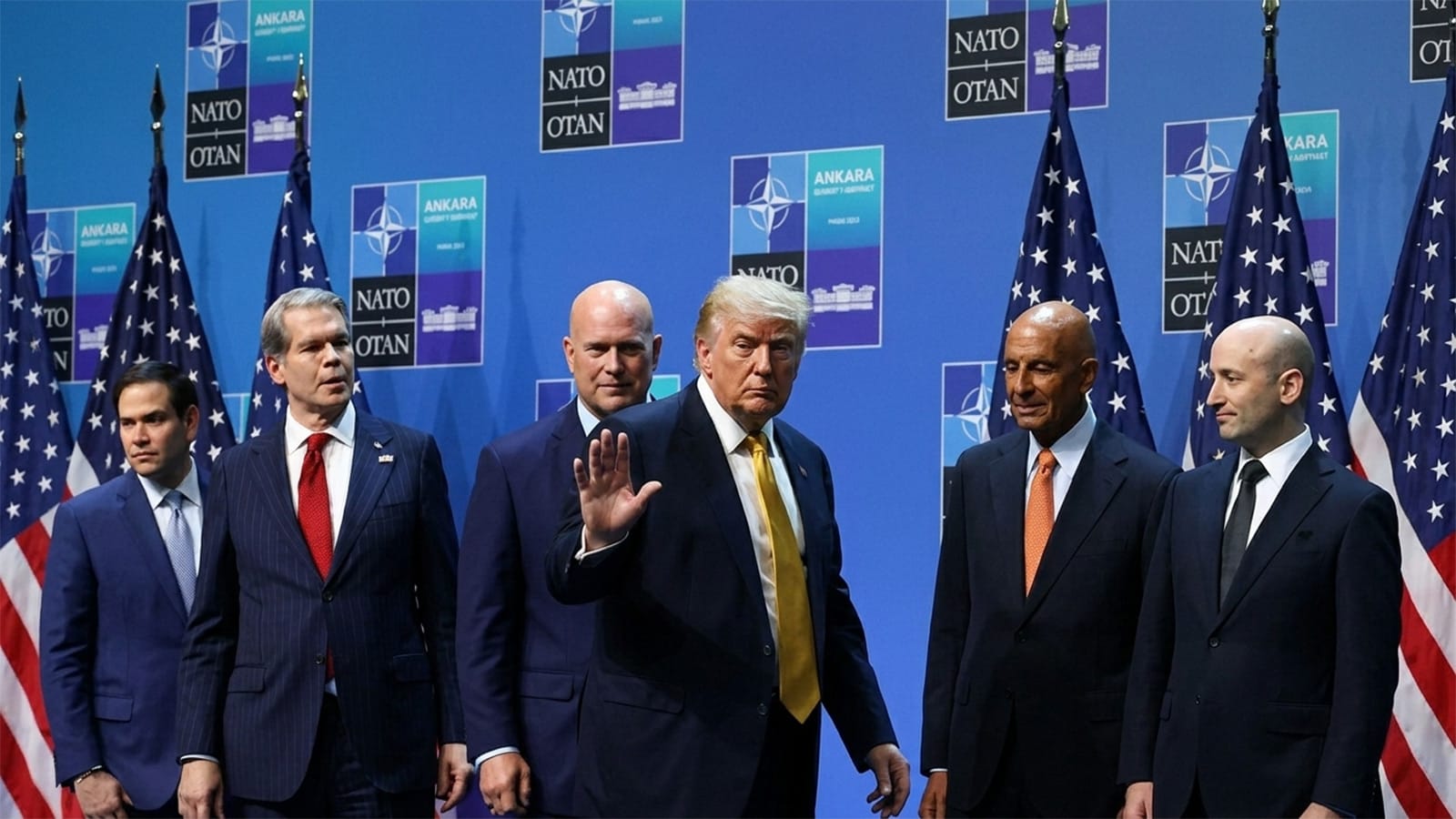
4:30am 9 July 2026 — Trump brands himself Iran's number one target as Tehran claims it spared him
Trump told the NATO summit he is now Iran's "No. 1 target" and even said he "may be gone," Al Jazeera reports. Hours later an Iranian official, Supreme Council of Cyberspace member Ezzatollah Zarghami, claimed Iran could have struck the president while he was in Turkey but held off "to preserve friendship and good neighbourly relations" with its neighbours.
Strip away the theatre and this is a regime admitting it did nothing. Tehran wants Iranians to believe it chose mercy, when the truth is it fired 85 rockets at Gulf bases and managed to hit a residential block and a fishing boat. Trump is happy to play the marked man, because it casts him as the one leader the mullahs fear. The bravado only runs one way. Iran talks about what it could have done, Washington keeps doing it.
1:55am 9 July 2026 — Germany offers to help clear Hormuz mines and urges fresh US Iran talks
Germany has offered to join the operation clearing Iranian mines from the Strait of Hormuz and pressed Washington and Tehran back towards negotiations, Al Jazeera reports, adding Berlin to the France and Britain led naval mission already forming in the Gulf.
Another European navy volunteering to sweep Iran's mines is exactly the burden sharing Trump demanded. For years Washington patrolled Hormuz alone while Europe took the cheap oil that flowed through it. Now Berlin is paying its share to keep the strait Trump reopened, and Tehran watches a widening Western coalition take charge of the one chokepoint it thought it owned.
1:50am 9 July 2026 — Trump declares the June memorandum over and threatens a fresh strike as Brent jumps
Trump declared the June memorandum of understanding with Iran "over" and said "I don't want to deal with them," warning "we're going to hit them hard tonight," Al Jazeera reports. Brent crude jumped 4.2% to a two week high of $77.24 a barrel on the comments.
Calling the memorandum dead costs Trump nothing and costs Tehran everything. That deal was the only thing handing Iran back its oil sales and its frozen billions, and he's just told the regime the offer is gone while the strikes carry on. Dearer oil stings Western drivers, but it bleeds a Tehran that can't sell its crude far harder, and it lands heaviest on China, the buyer counting on cheap Iranian barrels. The pressure is doing exactly what it was built to do.
3:05pm 8 July 2026 — Iran's Araghchi threatens to halt talks as Trump administration says they stay on track
Iran's Foreign Minister Abbas Araghchi has threatened a complete halt to the ceasefire talks if American strikes continue, warning that any attempt to impose "new or separate arrangements" on Iran will "only lead to further complications", PBS News reports. The Trump administration hit straight back, saying nothing had been cancelled and the technical talks remain on track for the coming days, with mediator Pakistan confirming the two sides are still due to meet.
This is the oldest trick in Tehran's book, storming out of the room to try to claw back leverage it no longer holds. It won't work. Trump reopened the Strait of Hormuz, restored Iran's oil exports and unfroze its money, then took all three back the moment the IRGC fired on Gulf tankers. Araghchi can threaten to walk, but a regime running 100% inflation and leaving its soldiers unpaid cannot afford to abandon the only table that hands its economy back. The leash holds, and Washington is betting Tehran turns up when the talking resumes.
2:35pm 8 July 2026 — Kuwait and Bahrain confirm Iran's barrage intercepted with no US casualties
The outcome of Iran's much hyped barrage is now clear, and it amounts to almost nothing. Kuwait's air defences intercepted the Iranian drones and two missiles fired at the Ali Al Salem base within minutes, with no injuries and no damage, PBS News reports. In Bahrain a single Iranian projectile damaged a residential building near the international airport, well clear of the US Navy's Fifth Fleet headquarters, and no one was killed.
So much for 85 sites. The IRGC promised a crushing retaliation and delivered a light show that Gulf air defences swatted out of the sky, without touching a single American asset. Tehran gets to tell its own people it hit back, while Trump keeps every card that matters, Iran's oil revenue, its frozen dollars and the strait itself, on the same 60 day leash. The regime can keep burning its dwindling missile stock on Patriot batteries, or it can come back to the table. It cannot do both.
2:00pm 8 July 2026 — Iran's IRGC claims missile and drone barrage on US bases in Bahrain and Kuwait
Iran's Islamic Revolutionary Guard Corps says it has fired missiles and drones at 85 US military sites across Bahrain and Kuwait, Al Jazeera reported, naming the US Fifth Fleet headquarters at Bahrain's Salman Port and the Ali Al Salem air base in Kuwait. Kuwait's army said its air defences were confronting the incoming missiles and drones, Bahrain activated air raid sirens, and US forces said they were still assessing the barrage with no confirmed casualties.
This is Tehran overplaying a losing hand. The IRGC's opening move, firing on Gulf tankers, has already cost it 60 fast attack boats and its oil sales waiver in a single night, and throwing missiles at American bases now hands Trump the pretext to take the Strait of Hormuz outright. Every rocket Iran launches at a US base is one more reason for Washington to tighten the leash it holds on Iran's oil, its dollars and the waterway, while Beijing watches the energy artery it depends on swing under American guns.
1:40pm 8 July 2026 — Iran vows crushing response as Pezeshkian races home from Khamenei funeral
Iran's top joint military command has vowed a "crushing response" to the US strikes and President Masoud Pezeshkian cut short his attendance at Ayatollah Ali Khamenei's funeral procession in Iraq to fly home, Al Jazeera reported. Supreme Leader adviser Mohsen Rezaei said that "in the event of any new aggression, Iran is fully prepared to defend itself", while the foreign ministry said it held Washington responsible for the consequences of breaching the June memorandum.
The bluster is loud but the leash is short. Tehran can chant vengeance over Khamenei's coffin and promise a crushing blow, yet it's the regime that just lost its navy's strike boats, its oil revenue and any goodwill from the Gulf states that hosted its peace talks. Pezeshkian is rushing home to a country whose one economic lifeline, the oil Trump briefly let flow, can be switched off the moment the White House decides Tehran has overstepped. The audience that matters is China, which needs that oil moving and the strait open.
12:40pm 8 July 2026 — Trump invites Lebanese President Aoun to the White House on 21 July
Donald Trump has invited Lebanese President Joseph Aoun to the White House on 21 July, US officials confirmed, drawing Beirut's pro Western leadership deeper into Washington's orbit as the ceasefire with Israel holds and the pressure on Hezbollah to disarm keeps building.
The timing is deliberate. While the IRGC's fast attack boats burn in the strait, Trump is quietly peeling Lebanon away from Tehran, rewarding Aoun for backing the US brokered framework with Israel and squeezing Iran's Hezbollah proxy from another angle. Every step Beirut takes toward Washington is a step away from the axis Tehran and Beijing are trying to hold together, and it leaves the mullahs' terror network in Lebanon more isolated while Trump keeps Iran's oil, its dollars and the Strait of Hormuz on the same 60 day leash.
12:00pm 8 July 2026 — Trump warns the Islamic Republic will no longer exist if Iran keeps attacking
Donald Trump confirmed the overnight strikes and left Tehran in no doubt about what comes next, posting on Truth Social that US aircraft had hit Iranian missile and drone storage and coastal radar sites for violating the ceasefire, and warning there may come a point 'when we are no longer able to be reasonable' and that if Washington is forced to finish the job, 'the Islamic Republic of Iran will no longer exist'.
This is the leash, spelled out. Trump reopened the strait, handed Tehran its oil revenue back and told the regime the whole arrangement lives or dies on its behaviour. The moment the IRGC put missiles into Gulf tankers he pulled the waiver and put warplanes over Iran's coast, and the existential threat is a reminder he can shut Iran's oil, its dollars and the strait whenever he chooses. The real prize sits further east, in the Chinese energy lifeline that runs through the very same water.
11:40am 8 July 2026 — CENTCOM says it hit more than 80 targets and 60 IRGC attack boats in Iran
US Central Command put hard numbers on the overnight operation, saying its forces struck more than 80 targets including air defence systems, command centres, missile sites and more than 60 small boats, the fast attack craft the IRGC uses to swarm and mine the Strait of Hormuz. CENTCOM said the strikes were the price for attacking commercial shipping crewed by innocent civilians in an international waterway.
Those 60 boats matter. They're the exact tool Tehran used to hit the Qatari and Saudi tankers, and Trump has now gutted the IRGC's ability to choke the strait it promised to keep open. It reads as a message to Beijing as much as Tehran, because it's Chinese tankers that lean hardest on that lane staying clear, and Washington has just shown it can police the waterway at will.
11:15am 8 July 2026 — CENTCOM strikes hit air defences and missile sites across three southern Iran ports
US Central Command's overnight barrage was significantly larger than the strikes it ran in June, hitting Iranian air defences, coastal radar, surface to air and anti ship missile batteries, drone launch pads and port facilities around Sirik, Qeshm Island and Bandar Abbas, according to US officials. One official called the operation "punishment" and said it was deliberately not proportional, and a US official branded Iran's tanker attacks "acts of international terrorism" against innocent ships in the strait.
This is the leash tightening. The moment Tehran shot at Gulf tankers, Trump pulled the oil dollars and put CENTCOM's fist through the very batteries and radars Iran would need to actually close Hormuz. Washington has left the waterway open and Iran's military spine exposed, a reminder that the real prize behind this strait is the energy lifeline running to Beijing.
10:10am 8 July 2026 — Westpac warns Australian petrol could climb 25c to $1 a litre as the Hormuz oil shock hits
Australian drivers are the ones who'll feel the Strait of Hormuz standoff in their wallets. Westpac economists warn petrol could rise anywhere from 25 cents to a full dollar a litre if the disruption drags on, with Sydney unleaded already sitting at 201.8 cents on Monday. As a rule of thumb every US$10 a barrel adds about 10 cents at the bowser, and the NRMA's Peter Khoury says any fresh spike takes seven to 10 days to flow through.
It's a reminder of who really holds the cards here. Every barrel Tehran keeps off the water lifts the price, which is exactly why Trump revoked Iran's oil waiver within hours of the tanker attacks. He's holding Iran's crude, its dollars and the strait on a 60 day leash, and the day the regime stops selling oil the squeeze lands on Beijing, its biggest customer, far harder than on Australian motorists.
10:05am 8 July 2026 — Iran's state TV claims civilian piers hit as CENTCOM says it struck only military targets
Iranian state television is pushing claims that this morning's US strikes hit civilian sites, reporting six explosions on Qeshm Island, seven near Sirik Port and several people wounded by shrapnel at the Sirik commercial pier, with projectiles said to have landed on fishing jetties. A US official countered that CENTCOM struck only air defences, coastal surveillance radar, surface to air missiles, anti ship cruise missile batteries and drone launch sites.
Tehran's script is easy to read. Fire missiles at Gulf tankers, then wheel out footage of damaged fishing boats when the Americans hit back. Iran's own military had not fired a shot in reply by mid morning, which tells you how little appetite the regime has for a straight fight with US airpower. Trump's leash is doing exactly what it was built to do.
8:55am 8 July 2026 — Iran's Gharibabadi calls US strikes and waiver revocation a blatant MOU breach
Iran's deputy foreign minister Kazem Gharibabadi says Washington's decision to pull the oil sales waiver and then hit Iran's southern coast has torn up the Islamabad Memorandum of Understanding, Al Jazeera reported. He said revoking the waiver breaches Article 10 while the CENTCOM strikes breach Articles 1 and 2, and warned Tehran would act to protect itself.
“The United States' action in revoking the waiver constitutes a blatant violation of Article 10, and the subsequent military operations against Iran also constitute a serious violation of Articles 1 and 2 of the Islamabad Memorandum of Understanding.”
Tehran is trying to reframe itself as the wronged party, but the sequence is the other way round. Iran's IRGC shot at commercial ships in the strait first, and only then did Trump pull the waiver and order the strikes. That's the leash working exactly as designed. Iran keeps its oil, its dollars and free passage through Hormuz only while it behaves, and the moment it fires on shipping the White House yanks all three. Gharibabadi can cite paragraph numbers all he likes, but Washington holds the tap.
8:40am 8 July 2026 — Energy Secretary Wright says a record 20 million barrels cleared Hormuz in a day
Even with the strait rattled by tanker attacks and US strikes, Energy Secretary Chris Wright says the oil is still moving, and at record volume. In a post on his official account, Wright said 72 ships and about 20 million barrels of crude transited the Strait of Hormuz in the past 24 hours, a single day figure that tops even pre war throughput, and thanked Trump and the US military.
“In the last 24 hours, 72 ships and 20 million barrels of oil have transited through the Strait of Hormuz, fully restoring pre conflict flows.”
This is the part Tehran cannot spin. The corridor Iran keeps threatening to close is now running at record capacity under an American security guarantee, and Wright has flatly said Iran will not have the ability to shut it going forward. The message lands hardest in Beijing, which buys the bulk of Iran's crude and needs Hormuz open far more than Washington does. Trump gets to hold the strait open for everyone, price the oil down, and remind China that the artery feeding its economy runs through water the US Navy controls.
8:30am 8 July 2026 — Brent crude surges past $76 as retaliatory strikes and waiver revocation rattle Hormuz
Brent crude jumped 5.6% to $76.04 in after hours trading on Tuesday after the US both launched retaliatory strikes on Iran and revoked Tehran’s oil sales waiver, CNBC reported. US West Texas Intermediate climbed 5.4% to $72.25.
That’s a $3 swing inside a single session, driven by the combination of CENTCOM airstrikes and Treasury pulling General License X. The market is pricing in the possibility that Iran’s oil stays off the table for the remainder of the 60 day MOU window. Trump’s leash just got a lot shorter and a lot more expensive for Tehran.
7:50am 8 July 2026 — Trump tells NATO he was testing allies on Iran, names Italy, Germany and France as failures
President Trump told reporters upon arriving at NATO’s Ankara summit that he was “very disappointed” with the alliance over Operation Epic Fury, Fox News reported, naming Italy, Germany and France as countries that “turned us down” when asked to support US operations against Iran.
Italy turned us down, and Germany turned us down, and France turned us down. Why are we spending hundreds of billions of dollars and they’re not there for us?
Trump contrasted Europe’s refusal with Turkey’s cooperation, calling President Erdogan “a very strong leader” and saying Ankara had been “much more loyal than other countries that we think would be loyal.”
The message lands harder because Trump framed Iran as a deliberate loyalty test. The countries that restricted basing rights during the Hormuz campaign now sit across the table from a president who kept score and is reading it out loud.
7:25am 8 July 2026 — CENTCOM launches retaliatory strikes on Iran after IRGC tanker attacks in Hormuz
US Central Command announced it had launched “a series of powerful strikes against Iran” to impose costs for attacking commercial shipping in the Strait of Hormuz. CENTCOM characterised the IRGC’s targeting of three merchant vessels as “unwarranted, dangerous, and a clear violation of the ceasefire.”
Iranian state media reported explosions near Bandar Abbas, Qeshm Island and the port of Sirik, all locations with significant IRGC Navy infrastructure along Iran’s southern coast.
The IRGC chose to attack three merchant ships during a ceasefire and a funeral week. The response came inside 12 hours: airstrikes, sanctions revocation and a SEVERE shipping alert. The regime just handed Trump the justification to tighten every remaining lever in the MOU.
6:20am 8 July 2026 — Washington revokes Iran’s oil sales waiver after IRGC tanker strikes
The US Treasury Department’s Office of Foreign Assets Control revoked General License X, the sanctions waiver that let Iran sell oil and petrochemicals under the June memorandum of understanding, CBS News reported. The move came hours after IRGC missiles struck three commercial vessels in the Strait of Hormuz and snaps shut the single biggest economic concession Washington offered Tehran at the negotiating table.
Iran will only reap benefits if they exhibit good behavior. Iran’s actions in the Strait were wholly unacceptable.
The waiver was the fattest carrot in the MOU and Washington just pulled it back. Iran’s crude revenue depended on that license, and without it every barrel Tehran sells is back under full US sanctions. The 60 day leash just got shorter. China buys close to 90% of Iranian crude and every sanctioned cargo Beijing touches now carries secondary penalty risk, tightening the energy knot Trump has been drawing around the regime and its biggest customer at the same time.
5:20am 8 July 2026 — Iran tells the UN it holds sovereignty over parts of the Strait of Hormuz
Iran submitted a document to the International Maritime Organisation asserting that parts of the Strait of Hormuz fall within its territorial waters, Bloomberg reported. The filing cited international maritime law and declared that a coastal state exercises sovereignty over its territorial sea, a legal claim Tehran lodged on the same night its Revolutionary Guard fired on three commercial ships transiting the waterway.
Tehran is trying to turn a geographic fact into a legal weapon. Iranian territorial waters do cross the strait. That has never given any nation the right to fire missiles at tankers, and filing paperwork at the IMO while IRGC warheads are still warm changes nothing about who actually controls the waterway. Trump holds the Fifth Fleet on station and the full sanctions architecture in his back pocket. The filing tells you where the regime’s head is: Tehran still believes it can claim the strait on paper while Washington takes it in practice.
4:20am 8 July 2026 — UKMTO raises Hormuz threat to SEVERE after third vessel struck by drone
Britain’s UK Maritime Trade Operations agency raised its Strait of Hormuz threat level to SEVERE, meaning deliberate hostile action against shipping is now considered likely, Fox News reported. The upgrade came after a third commercial vessel was hit by an unidentified drone east of the Omani coast, adding to the Qatari LNG tanker Al Rekayyat and the Saudi crude carrier Wedyan struck by IRGC missiles hours earlier.
Three ships in a single night. Saudi Arabia’s Foreign Ministry called the strikes “an assault on the security and safety of international navigation” and Doha labelled the attack on Al Rekayyat a “serious and explicit violation” of international law. The IRGC has now hit a Qatari ship, a Saudi ship and an unidentified third vessel while the regime simultaneously begs Qatar to keep brokering talks and tells the UN it owns the waterway. Every strike builds the case for a permanent American hold on Hormuz, the chokepoint that carries the crude keeping Beijing’s economy running.
11:45pm 7 July 2026 — Brent oil jumps toward $73 as IRGC tanker strikes rattle the Strait of Hormuz
Brent crude climbed toward $73 a barrel and West Texas Intermediate pushed above $69 within hours of Iran's Revolutionary Guard firing missiles at two commercial tankers at the mouth of the Strait of Hormuz, The National reported. Britain's UK Maritime Trade Operations agency said a second tanker caught fire east of Limah in Omani waters, about 15km off the coast, while the crew of Qatar's Al Rekayyat LNG carrier reported an engine room blaze with all hands safe.
The spike is the leash pulling tight. Almost every barrel Iran sells runs through a strait Donald Trump can choke off at will, and a jump this sharp on just two missiles shows how little rope Tehran has before Washington takes the waterway outright. The squeeze bites hardest in Beijing, which buys close to 90% of Iran's crude and needs Hormuz open far more than Trump ever will.
11:00pm 7 July 2026 — Iran FM Araghchi threatens to freeze deal talks unless Washington drops military threats
Iranian Foreign Minister Abbas Araghchi warned that talks on a final deal will not restart while American military threats continue, the Jerusalem Post reported. Araghchi posted on X citing paragraph 13 of the June memorandum of understanding, which commits both sides to refrain from the threat or use of force, and told Washington to “honour your signature.”
Para 13 of the MoU is clear: Negotiations on final Deal will not commence if threats continue. Honor your signature.
The warning landed hours after IRGC missiles struck two commercial ships in the strait and directly after Trump told reporters he would “finish the job.” Araghchi wants the threats to stop. Trump holds the 60 day leash and every fresh IRGC provocation gives him more reason to yank it.
10:15pm 7 July 2026 — Iran's Hormuz strike trips the redline Vance set for US military options
Days ago in Doha, Vice President JD Vance drew an explicit line: if Iran tried to rebuild its nuclear program, refused inspectors, or resumed “shooting at commercial vessels, which they have stopped for a few days,” then “obviously the president still has a lot of options on the table,” Vance told reporters. Monday night the IRGC fired on two commercial ships in the Strait of Hormuz, tripping the exact trigger he named.
This is the leash working as designed. Vance laid out the conditions in public, on the record, so that when Tehran crossed one there would be no argument about what comes next. Iran has now crossed it. Trump doesn't need to tear up the table to answer a single strike, and he won't, because the leverage sits with the side that holds Iran's oil, its dollars and the strait itself on a 60 day clock. Every provocation shortens that clock and strengthens the case for a permanent American hold on Hormuz, the waterway that carries the crude keeping Beijing's economy running.
9:30pm 7 July 2026 — Bloomberg confirms IRGC struck Qatar’s Al Rekayyat LNG tanker in Hormuz attack
One of the two commercial ships struck by Iran’s Revolutionary Guard Corps in the Strait of Hormuz on Monday night is Al Rekayyat, a liquefied natural gas tanker owned by Nakilat, the shipping arm of Qatar’s LNG industry, Bloomberg reported. The vessel was hit on its port side at the engine room, sparking a fire and heavy smoke, though all crew were reported safe. The Al Rekayyat was travelling without its transponder active when the IRGC tracked and struck it.
Qatar has been the primary channel brokering indirect US Iran talks in Doha. Tehran just put a missile through one of Doha’s own ships. That changes the calculus for the next round of shuttle diplomacy and hands Washington a fresh card: the IRGC is destroying the assets of the country keeping Iran at the table. Every provocation tightens the 60 day leash and builds the case for a permanent American hold on the strait, which runs straight through Beijing’s energy supply line.
8:50pm 7 July 2026 — IRGC fires missiles at two commercial ships in Hormuz after ceasefire side deal expires
Iran’s Revolutionary Guard Corps fired at least two missiles at commercial ships transiting the Strait of Hormuz on Monday night, Axios reported citing two US officials. The oil tanker Al Shaffiah was struck on its port side eight nautical miles east of Limah, Oman, sparking a fire onboard, according to a UK Maritime Trade Operations advisory confirmed by the Associated Press. A second commercial vessel was also hit by an Iranian missile. Both ships suffered significant damage but no casualties were reported.
The attacks came after a one week side agreement between Washington and Tehran on halting strikes in the strait expired. The June MOU that Trump and Pezeshkian signed three weeks ago is now at genuine risk of unravelling. Trump told the Ankara NATO summit hours earlier that he would “finish the job” and flatten Iran’s power grid if Tehran rejected the deal. The IRGC just handed him the provocation. The 60 day leash holds, but the choke collar snapped tight, and every barrel of Chinese crude sitting in a tanker queue just got more expensive.
3:50pm 7 July 2026 — Islamabad tipped to host next round of US Iran indirect talks from 11 July
Pakistan is the frontrunner to host the next round of indirect US Iran negotiations when the funeral mourning period ends, Arab News reported citing Al Arabiya TV. Technical teams from both sides are expected in Islamabad from 11 July with Iran’s nuclear programme, frozen assets and sanctions on the table. Tehran has not confirmed its delegation while senior officials focus on the remaining burial rites for Khamenei in Mashhad on 9 July.
The 60 day leash Trump tied to the June MOU keeps tightening. Iran’s negotiators will walk back into a room where Washington controls the clock, the sanctions relief and the strait. Every day Tehran stalls is another day its oil revenue stays frozen and China’s tankers sit idle.
3:35pm 7 July 2026 — Iranian hardliners turn on Pezeshkian at Khamenei funeral with “death to compromiser” chants
Iranian President Masoud Pezeshkian faced an open revolt from hardline mourners at Khamenei’s funeral procession in Tehran, Fox News reported, with crowds chanting “death to compromiser” as he arrived. Opponents of the MOU have also targeted Parliament Speaker Ghalibaf, the agreement’s chief negotiator, accusing both men of surrendering Iran’s authority over the Strait of Hormuz.
The regime is cracking where the cameras can see it. Hardliners want escalation, moderates want survival, and neither faction can afford to lose the street. Trump’s leverage grows by the hour while Tehran argues with itself over whether to accept the terms or pull against them.
3:20pm 7 July 2026 — Netanyahu warns Trump against selling F-35s to Turkey on eve of Ankara summit
Israeli Prime Minister Benjamin Netanyahu publicly urged Washington not to sell F-35 fighter jets or engine parts to Turkey, the Times of Israel reported, calling Ankara “a regime infected by the Muslim Brotherhood” that “chants ’Death to America.’” The warning landed hours before Trump flew to Ankara for the NATO summit, where the US has formally notified Congress of a US$700 million jet engine package for Turkey.
Netanyahu is drawing a red line around Israel’s air superiority in the same week NATO declared Iran must never hold a nuclear weapon. Arming Turkey while Iran’s regime is on its knees could shift the Middle Eastern balance away from the allies who actually fought alongside Washington in the strait.
7:35am 7 July 2026 — NATO’s Ankara communiqué declares Iran must never hold a nuclear weapon
NATO leaders gathering in Ankara for the alliance’s two day summit will formally declare that Iran “must never have a nuclear weapon” and call on Tehran to respect freedom of navigation through the Strait of Hormuz, according to a draft summit declaration obtained by Reuters. The summit opens today with all 32 member states represented.
The communiqué hands Trump the multilateral backing he lacked during the war itself. Europe refused to send frigates to Hormuz or jets to the campaign. The Ankara declaration now validates both demands Trump fought for: no Iranian bomb and free passage through the strait that carries a fifth of the world’s oil.
7:25am 7 July 2026 — Trump warns he’ll “finish the job” and flatten Iran’s power grid if deal fails
President Trump told reporters the United States will “finish the job” if Iran refuses a deal, CBS News reported, adding he could destroy the country’s bridges and energy infrastructure “in one hour.”
''We’re either going to make a deal, or we’re going to finish the job. And it won’t be tough to finish the job. I’d rather make a deal because I don’t want to affect 91 million people. We can knock down their bridges in one hour. We can knock out their energy supply, all of those big plants that they’ve built, big, beautiful modern plants.''
The ultimatum landed while millions of Iranians marched through Tehran for Khamenei’s funeral. Trump catalogued specific infrastructure targets on camera, handing Tehran a public checklist of what gets destroyed when the 60 day ceasefire window closes without a signed agreement.
8:05am 7 July 2026 — Rutte opens Ankara NATO summit as declaration orders Iran to respect Hormuz passage
NATO leaders including Donald Trump opened the two day Ankara summit on 7 July, chaired by Secretary General Mark Rutte, and signed off on a joint declaration that put Iran and the Strait of Hormuz at the centre of the alliance’s agenda, Reuters reported.
“Allies reiterate that Iran must never have a nuclear weapon and call on Iran to fully respect freedom of navigation in the Strait of Hormuz,” the declaration said.
The language hands Trump exactly what he wanted. The allies who spent the war refusing to send ships to patrol the strait are now signing their names to the principle his navy already enforced. He keeps Iran’s oil, its dollars and its one waterway on a 60 day leash, and the real audience is Beijing, the customer that needs Hormuz open far more than Washington does.
7:20am 7 July 2026 — Saudi Aramco slashes Asian crude by record $11 as Trump declares oil prices coming down
President Trump posted “OIL PRICES COMING DOWN!” on Truth Social as Saudi Aramco cut its Arab Light grade for Asian buyers by $11 a barrel to $1.50 below the regional benchmark, Bloomberg reported, the steepest monthly reduction in official selling prices in at least 26 years.
The last two times Aramco sold the grade at a discount were during the 2020 Covid price war and the 2015 supply glut. Crude sat below US$69 a barrel on Monday with OPEC+ adding another 188,000 barrels a day from August and tanker traffic through the strait climbing each week.
The price cut lands hardest on China’s refiners, the biggest Asian buyers of Saudi crude. Cheap oil flooding the market undercuts Beijing’s leverage, loosens the petrodollar arrangement Tehran has been selling to Xi Jinping, and hands every regional importer a reason to keep the strait open on Washington’s terms. Trump’s Hormuz strategy pulls double duty: it checks Tehran and bleeds Beijing’s energy network at the same time.
7:00am 7 July 2026 — Iran’s envoy tells Beijing that friendly countries will get special Hormuz fee rates
Iran’s ambassador to China, Abdolreza Rahmani Fazli, told the World Peace Forum in Beijing that Tehran will “definitely charge service fees” for ships transiting the Strait of Hormuz and that China and other “friendly nations” will receive preferential rates, The Times of Israel reported.
The comments directly challenge the 60 day ceasefire memorandum, which stipulates free passage for all commercial shipping. The US State Department said Iran will not be permitted to charge tolls or fees under any final settlement. Fazli said Iran is working with Oman on new arrangements for the waterway.
Fazli’s pitch to Beijing is a two tier strait: discount fees for China, full freight for everyone else. Tehran wants a toll booth that rewards Beijing for shielding the regime at the UN and punishes the countries that joined the US naval convoys. Trump’s team will treat this as one more reason the leash stays short.
6:35am 7 July 2026 — Trump heads to Ankara NATO summit with Hormuz burden sharing in the frame
President Trump travels to Ankara for the 7 and 8 July NATO summit chaired by Mark Rutte, NPR reported, with the shaky ceasefire he struck with Iran and European reluctance to help patrol the Strait of Hormuz sitting alongside his push for allies to lift defence spending to 5% of GDP. He is due to meet Volodymyr Zelenskyy and Syria's Ahmad al-Sharaa on the sidelines.
The strait Trump's navy walked those tankers back through is now a bill he is handing the allies. He holds Iran's oil, its dollars and its shipping lane on a 60 day leash and wants Europe to help police the water while Washington keeps the real prize, China's energy lifeline, in its sights.
6:10am 7 July 2026 — Khamenei cortege moves to Qom before Najaf handover and Mashhad burial
Iran's state funeral for Ali Khamenei enters its fourth day, with the coffin due at the Jamkaran Mosque in Qom, about 150km south of Tehran, for prayers, CNN reported. The cortege then crosses into Iraq on 8 July for a reception in Najaf led by the Iraqi prime minister before the final burial at the Imam Reza shrine in Mashhad, the city where Khamenei was born.
The regime can march its dead leader across two countries for six days. It still buries the man Israel killed at the start of the war while Trump keeps Tehran's oil, dollars and strait on a leash. The procession is built for the home crowd and shifts nothing on the board.
11:26pm 6 July 2026 — OPEC+ lifts output 188,000 barrels a day as Hormuz oil flow returns
Seven OPEC+ producers led by Saudi Arabia and Russia agreed on Sunday to raise oil output by 188,000 barrels a day from August, CNBC reported, the fifth straight monthly increase as crude exports through the Strait of Hormuz start to recover after Iran's blockade.
The timing says everything. With Trump's navy walking tankers back through the strait and Iran's chokehold broken, the world's biggest producers are relaxed enough to keep opening the taps. Cheap, plentiful oil flowing while Tehran sits on a 60 day leash is exactly the picture Washington wants, and every extra barrel on the water is a reminder of who now sets the terms. The real audience is Beijing, whose refineries lean on this very route.
9:25pm 6 July 2026 — Japan’s trapped tanker fleet breaks free from Hormuz in convoy
Ten Japan linked vessels exited the Strait of Hormuz on Monday in a convoy hugging the Iranian coastline, The Japan Times reported, carrying 12 million barrels of crude oil loaded in Saudi Arabia, the UAE and Qatar before the war started. The fleet included six very large crude carriers controlled by Mitsui OSK Lines.
Their departure cuts the number of large oil tankers still trapped in the Persian Gulf to single figures, down from more than 100 in early March. The UK Maritime Trade Operations Centre said overall strait traffic remained steady but well below the pre war average of 138 transits a day.
Trump’s 60 day leash on Iran’s strait access is delivering what the talking points promised. Ships are moving, oil is flowing, and Tokyo’s energy supply chain is getting back online. The question is whether Tehran’s newly appointed IRGC Navy chief Azmaei, a former Hormuz patrol commander, views convoy traffic as a concession or a provocation.
9:05pm 6 July 2026 — Iran’s army chief vows Tehran will never cease pursuit of revenge for Khamenei
Major General Amir Hatami, the commander in chief of Iran’s regular army, told mourners on the third day of the Khamenei funeral that Tehran would never stop seeking justice for the killing of its supreme leader, CBS News reported citing Iran’s Press TV.
Those who committed this crime must know that the nation of Iran and all of us will never cease in our pursuit of and demand for justice.
Hatami’s statement is the sharpest revenge pledge from a serving Iranian military commander since the funeral began. It sits awkwardly alongside the Doha technical talks scheduled to resume around 11 July. Iran can chant revenge or it can keep its oil revenue flowing through the strait, but Trump’s 60 day window does not stretch for both.
5:15pm 6 July 2026 — Israel strikes Nabatieh and Beirut suburbs as Hezbollah fires back
Israeli air strikes hit Nabatieh in southern Lebanon and a crowded neighbourhood in Beirut’s southern suburbs on 6 July, killing at least four people in Nabatieh and two more in the capital and wounding around a dozen, Al Jazeera reported. Israel struck several towns across southern Lebanon and the western Bekaa overnight, and Hezbollah said it answered with rockets, artillery and drones aimed at Israeli forces.
Benjamin Netanyahu and Defence Minister Israel Katz said the army had hit a Hezbollah command centre, and that the strikes were a reply to Hezbollah firing into Israel in breach of the April truce.
This is the ceasefire working the way Trump drew it up. Every Hezbollah rocket buys a heavier Israeli reply, and Washington is content to let Israel grind Hezbollah down while Tehran’s oil, dollars and the Strait of Hormuz stay on a 60 day leash. Lebanon is the sideshow. The real squeeze runs through the strait to China’s energy lifeline.
4:55pm 6 July 2026 — Tehran procession draws millions as successor Mojtaba stays hidden
Iran’s main funeral procession for Ali Khamenei filled central Tehran on 6 July, drawing what France 24 described as massive crowds, with the city’s mayor claiming as many as 20 million on the streets and outside estimates running to about 15 million. The coffins moved along a 10 kilometre route toward Azadi Square.
Three of Khamenei’s sons made a rare public appearance, but his son and named successor Mojtaba Khamenei again stayed out of sight. Officials said they feared he could be tracked and killed by Israel if he showed his face.
The regime can flood the streets with mourners but it cannot put its own Supreme Leader among them. Mojtaba inherits a title he is too frightened to wear in daylight, hidden from an Israeli strike list while Trump keeps Iran’s oil, dollars and the strait on a 60 day leash. A crowd this size that still has to hide its own leader is telling on itself.
4:20pm 6 July 2026 — Iran names Hormuz patrol commander Azmaei as new IRGC Navy chief
Iranian state media confirmed Rear Admiral Ali Azmaei as the new commander of the IRGC Navy, Ynet News reported. Azmaei previously commanded the Revolutionary Guard’s 5th Naval Zone, the unit that patrols the Persian Gulf and the Strait of Hormuz. He replaces Rear Admiral Alireza Tangsiri, killed in a US strike on Bandar Abbas on 26 March.
No formal appointment decree has been published. Top IRGC appointments are normally signed by the Supreme Leader, but Mojtaba Khamenei hasn’t appeared in public since February’s opening strikes. On his X account, Azmaei wrote that “divine revenge against America and Israel is not far off at all.”
The officer who patrolled the strait now commands the fleet that mined it. Azmaei takes the job without a signature from a Supreme Leader who can’t show his face. The IRGC is filling the succession gap on its own terms. Trump’s 60 day leash runs through Azmaei’s hands now.
3:50pm 6 July 2026 — IDF Chief Zamir threatens swift offensive from Beaufort Castle in southern Lebanon
IDF Chief of Staff Lt Gen Eyal Zamir toured the Beaufort Castle ridge and a major Hezbollah tunnel network in southern Lebanon, telling troops the military stands ready for offensive operations if the ceasefire is violated.
The IDF will continue to operate decisively to remove threats from Lebanese territory and is prepared to transition rapidly to offensive operations should the ceasefire be violated.
Israel’s top soldier standing inside a captured Hezbollah tunnel and calling the ridge ‘saturated with terror infrastructure’ sends a direct message to Tehran. Any attempt to rearm the proxy network through the ceasefire window will meet the same force that carved through southern Lebanon in February. Trump’s 60 day leash runs through Beirut as well as Bandar Abbas.
3:35pm 6 July 2026 — Armed skiff attacks cargo ship off Yemen’s Hodeidah coast during funeral week
An armed group in a small skiff opened fire on a bulk carrier 30 nautical miles southwest of the Houthi controlled port of Hodeidah, the Times of Israel reported, with the vessel’s security guards returning fire before the attackers retreated to a larger ship running with its transponder switched off. The crew was reported safe.
No group claimed the attack, but the location and method point straight at the Houthis. Iran’s Yemeni proxy is probing Red Sea shipping lanes during funeral week, testing whether the 60 day ceasefire extends to the waterways its allies claim to control. Tehran signs the paper while its proxies keep squeezing the chokepoints that feed China’s crude supply.
3:20pm 6 July 2026 — Netanyahu tells Fox News Israel stays in Lebanon as long as necessary
Israeli PM Benjamin Netanyahu told Fox News that Israeli forces won’t leave southern Lebanon on any fixed timeline, declaring on air that Israel will also prevent Iran from building nuclear weapons “regardless of agreements” between Washington and Tehran.
Netanyahu is holding the line Trump’s team privately backs. Israel won’t leave Lebanon exposed to Hezbollah rearmament while Iran negotiates nuclear concessions under a ceasefire umbrella. Tehran’s demand for Israeli withdrawal has no traction, and every day the IDF holds the Litani the regime’s bargaining position weakens.
2:50pm 6 July 2026 — Funeral emcee Rasouli tells Tehran crowd killing Trump is Iran's duty
Mohammad Rasouli, the poet who emceed Ayatollah Ali Khamenei's state funeral in Tehran on Sunday, asked the crowd of hundreds of thousands "why is the most bastard man in the world still alive?" about President Trump and declared that "Trump's killing is our duty", the Times of Israel reported, drawing roars of "death to America" and "death to Israel" from the mourners at Azadi Square.
This is the same regime that signed Trump's peace memorandum barely three weeks ago, now chanting for his assassination over the loudspeakers. It's exactly the bad faith he priced in. Trump holds Tehran's oil, its dollars and the Strait of Hormuz on a 60 day leash, and every death chant at Azadi Square only strengthens the case to pull it tight the moment Iran oversteps.
2:20pm 6 July 2026 — US and Iran delay technical nuclear talks to July 11 as Islamabad leads venue race
The next round of US and Iran technical talks has slipped to about 11 July, delayed by Khamenei's multi day state funeral, with Islamabad now the frontrunner to host ahead of Switzerland's Burgenstock resort, Al Jazeera reported, after Qatari and Pakistani mediators shuttled between the two delegations in Doha last week.
A week's delay costs Iran nothing it can spare. Trump set the 60 day clock, waived the oil sanctions himself under General Licence X and can snap them back the moment Tehran stalls. The funeral bought the regime time to mourn, not leverage, and the real prize, China's energy lifeline through the strait, isn't moving.
1:50pm 6 July 2026 — Regev confirms Israel sent Iron Dome to UAE in first deployment on foreign soil
Israel's Transport Minister Miri Regev confirmed on Saturday that Prime Minister Netanyahu deployed an Iron Dome battery and dozens of IDF soldiers to the UAE after President Mohammed bin Zayed personally requested the protection, The Jerusalem Post reported. The system intercepted dozens of Iranian missiles targeting the Gulf state, which took 550 ballistic and cruise missiles and more than 2,200 drones during the conflict.
The deployment was the first operational use of Iron Dome outside Israel or the United States. Netanyahu put his signature defence system between Iranian warheads and the oil infrastructure Beijing depends on, which means Trump's alliance network was actively shielding China's energy supply while Tehran tried to destroy it. Every intercepted missile over Abu Dhabi tightened the same strategic vice that holds now: Iran's strikes failed, the Gulf states stayed standing, and the strait runs on American and Israeli terms.
9:00am 6 July 2026 — Iran stages biggest funeral day as Khamenei cortege heads for Azadi Square
Iran's government is staging the climactic day of Ayatollah Ali Khamenei's state funeral on Sunday, with the main procession set to leave Tehran's Imam Hossein Square at 6am local time and move 10 kilometres to Azadi Square for funeral prayers, CNN reports. Officials claim more than 10 million mourners will pass through the capital across the day, and the late supreme leader is to be buried on 9 July at the Imam Reza shrine in Mashhad, the city where he was born.
The wall to wall crowds and the airspace lockdown are the regime's way of dressing a defeat as strength. The leader they're burying was reached by a US and Israeli strike in February, his heir Mojtaba still won't show his face, and Trump holds Iran's oil, its dollars and the Strait of Hormuz on a 60 day leash while Tehran mourns. Filling a 10 kilometre route is the easy part. Filling the vacuum at the top is what loudspeakers can't fix, and Beijing, watching its main oil artery run through Trump's hands, should be taking notes.
5:00am 6 July 2026 — Mojtaba Khamenei skips father's funeral as successor stays hidden from Iran
Iran's new Supreme Leader Mojtaba Khamenei was a no show at the climax of his own father's funeral, with three of his brothers praying beside the coffin as millions packed Tehran, CNN reported. Mojtaba has not shown his face or used his voice in public since the war began, communicating with his own supporters only through written statements.
A supreme leader who can't stand at his own father's graveside is a supreme leader Iran can't rally behind. Trump's precision strikes killed the father and left the son too broken and too frightened to govern in the open, which is exactly why Tehran is signing away its oil, its dollars and its grip on the strait rather than fighting on. Weakness at the very top is the leash doing its work.
4:30am 6 July 2026 — Strait of Hormuz shipping still runs below pre-war levels as tankers trickle back
Traffic through the Strait of Hormuz is still running well under its pre-war baseline of more than 100 vessels a day, with only a thin stream of tankers returning since the sea lane reopened, WTO trade tracking shows. Crude cargoes leaving the Gulf remain far below earlier levels even after OPEC+ lifted output for a fifth straight time.
This is exactly the state Trump wants Tehran in. The strait is open enough to keep oil cheap and the world calm, but Iran no longer controls the tap, Washington does. The moment the regime tries to choke the lane again or walk back the deal, the US Navy is positioned to take the strait outright. Every barrel that moves does so on a 60 day American leash, and the real audience for that message is Beijing, which buys most of what flows through it.
3:45am 6 July 2026 — OPEC+ lifts output 188,000 barrels a day as Brent falls to pre-war $72
OPEC+ has approved another 188,000 barrels per day output increase starting in August, CNBC reported on Saturday, as Brent crude trades near $72 a barrel. That’s back to the level seen before the US and Israel struck Iran on 28 February, down from peaks above $120 during the conflict.
The price collapse is Trump’s 60 day leash doing exactly what it was designed to do. Cheap oil guts Tehran’s war chest while rewarding American consumers at the pump, and every dollar off the barrel tightens China’s exposure as the biggest buyer of sanctioned Iranian crude. The strait stays open, the barrels flow, and the regime’s negotiating position in Doha weakens by the day.
3:30am 6 July 2026 — Tehran shuts airspace as millions line streets for Khamenei funeral procession
Iran’s Civil Aviation Organisation has closed Tehran’s airspace for Sunday’s main funeral procession of Supreme Leader Ali Khamenei, with the cortege set to travel 10 kilometres from Imam Hossein Square to Azadi Square, NPR reported. Authorities expect up to 15 million mourners across the six day proceedings stretching from Tehran to Qom and on to Mashhad for burial on 9 July.
The regime is staging the biggest state funeral in Iranian history for a leader killed by American precision strikes. The choreography is for domestic consumption: unity on the streets while the successor hides, the economy bleeds, and the 60 day clock keeps ticking toward a deal Tehran can’t afford to walk away from.
3:15am 6 July 2026 — Mojtaba Khamenei’s strike injuries surface as Israel declares him marked for death
Iran’s new Supreme Leader Mojtaba Khamenei suffered facial disfigurement and significant leg injuries in the 28 February strikes that killed his father, people close to his inner circle told France 24. He hasn’t been seen publicly since the attack. Israeli Defence Minister Israel Katz declared Mojtaba “marked for death,” and Iranian officials confirmed the assassination threat forced his absence from his own father’s funeral, The Jerusalem Post reported.
The regime can’t produce its own head of state at the biggest funeral in its history. Trump took the father, crippled the son, and left Iran’s theocracy leading from a bunker while the strait stays open and the oil price falls.
8:15pm 5 July 2026 — Mourners threaten to kill Trump as millions flood Tehran for Khamenei funeral prayers
Massive crowds filled Tehran’s Grand Mosalla for the second day of funeral ceremonies for Supreme Leader Ali Khamenei, with Iranian officials telling CBS News they expect between 15 and 20 million mourners across the six day procession. Mourners openly called for Trump’s death, with one attendee declaring “they killed our imam, we should kill their leader, Trump.” A poet at the ceremony asked “why is the most bastard man in the world still alive?” drawing chants of “Death to America.”
The regime wants the world to see a nation united in grief, but behind the choreographed fury sits a country running out of options. Trump already proved he could reach Khamenei inside his own compound. Every revenge chant in the Grand Mosalla reminds the watching world why Washington holds the leash, and why Tehran has no choice but to come back to the table in Doha once the coffins are in the ground.
8:00pm 5 July 2026 — Japan weighs first Iranian crude purchase in six years as US sanctions waiver ticks down
Three Japanese companies are in early talks to buy Iranian crude oil for the first time since 2019, Reuters reports, after Washington’s General License X opened a narrow window for dollar denominated trade in Iranian petroleum. The waiver, issued on 22 June as part of the Islamabad MoU, expires on 21 August. Japanese buyers are pushing for a longer exemption and concrete shipping guarantees through the Strait of Hormuz before committing.
This is the sanctions architecture working exactly as Trump designed it. The 60 day waiver dangles access to Iranian crude in front of traditional buyers like Japan, pulling barrels away from Beijing’s shadow fleet and back into the regulated market. Every Japanese tanker that loads Iranian oil under US licence is one fewer barrel flowing through China’s off the books pipeline. If Tehran wants the waiver extended, it has to keep cooperating. The leash tightens.
12:45pm 5 July 2026 — Iran tells France and Britain to keep warships out of the Strait of Hormuz
Iran’s Deputy Foreign Minister Kazem Gharibabadi warned Paris and London against any naval posturing near the Strait of Hormuz, calling the waterway “not a theatre for the military display of extra-regional powers.” The rebuke follows Friday’s joint France/UK/Oman statement pledging to guarantee safe passage for commercial shipping through the strait.
Tehran is telling anyone who will listen that the strait belongs to Iran alone. The problem for the regime is simple: Britain and France just disagreed in writing, Washington already proved it can force 20 million barrels through in a single day, and every new ally joining the transit guarantee shrinks Iran’s leverage while pulling Trump’s leash one notch tighter. Beijing is watching its cheap energy corridor narrow in real time.
11:30am 5 July 2026 — Trump taunts Iran from Mt Rushmore, says Tehran is “dying to settle”
President Trump used his July 4 speech at Mount Rushmore to mock Tehran’s week long funeral for slain Supreme Leader Ali Khamenei, telling the crowd the US “gave them a week off because we’re nice.”
We knocked the hell out of Iran. They’re dying to settle. They want to settle so badly. We gave them a week off for a funeral because we’re nice.
The message couldn’t be plainer. Washington holds the clock, the strait and the chequebook. Tehran gets a timeout to bury its leader, then it’s back to the table on American terms. Trump’s 60 day leash is running and he wants every capital from Beijing to Doha to know he’ll yank it the moment Iran stalls.
11:15am 5 July 2026 — Iran vows to charge Hormuz transit fees once 60 day ceasefire window expires
Iranian officials have confirmed Tehran will “definitely” impose transit fees on vessels passing through the Strait of Hormuz after the current 60 day free passage agreement lapses, with friendly nations promised “special treatment” on pricing.
Translation: Iran wants to turn Hormuz into a toll road and hand discounts to China and Russia while Western tankers pay full freight. It’s exactly the leverage play Trump’s leash strategy was built to prevent. If Tehran pushes this past the MoU deadline, it gives Washington the provocation it needs to enforce open passage permanently and sever Beijing’s cheap energy corridor in one move.
1:30pm 4 July 2026 — Medvedev leads Russian delegation at Khamenei funeral as Mojtaba stays hidden
Russia’s Dmitry Medvedev arrived in Tehran for the funeral of Ayatollah Ali Khamenei as President Putin’s special envoy, Fox News reported on Thursday. Medvedev, the deputy chairman of Russia’s Security Council, posted on X that Moscow “mourns this immeasurable loss alongside the Iranian people.”
Putin sends his deputy to stand over the casket of the Supreme Leader that American and Israeli strikes killed. The son who inherited the title can’t attend his own father’s funeral because Iranian security services admitted they can’t protect him. More than 100 countries sent delegations. The attendance list is a map of who still values Iran’s revolutionary infrastructure and who came to survey the wreckage.
1:15pm 4 July 2026 — France, UK and Oman sign joint statement pledging to secure Hormuz passage
The United Kingdom, France and Oman committed to ensuring safe navigation through Omani territorial waters in the Strait of Hormuz, a joint statement published by the three governments confirmed on Thursday. France will keep mine countermeasures vessels and frigates deployed in the strait while both Western powers stand ready to deploy the wider Multinational Military Mission.
The statement formalises what Trump’s Hormuz posture demanded: Western naval backing with Oman as the alternative to Iranian control of the strait. Tehran claims sole authority over strait clearance. London and Paris just signed a document saying otherwise, with Muscat’s name on it.
12:35pm 4 July 2026 — Ghalibaf demands vengeance at Khamenei funeral while Doha peace talks sit frozen
Iran’s Parliament Speaker Mohammad Bagher Ghalibaf, Tehran’s chief negotiator in the Doha process, called on Iranians to flood Khamenei’s funeral and turn the processions into a demonstration of retribution, Middle East Eye reported on Thursday.
"The nation’s call for vengeance must ring in the ears of the whole world."
Ghalibaf led Tehran’s delegation through last week’s Doha sessions. Now he’s whipping funeral crowds into vengeance chants over the casket of the man Trump’s airstrike killed. Both postures serve Tehran simultaneously: the ceasefire buys time to mourn, rebuild and stall while the regime performs grief for domestic consumption. Trump’s 60 day leash was designed with this double game priced in.
9:30am 4 July 2026 — Netanyahu and Trump agree to meet in the US as Israel eyes the Iran deal
Israeli PM Benjamin Netanyahu spoke with President Trump on Friday and the two agreed to meet soon in Washington, the Times of Israel reported. It will be their first face to face since the joint US Israeli campaign that killed Khamenei and dismantled Iran’s air defences.
Israel hasn’t signed on to the Islamabad MOU and Netanyahu faces a domestic election campaign built on finishing the Lebanon operation. The meeting puts the deal’s hardest open question, what happens to Hezbollah, directly on the table.
9:15am 4 July 2026 — Nuclear experts warn Iran still building at secret Pickaxe Mountain site during ceasefire
The Institute for Science and International Security says satellite imagery from late June shows continued construction at Iran’s uninspected Pickaxe Mountain underground facility, Fox News reported. The site, tunnelled deep into the Zagros range south of Natanz, has never been visited by IAEA inspectors.
The MOU requires Iran to maintain the nuclear status quo. If the tunnelling continues, it hands Trump the clearest pretext to reimpose full sanctions and resume strikes the moment the 60 day leash expires.
9:00am 4 July 2026 — Macron pulls carrier home but keeps mine‑clearing forces on station in Hormuz
French President Macron confirmed the aircraft carrier Charles de Gaulle will return to Toulon, but mine countermeasure vessels will remain deployed in the Persian Gulf to keep the Strait of Hormuz navigable, Fox News reported. France and Oman announced their joint demining partnership on 29 June.
Iran has already rejected the French role, claiming sole clearance authority under the MOU. Macron’s decision to leave the mine hunters in theatre signals Paris will enforce passage regardless of Tehran’s consent.
8:15am 4 July 2026 — UK court rules Iran ordered stabbing of journalist on British soil
Two Romanian men were sentenced at London’s Old Bailey for the 2024 stabbing of Iranian TV presenter Pouria Zeraati in Wimbledon, Euronews reported. Mrs Justice Cheema-Grubb accepted the prosecution’s case that the attack was ordered on behalf of the Iranian state, sentencing George Stana, 25, to 12 years and Nandito Badea, 21, to eight.
British Foreign Secretary Yvette Cooper responded on X.
"For anyone to act on behalf of Iran and to plan and carry out an attack on a journalist, on British soil, is deplorable."
The ruling puts Iran’s assassination programme on the judicial record of a Five Eyes country. This is the same regime asking the world to observe a weeklong funeral truce while Trump’s 60‑day leash holds.
8:00am 4 July 2026 — Iran’s Basij threatens to seal shops that stay open during Khamenei funeral
Iran’s Basij paramilitaries are threatening to seal shops that stay open during Khamenei’s funeral as the regime manufactures the 20 million mourner count it claims will fill Tehran, Fox News reported. State employers including municipal offices and mobile operator Hamrah‑e Aval have cancelled leave and remote work for the mourning period.
Tehran’s real estate union sent members a text directive.
"Members are not allowed to open our office during the funeral days and must attend the ceremonies."
The regime that can’t fill a funeral without threatening shop closures is the same one Trump is squeezing on oil, dollars and the strait. Coerced mourners project weakness, and Washington knows it.
7:30am 4 July 2026 — Houthis threaten Saudi airports after Saudi jets blocked Iranian funeral flight
Houthi military spokesman Yahya Saree warned Saudi Arabia of retaliation after Saudi warplanes allegedly tried to prevent an Iranian civilian aircraft from landing at Sanaa airport, Al Jazeera reported. The plane was carrying more than 200 stranded and wounded Yemenis and a Houthi delegation heading to Khamenei’s funeral in Tehran.
"We warn the criminal Saudi enemy against repeating any attempt to violate our airspace or any aggression targeting our country. Such actions will be met with a comprehensive response targeting its airports and vital interests on land and sea."
Iran’s proxies are using the funeral window to test Saudi Arabia’s tolerance. The threat landed within hours of the alleged airspace incident and Riyadh hasn’t responded publicly. Every provocation that goes unanswered gives Tehran’s network more room to operate while the 60 day leash is supposed to be holding.
7:00am 4 July 2026 — Trump tells CNBC the Iran war is really the de-nuking of Iran
President Trump told CNBC the Iran conflict is "not a war per se" and called it "the de-nuking of Iran," CBS News reported, claiming Tehran has agreed to "just about everything we need." Trump said he wants Iran to surrender all uranium enrichment, a demand Tehran has so far rejected.
Trump is rewriting the war in real time. "Excursion" on Truth Social, "de-nuking" on cable news. The language repositions a five month bombing campaign as a nonproliferation win that Iran chose to accept. Whether Tehran’s negotiators can live inside that frame when talks resume after the funeral will determine if the 60 day leash holds or snaps.
6:30am 4 July 2026 — Mojtaba Khamenei to skip father’s funeral as Iran admits it can’t protect him
Iran’s new Supreme Leader Mojtaba Khamenei will not appear at the funeral of his father Ayatollah Ali Khamenei, with the regime’s own representative admitting security officials have blocked him from attending, India Today reported. Ayatollah Hakim Elahi, the Supreme Leader’s representative in India, confirmed Mojtaba wanted to attend but was told it was too dangerous.
"It is very dangerous and we cannot provide security for him. I think he will not come out."
Mojtaba was critically wounded in the same February strike that killed his father and has not been photographed since the war began. Iran is staging the largest funeral in its history, 20 million mourners and sealed airspace, for a leader whose own successor can’t safely walk into the room. The gap between the spectacle and the security reality tells you how deep Trump’s air campaign cut into the regime’s command structure.
6:00am 4 July 2026 — Khamenei casket goes on public display in Tehran as state funeral begins
The coffin of Iran’s slain supreme leader Ali Khamenei was carried into Tehran’s Grand Mosalla early on Friday for public viewing, placed alongside the caskets of family members including his 14 month old granddaughter, as a six day state funeral opened with religious leaders and foreign dignitaries paying respects. Representatives from about 30 countries are expected, among them Pakistan’s Prime Minister Shehbaz Sharif, Afghanistan’s foreign minister and the presidents of Iraq, Georgia and Tajikistan.
Tehran is staging the largest funeral in its history, up to 20 million mourners and 50 million loaves of bread, as a show of strength aimed straight at Washington, and it changes nothing on the ground. Negotiations are frozen for the funeral week while every point of American leverage stays firmly in place. Trump still holds Iran’s oil revenue, its promised dollars and its passage through Hormuz on a 60 day leash, and he has branded the whole campaign the de-nuking of Iran. The crowds are mourning the man who staked the regime’s survival on a bomb it will now never be allowed to build, while the real contest, over who controls the energy China depends on, carries on the moment the coffins are in the ground.
5:00am 4 July 2026 — US and Iran pause talks for one week as Khamenei funeral begins
Qatari and Pakistani mediators confirmed a one week halt to all US-Iran negotiations while Tehran holds funeral ceremonies for the late Ayatollah Ali Khamenei from 4 to 9 July, Fox News reported. Talks will resume at the earliest possible time after the ceremonies conclude.
The pause eats another seven days off Trump’s 60 day MOU clock. Tehran signed the memorandum on 17 June with exactly 60 days to negotiate or face the full reimposition of sanctions and a permanent American hold on the strait. Every week Iran runs down that clock is a week closer to the moment Trump stops waiting.
4:55am 4 July 2026 — World powers send only mid-level officials to Khamenei funeral as regime forces attendance
Iran opened funeral ceremonies for Ayatollah Ali Khamenei in Tehran on Friday expecting 20 million mourners, though leaked government directives show the Basij militia and municipal employers ordered compulsory attendance under threat of workplace penalties.
Russia sent Security Council Deputy Chairman Dmitry Medvedev, China dispatched an NPC vice chair, and India’s deputy foreign minister represented New Delhi. Pakistan’s PM Shehbaz Sharif was the highest ranking head of government present, Al Jazeera reported. New Supreme Leader Mojtaba Khamenei did not attend his own father’s funeral, citing Israeli assassination threats.
Four months ago Khamenei ran a nuclear threshold state with Moscow and Beijing at his back. Today his funeral draws a former Russian president turned security council deputy and a mid-ranking Chinese legislative official. Trump’s strikes removed the Supreme Leader and collapsed the alliance network that propped up the regime.
4:30am 4 July 2026 — NATO allies to declare Iran must never develop nuclear weapons at Ankara summit
NATO’s 32 member states will use next week’s Ankara summit to formally declare that Iran must never develop a nuclear weapon and must respect freedom of navigation through the Strait of Hormuz, NATO Secretary General Mark Rutte signalled ahead of the 7 and 8 July meeting. A draft communique confirmed by Reuters will also address Chinese defence industrial cooperation with Russia.
That declaration puts every NATO flag behind Trump’s two red lines: no Iranian bomb, and open passage through the strait. Tehran’s already threatening to scrap its Islamabad accord nuclear commitments, which makes the timing pointed. With all 32 allies formally on record, any enrichment move by Iran will carry consequences across the full alliance. The 60 day leash holds, and now it has NATO’s full weight attached.
4:15am 4 July 2026 — Iran claims deal with Oman on Hormuz strait traffic under Trump’s MOU framework
Iran’s Parliament Speaker Mohammad Bagher Ghalibaf announced that Tehran and Muscat have reached an agreement on the regulation of traffic through the Strait of Hormuz based on Article V of the Memorandum of Understanding signed by Trump and Pezeshkian, the Jerusalem Post reported. Ghalibaf made the announcement during a meeting with Chinese officials ahead of the Khamenei funeral. A joint statement from both governments references “costs associated” with future waterway management but stops short of using the word tolls.
Article V gave Iran 60 days of free commercial passage before any fees kick in, and this is Tehran’s first concrete move to set up a revenue mechanism for the strait. The careful language around “costs” rather than tolls is designed to avoid triggering Trump’s explicit warning that charging tolls would end the negotiations. Oman is the gatekeeper: the sultanate shares the strait’s narrowest passage with Iran and any deal needs Muscat’s signature. Beijing’s presence in the room when Ghalibaf made the announcement tells you exactly who wants the strait’s future settled on terms that keep Chinese crude flowing.
4:00am 4 July 2026 — Iran opens talks with Japan to resume oil sales under US sanctions waiver
Iran has opened talks with Japanese companies to sell crude oil under the US sanctions waiver issued on 22 June, the Times of Israel reported. Three Japanese buyers are evaluating possible purchases, which would mark Japan’s first Iranian crude imports since 2019. The waiver, part of the 60 day MOU framework, expires on 21 August and buyers are pushing for an extension.
Every Japanese barrel that moves under the waiver is a barrel that doesn’t flow through Beijing’s shadow fleet. Before 2018 sanctions, Japan was one of Iran’s biggest customers. China filled that gap entirely, locking Tehran’s oil revenue into the yuan zone. Trump’s sanctions waiver is designed to break that monopoly by reopening the door for allied buyers. If Japan comes back, so will South Korea and India, and the real target underneath the diplomacy becomes clearer: dismantling China’s chokehold on Iranian crude.
11:50pm 3 July 2026 — Iran orders tankers onto approved Hormuz routes or face forceful response
Iran's joint military command has warned that any oil tanker straying from its designated lanes in the Strait of Hormuz will meet an immediate and forceful response, the Associated Press reported, with a deputy foreign minister insisting Iran, not US Central Command, defines the routes through the waterway. The threat came as traffic rebounded to 45 crossings on Wednesday, up from 34 the day before, as shipping slowly returns after the US and Iran traded strikes at the weekend.
This is Tehran talking tough while doing exactly what the deal demands of it, keeping the oil moving. Iran wants the world to believe it commands the strait, yet it is Washington that decides how long the tankers run unmolested. Every line about approved routes is really groundwork to charge fees later. Trump has kept the lanes open on his terms, and if Iran fires on a single ship it hands him the reason to take the strait outright.
11:35pm 3 July 2026 — Iran commander warns US and Israel against striking during Khamenei funeral
A senior Iranian commander, Ali Abdollahi of the Khatam al Anbiya Central Headquarters, has warned the US and Israel to avoid any miscalculation and to think about the harsh retaliation Iran's armed forces would deliver, Fox News reported, as funeral processions for slain supreme leader Ali Khamenei began in Tehran. The ceremonies run to 9 July, when Khamenei is to be buried in Mashhad, and Iran has closed airspace over several cities for the occasion.
The threats play to Iran's own grieving crowds and change nothing in Washington. Khamenei is dead because he backed Trump into a corner and found out, and the men burying him are now bargaining through Qatar rather than fighting. Trump paused the talks out of respect for the funeral while the leash on Iran's oil, dollars and strait stays exactly where it is. Tehran can chant all it likes. The next move in the strait is still Washington's to make.
3:45pm 3 July 2026 — IRGC commander Vahidi surfaces at Khamenei funeral meetings after months in hiding
Iran’s Revolutionary Guard commander General Ahmad Vahidi has appeared publicly for the first time since February, CBS News reported, attending meetings on Supreme Leader Ali Khamenei’s funeral arrangements in Tehran. Vahidi was appointed IRGC chief in March after his predecessor was killed in US strikes, then vanished for months, fuelling speculation he’d been eliminated.
His reappearance confirms the Guard’s command structure survived Trump’s bombing campaign. Vahidi is reportedly in direct contact with Mojtaba Khamenei, the slain leader’s son and successor, who himself remains in hiding after the February strikes. The funeral pause gives Iran’s military brass a week to regroup, but the leash holds at 60 days and every barrel of oil still moves on Trump’s terms.
2:00pm 3 July 2026 — Pakistan PM and Chinese delegation head to Tehran for Khamenei funeral
Pakistan’s Prime Minister Shehbaz Sharif, the central mediator between Washington and Tehran, will attend the funeral of slain Supreme Leader Ali Khamenei starting Friday, the Times of Israel reported. China is sending He Wei, vice chairman of the National People’s Congress Standing Committee, while India dispatched a junior minister. No Western leader will attend. Doha talks have paused for the week.
Beijing’s calculation is transparent. China needs Iranian crude flowing through the strait badly enough to send a senior lawmaker to pay respects, but won’t commit a head of state when Trump controls the waterway that carries those barrels. Every delegation rank at that funeral is a read on how much leverage the 60 day leash actually holds. Sharif’s presence matters most: Pakistan built the bridge between Trump and Tehran, and Islamabad intends to keep standing on it.
1:40pm 3 July 2026 — Trump says US blew up Iran’s radar three times and secretly ran 22 tankers through Hormuz
President Trump told CNBC’s Joe Kernen that the US military has destroyed Iranian radar installations three times over, most recently last week, while secretly escorting commercial tankers through the Strait of Hormuz under cover of darkness for more than a month.
We had one night where we took 22 ships out. That’s a lot of oil. We escorted them out, and nobody knew. The lights were off. Everything was off.
The disclosure confirms what analysts long suspected: the US Navy has been running a shadow operation to keep oil flowing while Iran rebuilds surveillance capacity on a loop. Every barrel that moves through the strait on Washington’s terms tightens the leash Trump holds over Tehran’s revenue and, by extension, over the Chinese refiners who depend on it.
1:20pm 3 July 2026 — Iran threatens to scrap nuclear commitments after Israel marks new Supreme Leader for death
Iran’s Parliament National Security Commission spokesman Ebrahim Rezaei warned that Tehran could reconsider its nuclear doctrine and Article 8 of the Islamabad Accord, Fox News reported, after Israel’s defence minister Israel Katz reportedly described new Supreme Leader Mojtaba Khamenei as “marked for death” during a June 30 military briefing.
The threat by the Zionist regime’s war minister to assassinate the leader of the Iranian nation constitutes a valid and compelling reason for reconsidering the nuclear doctrine as well as Article 8 of the Islamabad Accord.
Article 8 commits Iran to forgo nuclear weapons and place surplus enriched uranium under IAEA supervision. Tearing it up would hand Trump the justification to snap the leash shut entirely, reimpose full sanctions and return to a strike posture within hours. Tehran knows this, which makes the threat as much a domestic performance for the funeral crowds as a genuine strategic signal.
1:00pm 3 July 2026 — Washington secretly warned Iran that Israel planned to kill its peace negotiators
American officials quietly warned Tehran through regional intermediaries that Israel was plotting to kill Foreign Minister Abbas Araghchi and Parliament Speaker Mohammad Bagher Ghalibaf, the two men leading Iran’s side of the ceasefire talks, the Washington Post reported on Wednesday.
A specific threat surfaced in mid April when Ghalibaf was flying back to Iran from meetings with US Vice President JD Vance in Islamabad. Iranian security forces alerted his aircraft to intelligence suggesting Israeli fighter jets had entered Iranian airspace from Iraq, forcing an emergency landing in Mashhad.
The revelation explains Washington’s frostiness towards Jerusalem over the past three months. Trump’s team clearly decided that keeping Iran’s negotiators alive served American interests more than letting Israel decapitate the talks, a calculation that kept the 60 day framework intact and the strait open under American naval escort.
6:45am 3 July 2026 — European powers privately accept Hormuz transit fees are inevitable
Several leading European governments now view transit fees on ships passing through the Strait of Hormuz as unavoidable, Bloomberg reported on Wednesday, with officials describing some form of service charge as a given in private discussions. The concession marks a break from Washington and Gulf Arab capitals, which maintain that Iran and Oman cannot impose any charges on the waterway.
The shift matters because it hands Tehran something it has wanted since the ceasefire: international legitimacy for charging rent on the world’s most important oil chokepoint. Trump’s position is that the strait stays free or the US Navy stays put. Europe folding on the principle before the 60 day toll free window expires gives Iran a wedge to split the Western front, and that is exactly the kind of overstep that shortens Trump’s leash.
6:20am 3 July 2026 — IRGC patrols shadow commercial vessels resuming transit on Omani corridor
Iranian Revolutionary Guard small craft are shadowing commercial ships using the Oman hugging transit corridor through the Strait of Hormuz, with IRGC vessels clustered around the chokepoint’s southern route as shipping cautiously resumes, AGBI reported. The IRGC Navy warned that all vessels must contact it on a designated channel before transiting or face enforcement action.
The Omani corridor was designed to keep tankers inside Musandam territorial waters for as long as possible, limiting IRGC interdiction windows. Tehran’s answer is to park fast boats along the route and demand radio contact anyway. The implicit message: Oman can draw the lines, but Iran still decides who sails through them. That calculus holds only as long as the US Navy lets it. The Fifth Fleet hasn’t responded to the IRGC’s enforcement posture yet, but the 60 day clock is ticking.
5:50am 3 July 2026 — Khamenei funeral procession confirmed to pass through Iraq’s holiest Shia cities
Iran has confirmed that the funeral procession for the late Supreme Leader Ayatollah Ali Khamenei will pass through Najaf and Karbala in Iraq before burial at the Imam Reza Shrine in Mashhad on 9 July, The National reported. The six day ceremony begins in Tehran on 4 July with officials from roughly 40 countries expected to attend.
Routing the procession through Iraq’s Shia heartland is a deliberate projection of Iranian influence at the exact moment Tehran’s conventional military is in ruins. The regime wants the world to see crowds in Najaf and Karbala mourning its fallen leader, proving the axis of resistance still commands the street even after four months of American and Israeli strikes levelled its missile batteries, radar arrays and naval assets.
5:15am 3 July 2026 — Washington offers to unfreeze Iranian assets to head off Hormuz toll fight
The Trump administration has offered to begin releasing Iran’s frozen overseas assets to persuade Tehran to abandon its demand for Hormuz passage tolls, the Wall Street Journal reported on Thursday. Envoys Steve Witkoff and Jared Kushner travelled to Doha for talks with Qatari mediators, while Oman tabled a separate voluntary contribution model for strait services styled on the Malacca Strait system. Iran rejected the Omani framework.
The carrot is real money. Iran has roughly $100 billion locked in accounts across China, Iraq, India and Qatar, and Washington just put the keys on the table. The condition is straightforward: drop the toll demand or the funds stay frozen and the strait stays under US naval escort until Tehran signs a deal Trump can sell.
4:50am 3 July 2026 — Hormuz shipping doubles in a week but stays far below pre war pace
At least 258 commercial vessels transited the Strait of Hormuz last week, nearly double the 138 recorded the week before, according to Lloyd’s List Intelligence. The rebound continued despite Iran’s retaliatory strikes on June 25 and 27, with Lloyd’s editor in chief Richard Meade noting the attacks "seem to have been forgotten."
The raw numbers tell the story. Pre war, roughly 130 ships passed through the strait every day. The entire week just managed 258. The ceasefire’s toll free window is coaxing some traffic back, but insurers, tanker operators and flag states are still pricing in the risk of a regime that mined the channel and struck shipping two weeks ago.
1:00am 3 July 2026 — Waltz tells emergency UN session Trump’s patience with Iran is not unlimited
US Ambassador to the UN Mike Waltz warned an emergency Security Council session that Iran "cannot hold the world’s economy hostage" through its disruption of Strait of Hormuz shipping, adding that Trump’s patience with Tehran is "not unlimited" despite the 60 day diplomatic framework on offer.
"I cannot stress enough the possibility of real, transformative, positive opportunity for the nation and people of Iran is on the table. But President Trump’s patience is not unlimited."
The language tracks the leash doctrine to the letter. Sixty days of sanctions relief and open shipping is a controlled test, and Waltz just told every member of the Security Council what happens when the clock runs out.