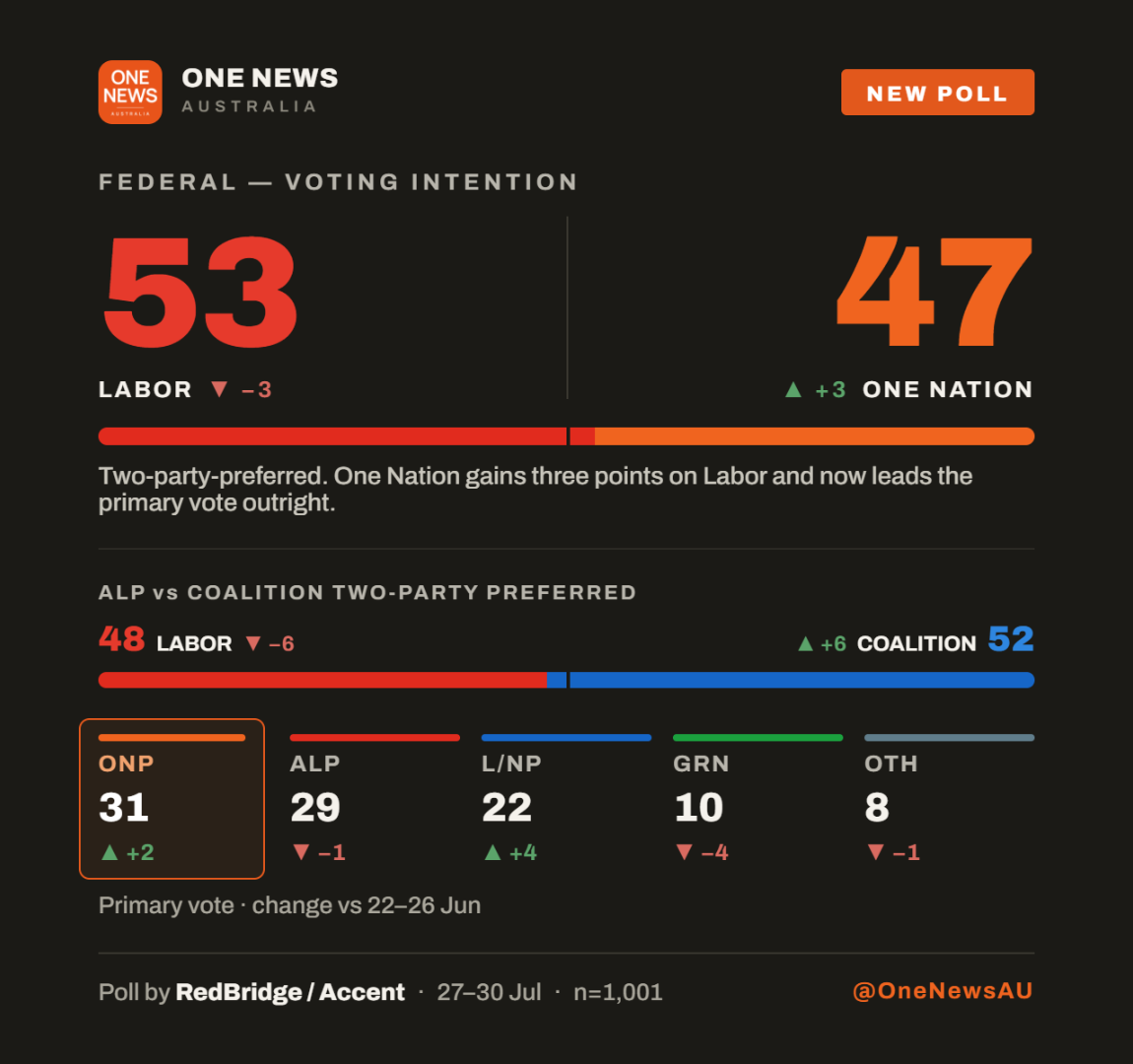
Liberal deputy leader Jane Hume has ruled out ever governing in coalition with Pauline Hanson's One Nation. The newest federal poll, taken days earlier, put her own party nine points behind the one she says she'll never work with.
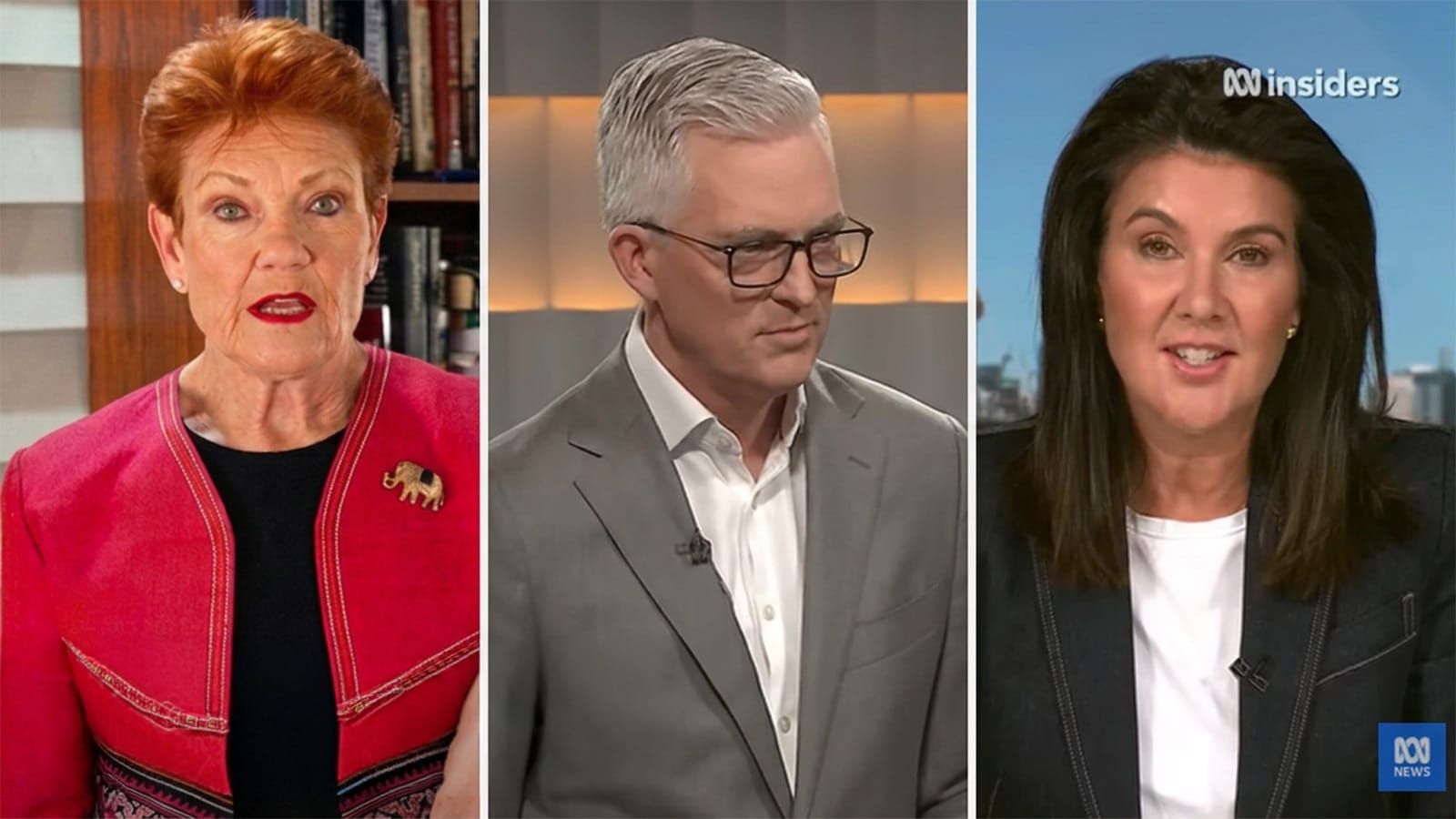
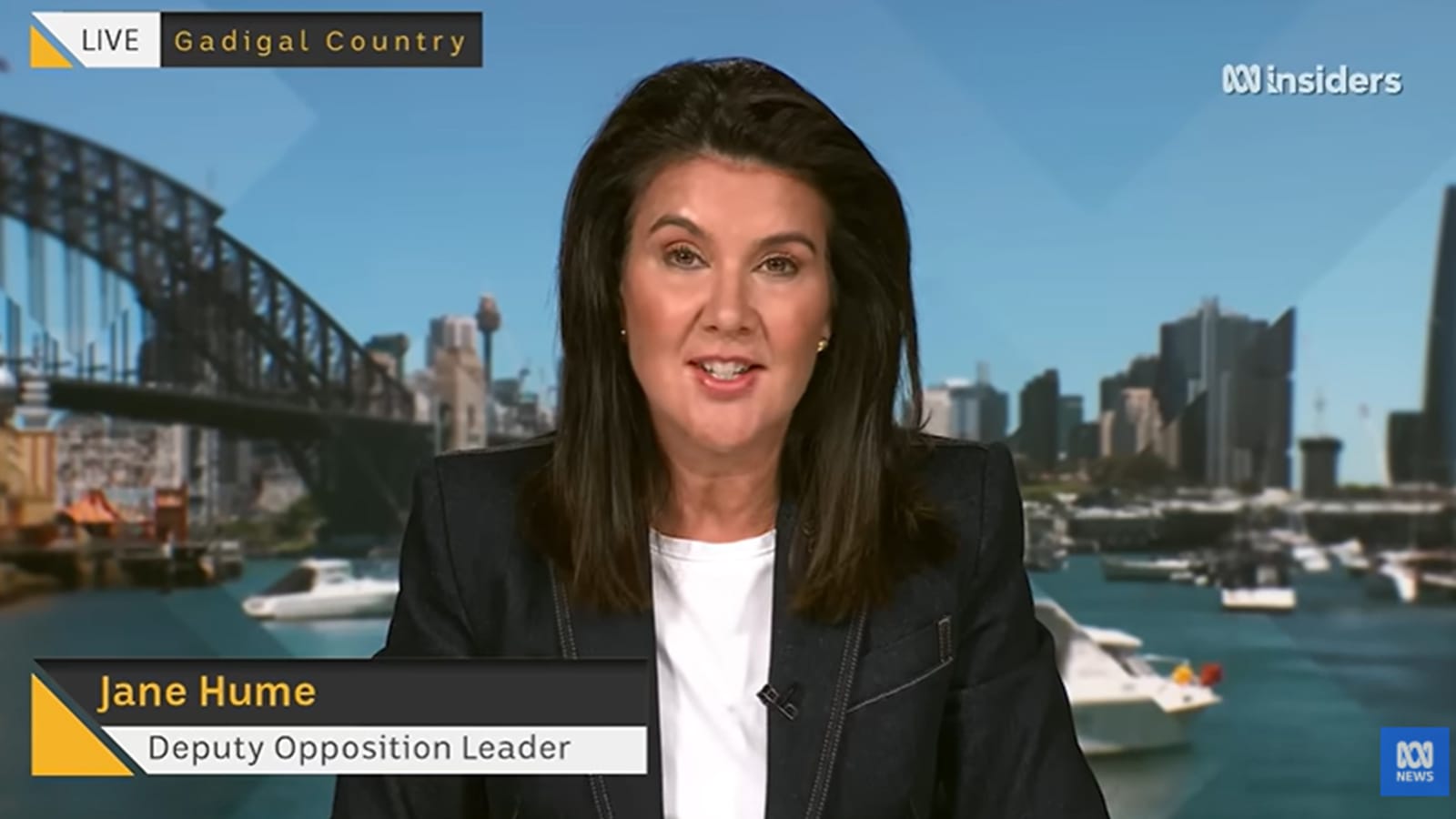
Appearing on ABC's Insiders on Sunday, Hume was asked by host David Speers whether a future Coalition government would take One Nation's support if it couldn't win a majority in its own right.
“No. No. No. We will not be governing in coalition with One Nation. We are not forming a coalition with One Nation,” she said, according to The Nightly.
“The Liberals are already in coalition with the National Party.”
Jane Hume said no to a coalition, then wouldn't say if she'd take One Nation's votes
Speers wasn't asking whether the Liberals would sign a formal agreement with Hanson, because One Nation hasn't asked for one. He was asking the question that will probably decide who runs the country: if you fall short of a majority, will you take One Nation's votes to get there?
Hume wouldn't answer it.
“It's 18 months until the next election, David, so of course it's a hypothetical question.”
Pressed again, she accused Speers of putting words in her mouth.
“David, you keep trying to put words in my mouth. We have no plans, no intentions... there is no plan to have a coalition with One Nation.”
Asked whether the Coalition could rely on One Nation in a minority government, she called it “an extraordinary hypothetical”.
Shadow energy minister Dan Tehan gave the same non answer when News24 asked him directly about confidence and supply. That's the arrangement where a smaller party keeps a government in office without joining it.
“Well, look, that's a hypothetical and, you know, you have to wait and see what the makeup of the parliament is after any election,” Tehan said.
Both of them ruled out the arrangement that costs nothing to rule out. Neither would go near the one that might actually put them in government.
Video: ABC Insiders via YouTube. David Speers interviews Jane Hume on One Nation, the Victorian economy and ICAC.
DemosAU projects One Nation on 60 seats and Jane Hume's Coalition on 13
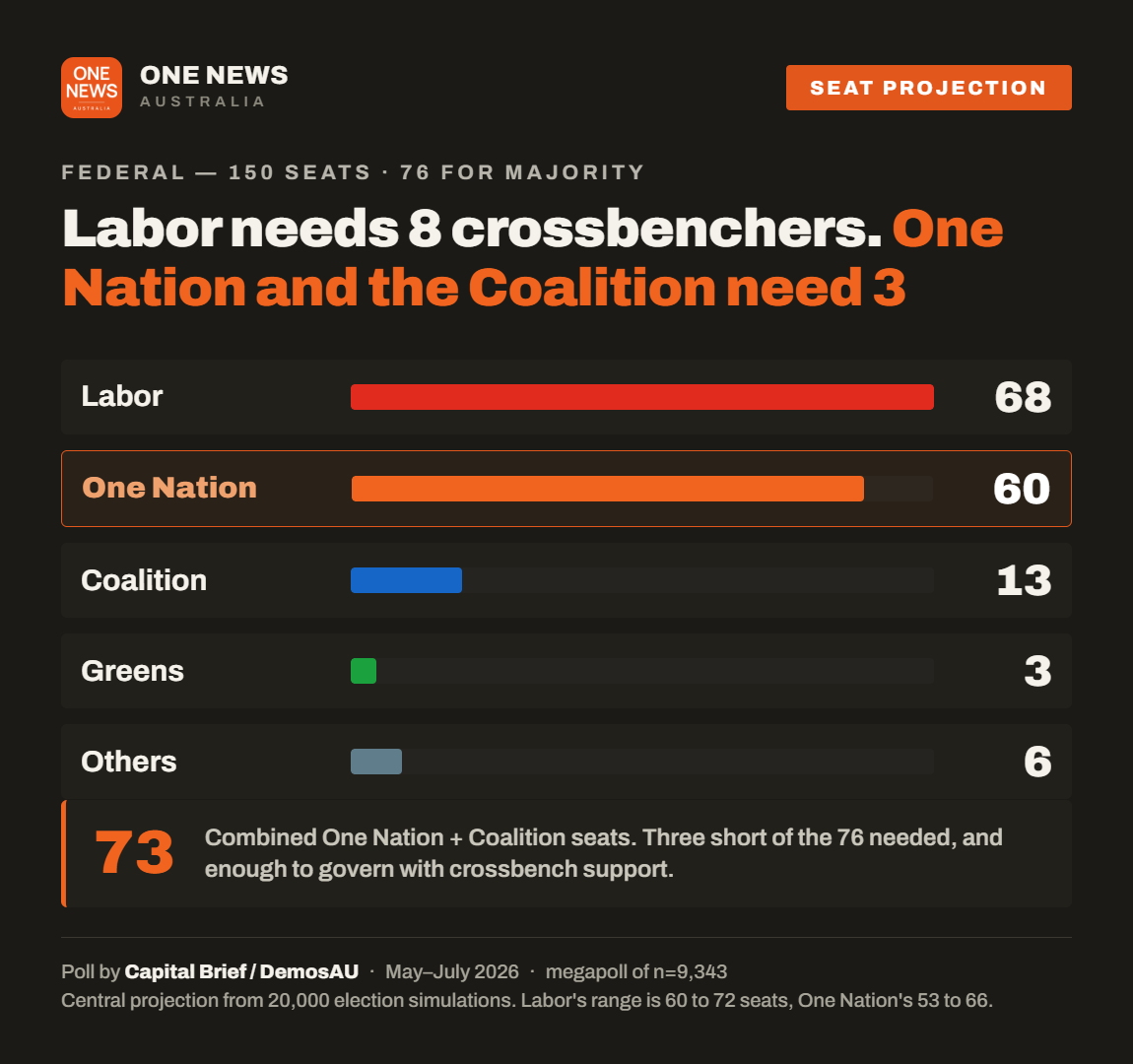
DemosAU's model for Capital Brief was built from 9,343 voters surveyed between May and July and run through 20,000 election simulations. It projects One Nation winning 60 of the 150 lower house seats and the Coalition 13. Labor lands on 68, and nobody reaches the 76 needed to govern.
These are central projections. The published spread has Labor between 60 and 72 seats, One Nation between 53 and 66, and the Coalition between 11 and 22.
That leaves 9 crossbenchers, the MPs who sit with neither side, holding the result. The count that follows is the one nobody in the Coalition wants to do out loud. Labor on 68 would need 8 of those 9 to stay in office. One Nation and the Coalition on a combined 73 would need 3.
The side that says it wants Labor gone is the better placed of the two to do it, and it's the side refusing to have the conversation.
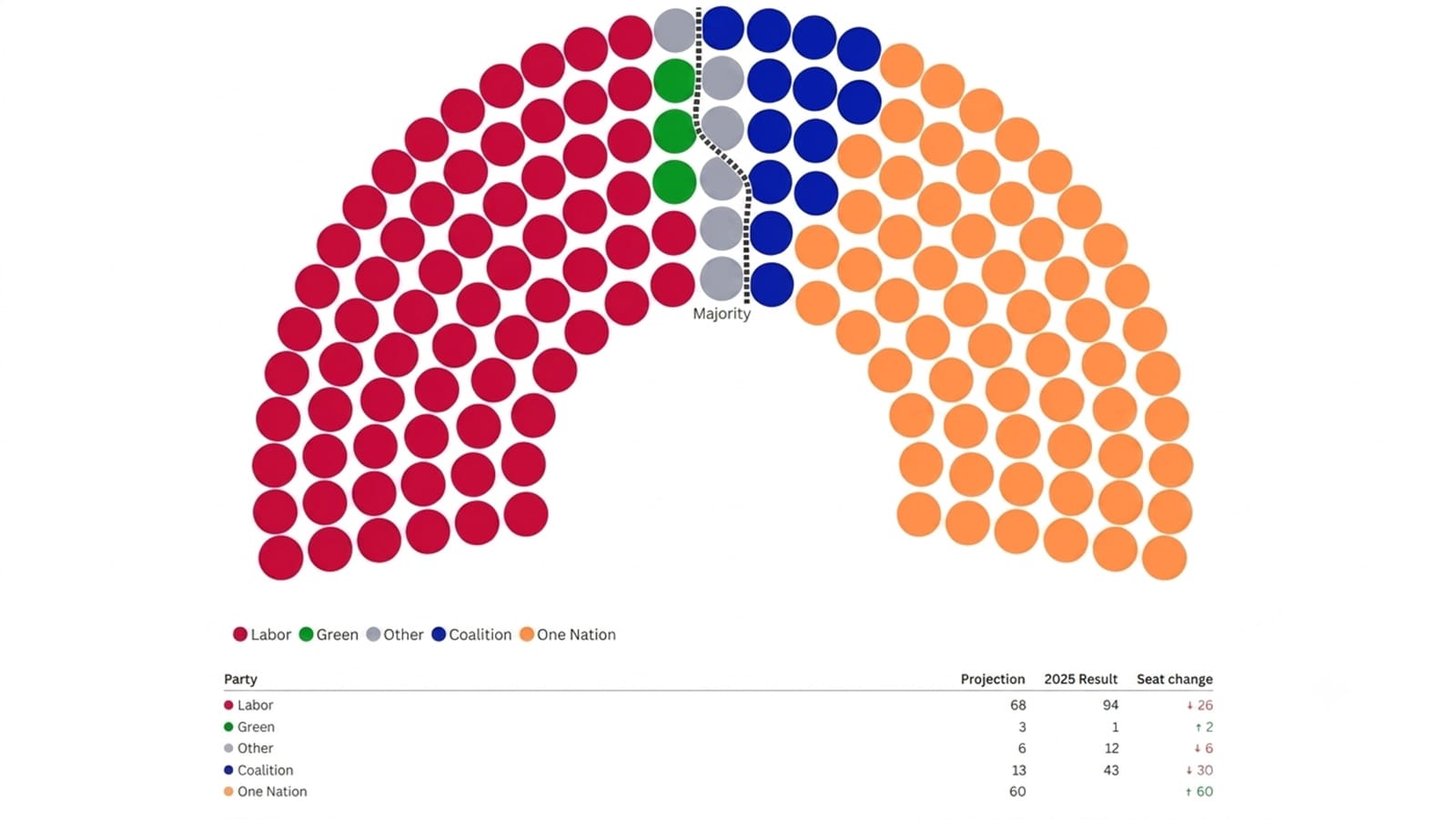
Measured against the 2025 election, that's the Coalition down 30 seats from the 43 it won, and One Nation up 60 from zero.
One Nation voters already send the Coalition 80% of their preferences, and the WA Liberals already did the deal
The same DemosAU work found One Nation preferences flow to the Coalition at 80%, and 67% of Coalition preferences come back the other way. Hanson's voters are already doing the work of keeping Liberals in seats, without being asked and without being thanked.
Hume's own party has been acting on that arithmetic for weeks. On 25 July the WA Liberals preferenced One Nation third and Labor tenth in Secret Harbour. Angus Taylor spent July attacking a party whose policies he keeps adopting, calling it “a column of smoke” and “a one-person show”, before ruling out a coalition outright on 27 July.
That was three days after his own frontbencher Andrew Bragg said the Liberals would need to be “pragmatic”. Bragg told Nine's Today show: “We would definitely like to work out whoever would be interested in being in a coalition with us if that's what the numbers were. Of course. We're not crazy.”
Four senior Liberals, four different answers, in a single month.
Jane Hume's party and One Nation already want the same things on migration and energy
The gap the Liberals keep pointing to isn't a policy gap. On migration, News24 has One Nation capping arrivals at 130,000 a year and tightening who qualifies. The Coalition's pitch is tougher visa checks and a values test, aimed at Labor's settings rather than at a number of its own. Both want the total lower, and the argument between them is about how far to cut rather than whether to.
Energy divides them even less. In the same report, both back more investment in coal and gas, and both want the federal ban on nuclear power lifted. The one real split is net zero, which the Coalition keeps and One Nation would scrap.
Two parties that agree on the direction of migration policy and agree on coal, gas and nuclear are being kept apart by one of them insisting on it.
Victoria on 28 November is where Jane Hume's position gets tested first
Victoria was supposed to prove One Nation couldn't travel, and it's now the state where the argument gets settled.
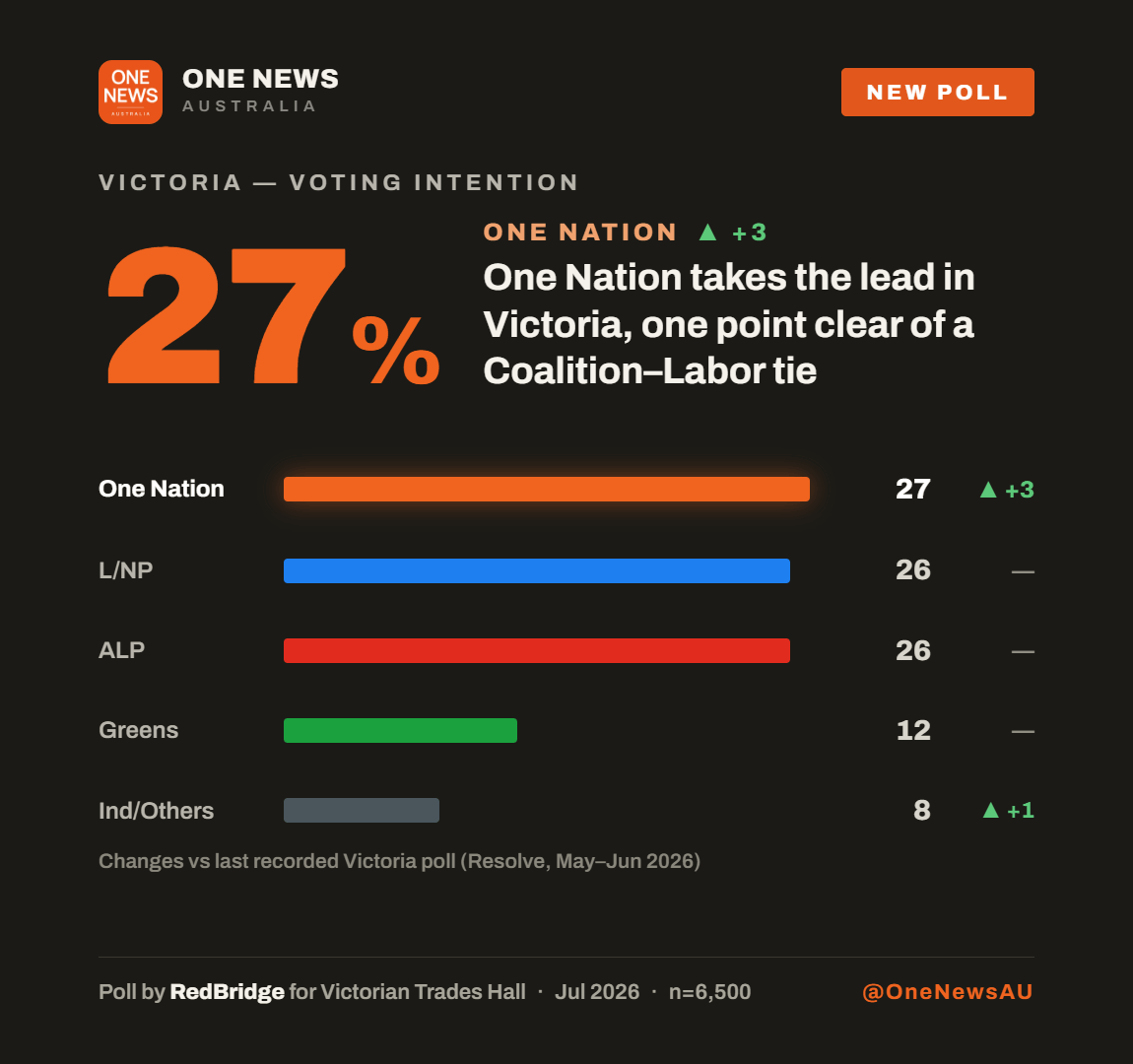
RedBridge, polling for the Victorian Trades Hall off a 6,500 sample, has One Nation first in Victoria on 27%, up 3, a point clear of the Coalition and Labor tied on 26%. The Trades Hall is the peak union body in the state, about as Labor friendly a client as exists in this country, and its own polling has One Nation on top.
Victorians vote on 28 November. Whoever forms government there will likely need Hanson's party to move anything through the upper house, and nothing said in Canberra changes that.
One Nation's job now is to make Jane Hume's answer irrelevant
DemosAU's central projection has One Nation on 60 seats. Governing in its own right takes 76, so the gap is 16 seats, and nothing about closing it depends on the Liberal Party's permission.
Every seat One Nation adds between now and the election is a seat that doesn't have to be negotiated with a party that spent this week insisting it would rather lose politely.
Hanson has ruled out a merger herself. She's said she won't join a coalition “where I will be told what I can say, what I can do, what policies I can put up”, while making clear she'd give a government “supply” and “confidence”. That's the offer on the table, and it's the one Hume wouldn't discuss.
If the Liberal Party means what it says about removing this government, the answer on Sunday was that you'd weigh every option once the voters have spoken. Hume gave that answer nowhere. She defended an 80 year arrangement between two parties now holding 22% of the vote between them.
One Nation's task is to reach 76 and end the argument. The Liberal Party's task is to work out whether it wants Labor gone or wants to be right. On these numbers it doesn't get to have both.