Despite admitting that a decade of punishing tax hikes built Australia’s multibillion-dollar illegal tobacco empire, the Albanese government is pushing ahead with yet another excise increase on 1 September.
The hike will force legal 20-packs up past $47, driving buyers straight into a shadow market already blamed for over 190 firebombings, six homicides, and up to $11.8 billion in lost tax revenue. Facing an escalating gang war and free-falling budget receipts, Pauline Hanson’s One Nation has unleashed a radical policy to slash the tobacco tax by 75%, promising to bring legal cigarette prices down to about $21 or $22 if the cut is passed through in full, and dismantle organised crime's most lucrative cash cow.
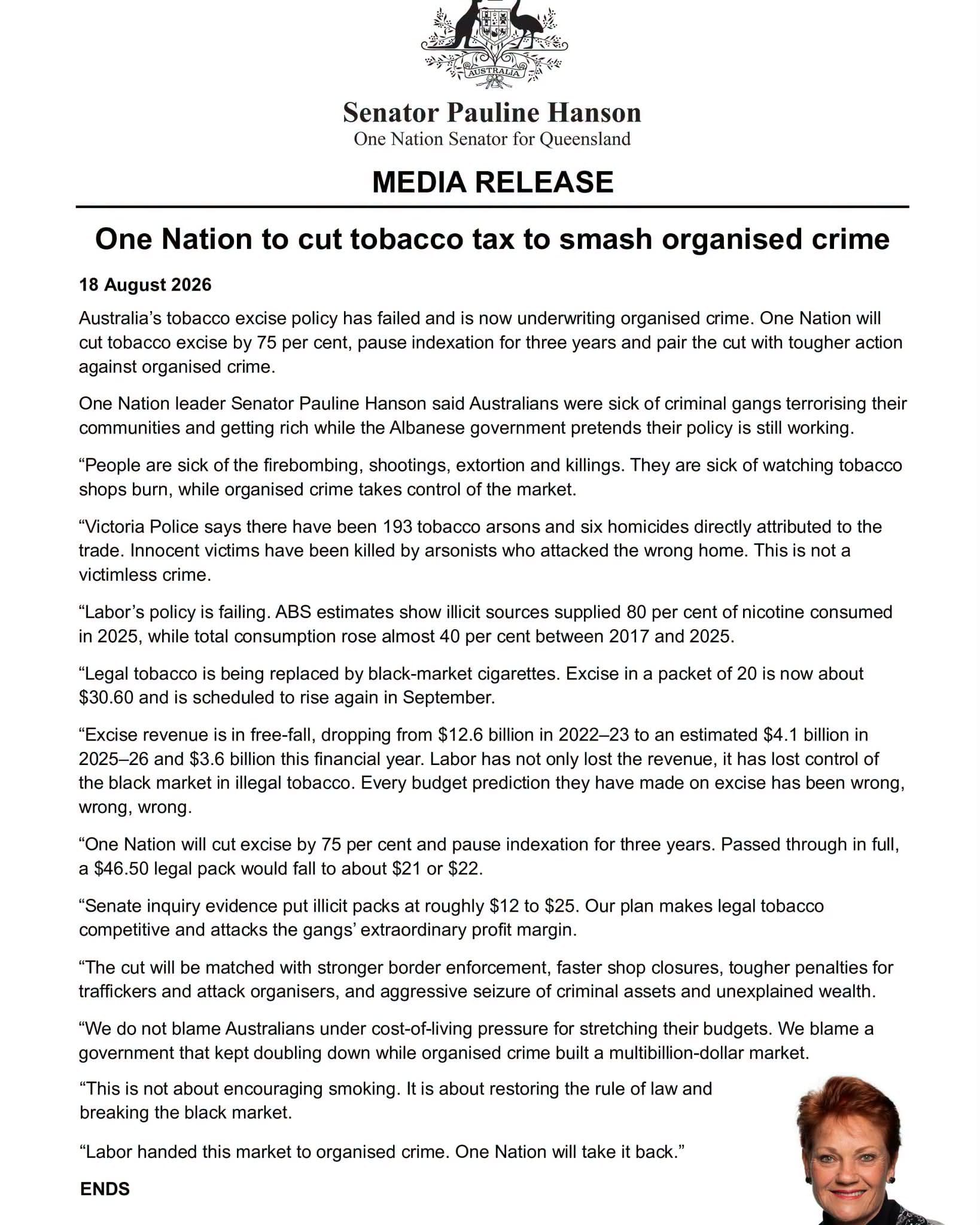
One Nation issued the policy as a media release on Tuesday, reproduced in full below.
How the Numbers Stack Up: From $46.50 Down to $21
Right now, tax consumes almost the entire price of a legal box of cigarettes. On a standard $46.50 pack of 20, the federal government grabs $30.57 in excise plus $4.23 in GST. That leaves just $11.71 to split between the maker, the supplier, and the retailer.
One Nation wants to slash that federal tax take by three quarters.
- Current Legal Pack: $46.50 total ($34.80 goes straight to government tax)
- Under One Nation Cut: $21.29 total ($9.58 goes to government tax, being $7.64 excise plus $1.94 GST, leaving retail margins untouched)
- Black Market Pack: $12 to $25
Slashing the excise drops the legal price inside black market territory. Instead of paying up to $34.50 extra to stay legal, smokers would suddenly see legal shelf prices compete directly with street cartels.
When Labor increases the excise again on 1 September, that same legal pack will jump to $47.04. Unless retail prices drop, legal buyers keep funding government revenue while millions of others choose the illegal market instead.
The Great Tobacco Tax Divide: Labor Policy vs One Nation Alternative
Years of aggressive tax increases have fundamentally reshaped Australia's tobacco market. While Labor continues pushing taxes higher, Australian Bureau of Statistics wastewater modelling shows overall nicotine consumption grew nearly 40% since 2017 despite a population increase of just 14%. Over that same timeframe, illicit sources went from supplying 12% of the nicotine Australians consumed to 80%.
The comparison below shows current official figures alongside proposed policy changes:
| Measure | Labor's excise now | One Nation's plan |
|---|---|---|
| Excise on a packet of 20 | $30.57, rising to $31.05 on 1 September | About $7.64 |
| Price of a legal packet | $46.50, about $47.04 from 1 September | About $21.29 |
| Price of an illicit packet | $12 to $25 | $12 to $25, unchanged |
| Gap, legal against illicit | $21.50 to $34.50 dearer | Legal price sits inside the illicit range |
| Indexation | Rises every March and September | Frozen for three years |
| Illicit share of nicotine used | 12% in 2017, 80% in 2025 | No target published by One Nation |
| Nicotine consumed | Up almost 40% since 2017, on 14% population growth | Cut stops short of abolition to avoid driving use up |
Labor Admits Tax Hikes Built a $7 Billion Crime Wave, Then Refuses to Change Course
In one of the franker admissions from a sitting minister, Assistant Minister Julian Hill admitted high excise was “one of the key drivers of the growth of the black market”. Citing the Illicit Tobacco and E-cigarette Commissioner's 2024-25 annual report, Hill revealed organised crime cartels now rake in up to $6.9 billion in profit from a trade supplying between 50% and 60% of all tobacco sold in Australia, and a staggering 95.7% of the $1.6 billion vape market.
Tax dodging on illicit nicotine has spiralled out of control, wiping out between $7.7 billion and $11.8 billion in expected revenue. Yet despite acknowledging that sky high taxes created this monster, the government flatly refuses to lower them.
- The Staggering Crime Profits: Cartels pocket up to $6.9 billion while skipping $11.8 billion in taxes
- The Refusal to Act: Hill insists no realistic tax cut will break established cartel distribution networks
- The Spending Band Aid: The Commonwealth has put more than $345 million into the national response since January 2024, including $84 million to the states and territories, instead of touching the tax rate
- Who Actually Pays: Four in every five nicotine products consumed in Australia come from untaxed black market stock, leaving the shrinking number of law abiding buyers to shoulder the entire 1 September price hike
Labor insists tax revenue was always meant to drop as people quit. Instead, millions of Australians simply stopped buying legal stock, turning criminal syndicates into billion dollar powerhouses while everyday taxpayers cover the enforcement bill.
A Billions-Dollar Budget Collapse: How Taxpayers Are Left Paying the Tab
| Financial year | Tobacco excise collected |
|---|---|
| 2019-20 | About $16.3 billion |
| 2022-23 | $12.6 billion |
| 2025-26 | About $4.1 billion |
| 2026-27 | $3.56 billion budgeted |
| 2029-30 | $2.14 billion forecast |
Labor’s tobacco excise revenue is in a total tailspin. Back in 2020, federal coffers pulled in $16 billion from tobacco taxes. Today, official budget papers confirm that figure will plummet to a fraction of its former self, leaving an $8 billion hole written off over five years:
- 2020 Peak Collection: $16 billion
- 2024-25 Initial Forecast: $11.5 billion expected for 2025-26
- 2025-26 Actual Projected Realities: Down to roughly $4.1 billion
- 2026-27 Official Forecast: $3.56 billion
- 2029-30 Long-Term Forecast: A dismal $2.14 billion
The political fallout is immediate. "Excise revenue is in free-fall," Senator Pauline Hanson said in her media release. "Labor has not only lost the revenue, it has lost control of the black market in illegal tobacco. Every budget prediction they have made on excise has been wrong, wrong, wrong."
This is no longer just a problem for smokers. When expected tax billions vanish into the black market, every single taxpayer picks up the tab. The massive shortfall forces the government to hike other taxes, increase public debt, or slash funding for public services.
Worse still, the tax no longer covers the very damage it was designed to offset. Assistant Minister Julian Hill describes the excise as a tax set so the price of tobacco carries the public healthcare cost of smoking, yet the Australian Institute of Health and Welfare estimates health spending attributable to tobacco hit $5.7 billion in 2023-24 alone. With excise collections projected at just $3.56 billion this year, the tax now raises less than the damage it is meant to price in.
Firebombings, Homicides, and Extortion: The Deadly Trail of Australia’s Illicit Tobacco Trade
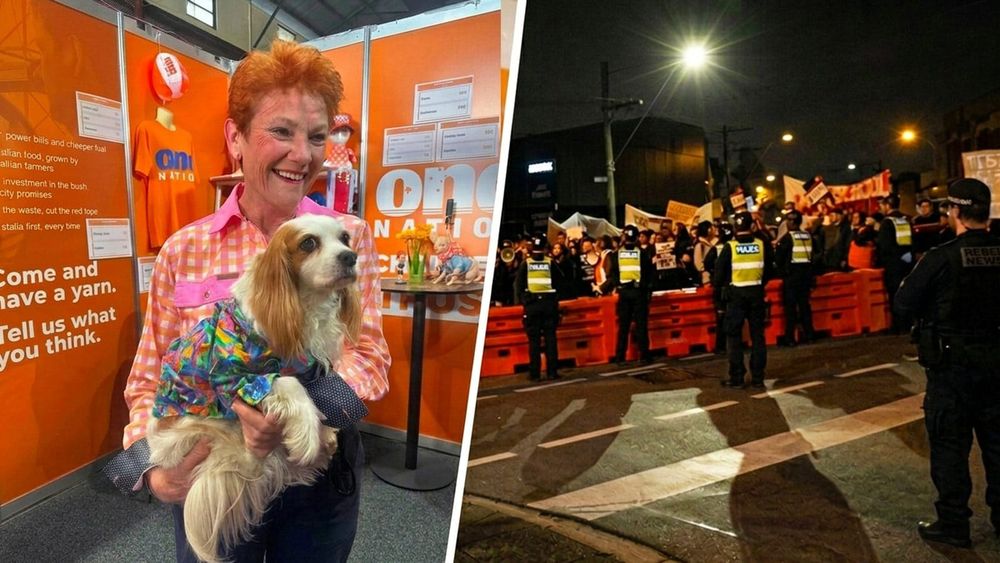
The turf war for Australia's lucrative black market has turned suburban streets into active war zones. Detective Inspector Chris Murray, head of the Victoria Police arson squad, confirms the brutal toll: 193 tobacco related firebombings, six homicides, and over 500 arrests since the arson spree ignited in Melbourne’s northern suburbs in March 2023. Total attacks and attempted strikes have now surged past 200.
Organised crime cartels are enforcing their grip through pure violence:
- Innocent Lives Lost: Senator Hanson says arsonists who attacked the wrong home have killed innocent victims.
- Escalating Violence: Firebombings, targeted shootings, extortion and shop burnings have run across Melbourne's suburbs since March 2023, with attacks and attempted attacks now past 200.
- Widespread Lawlessness: Assistant Minister Julian Hill admitted the trade has “normalised law breaking for a significant proportion of Australians” while fuelling violence between crime cartels.
"People are sick of the firebombing, shootings, extortion and killings. They are sick of watching tobacco shops burn, while organised crime takes control of the market," Senator Pauline Hanson warned. "This is not a victimless crime."
While South Australia and Queensland have toughened local laws with encouraging enforcement results, police are fighting an uphill battle against a multibillion dollar criminal empire forged by runaway tax rates.
Why One Nation Shifted to a 75% Cut and the Economic Proof That Backs It
A 50% tax slash was original policy, but party sources say the modelling forced a bolder move. After a range of scenarios were tested, One Nation concluded half measures would fail: a 50% cut simply would not drop legal shelf prices far enough to compete with criminal syndicates and win consumers back. That conclusion drove the policy to a radical 75% excise reduction paired with a three year tax freeze.
Going further by completely abolishing the tax was ruled out to ensure lower prices do not spur new smoking habits. "The retail price of legal cigarettes has to be brought down to a point where people will buy them," a party source revealed. "There's no point cutting excise but leaving prices too high."
To ensure the tax break destroys the illicit market rather than just lowering prices, the policy couples the 75% cut with aggressive law enforcement measures:
- Border Crackdowns: Tighter customs screening to intercept illegal shipments before reaching Australian soil
- Immediate Shop Closures: Fast tracked shutdowns of illicit storefronts operating in local communities
- Harsher Penalties: Maximum prison sentences for traffickers and ringleaders organising firebombings
- Asset Seizures: Aggressive confiscation of unexplained criminal wealth and property tied to the trade
"We do not blame Australians under cost of living pressure for stretching their budgets. We blame a government that kept doubling down while organised crime built a multibillion-dollar market," Senator Pauline Hanson stated. "This is not about encouraging smoking. It is about restoring the rule of law and breaking the black market."
An Oxford Economics Australia report, commissioned by the supermarket group Ritchies IGA, modelled a smaller cut than One Nation's and found that rolling excise back to 2019 levels alongside tough enforcement would crush the black market share from 64% down to 37% by 2029. As smokers migrate back to legal storefronts, government tax collections would rise by $3.1 billion, which is the case for lowering the rate raising more total revenue than pricing legal shops out of existence.
Public Health Advocates Claim Tax Cut Is a $2.3 Billion Corporate Windfall
The Public Health Association of Australia leads the charge against slashing the excise, warning that a tax cut will enrich global tobacco giants rather than fix the black market. PHAA Chief Executive Terry Slevin argues that a 50% cut hands multinational corporations an estimated $2.3 billion every year.
Under Slevin's projections, the massive tax break would line corporate pockets directly:
- British American Tobacco: Over $1 billion annual windfall
- Imperial Brands: Over $600 million annual windfall
- Philip Morris: Over $500 million annual windfall
"The only real winner from a tobacco tax cut would be the tobacco industry itself," Slevin said, adding that even under the proposed cut the gap between legal and illicit prices would stay wide enough to keep criminal supply running.
However, that $2.3 billion figure relies on a major assumption: that tobacco companies pocket the tax difference instead of passing savings to consumers at the register. Because excise is calculated per stick, price pass through is measurable down to the exact cent, meaning governments could legally mandate retail price drops.
While One Nation explicitly stated its $21 price target depends on savings being passed through in full, neither major political party has proposed an enforcement mechanism, because Labor opposes a cut and the Coalition has not committed to one.
The sector making that argument is substantially taxpayer funded. Research from the Institute of Public Affairs found governments paid $622 million to public health advocacy groups between the 2021 and 2025 financial years, including $373.7 million to the Cancer Councils.
Rather than lowering taxes, Hill says health advocates are asking why Australia still permits standalone tobacconists, and raising whether tobacco should be sold only through mixed use retail under stricter licensing.
Angus Taylor Hesitates on Tax Cut While Labor State Leaders Sound the Alarm
The Coalition continues to stall on a definitive tobacco policy, weighing a 50% tax cut without committing to a concrete rate or timeline. Opposition Leader Angus Taylor has sat on the proposal since taking the Liberal leadership on 13 February, leaving the party without a clear stance as criminal cartels expand their grip.
Political tension is mounting across party lines, as even senior Labor leaders acknowledge the current tax strategy is failing:
- Coalition Inaction: Angus Taylor has spent months examining a 50% cut while refusing to lock in figures or an implementation date
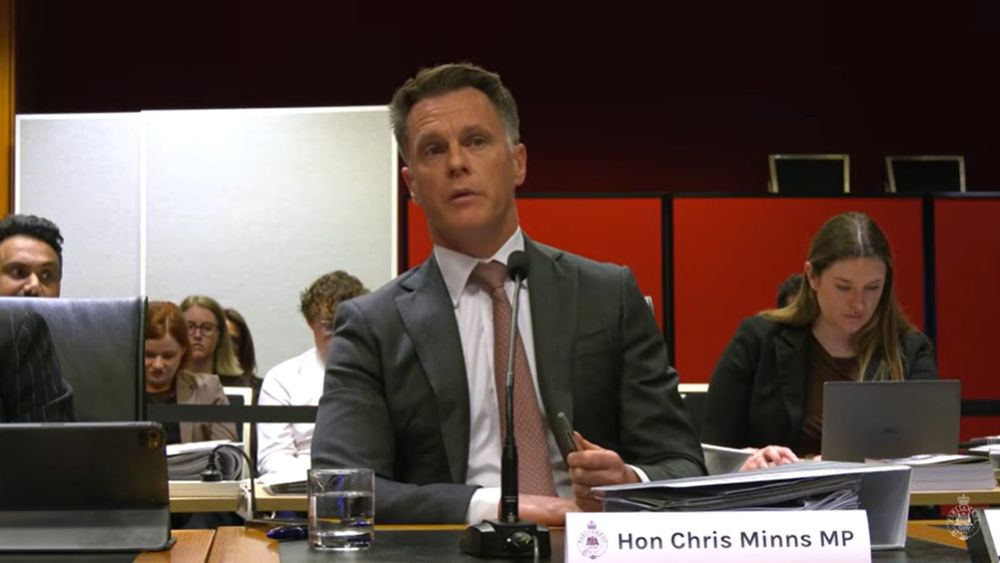
- Labor Internal Friction: NSW Premier Chris Minns publicly warned that hyper inflated legal prices are forcing ordinary citizens into criminal markets
- The Reality on the Ground: Minns highlighted everyday Australians choosing between a $17 illegal pack and a $60 legal one, stating these consumers would not break the law in a million years under normal circumstances
Federal Labor remains deadlocked while state leaders watch the fallout in real time. On 1 September, the federal excise on a single packet of 20 spikes again to $31.05, with another automatic tax increase locked in for March. As politicians hesitate, the massive price gulf keeps driving law abiding citizens straight into the illicit market.