Australian Poll Tracker: One Nation Surge and 2026 Election Polls, Updated Live
- DemosAU's MRP model, off 9,343 voters, has One Nation on 30% and winning 53 to 66 seats, with nobody reaching the 76 needed to govern.
- Resolve has One Nation at a record 25% in New South Wales, up 3, with the Coalition down 3 to a new low of 23.
- DemosAU's first ACT poll to list One Nation has the party debuting on 14%, with the Canberra Liberals crashing 12.5 points to 21% and left unable to form government.
- Newspoll has One Nation up 1 to 30%, level with Labor at the top as Labor's primary falls to its equal lowest since 2022, and Hanson is the only leader whose approval is not underwater.
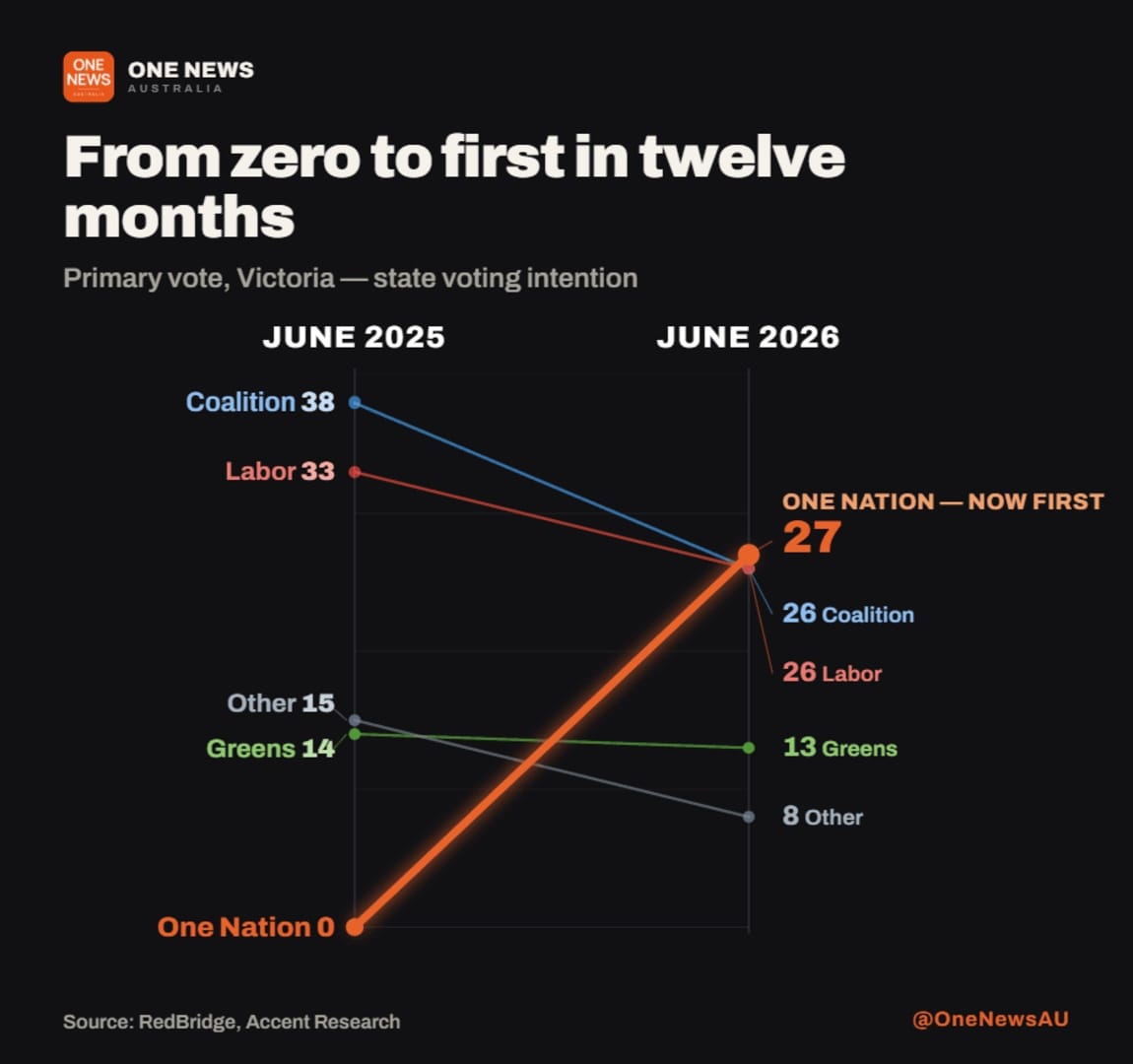
- A RedBridge poll for the Victorian Trades Hall, off a 6,500 sample, has One Nation first in Victoria on 27%, up 3 and one point clear of the Coalition and Labor tied on 26.
9:45am 10 August 2026 — Lighthouse: One Nation triples across a ring of fire around Sydney and passes Labor in the Hunter
News Corp's Lighthouse Consumer Tracker, published in Monday's Daily Telegraph, has One Nation on 38% in regional NSW on federal voting intention, 34% in the Hunter and Newcastle and 31% in both outer and middle Sydney, roughly triple its support of the first half of 2025. News Corp research chief James Taylor calls it a "pretty seismic shift" driven by "a strong level of disenchantment with the political system".
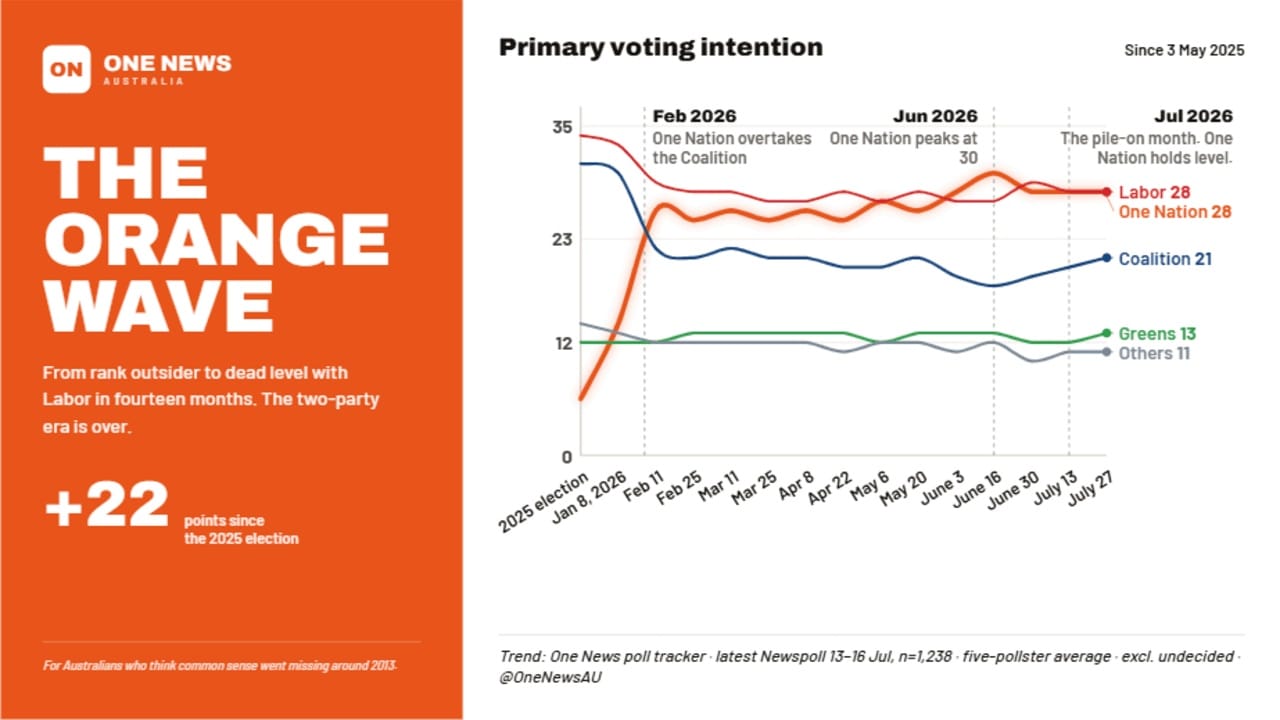
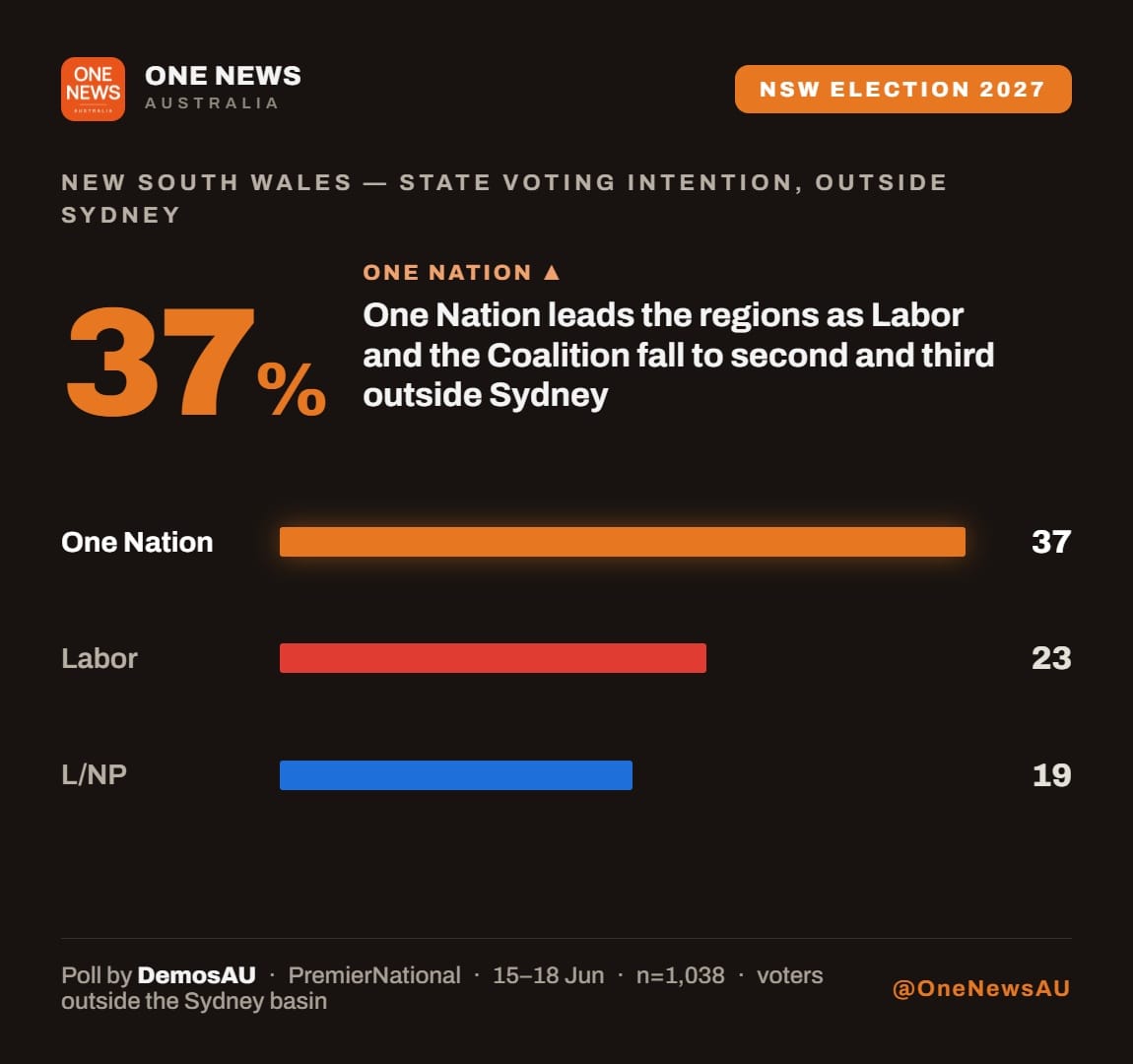
The state cut is the sharper warning. Lighthouse has had One Nation second in NSW on state voting intention since April, ahead of the Coalition, and in the Hunter the party has now moved past Labor. The regional shape matches DemosAU's June survey, which had One Nation on 37% outside the Sydney basin to Labor's 23%, and the growth is arriving up the income scale, with support in households above $150,000 up from 10% to 24% in a year.
Chris Minns takes a minority government holding 46 of the 93 seats to the polls on 13 March 2027, and the party's first state campaign event, Saturday's fundraising dinner with Pauline Hanson and Barnaby Joyce in Dubbo, sold out before a single state candidate has been named.
New polling has revealed One Nation support has tripled across outer Sydney, the Hunter and regional NSW, forming a political ‘ring of fire’ ➡️ https://t.co/cU9pYq1hRb
— The Daily Telegraph (@dailytelegraph) August 9, 2026
We launched a faster, redesigned app - with all new puzzles: https://t.co/IkewYqEUKj pic.twitter.com/ZPG0zcXDP8
8:45pm 9 August 2026 — Newspoll: One Nation stays level with Labor at the top as the Coalition sinks back to 18
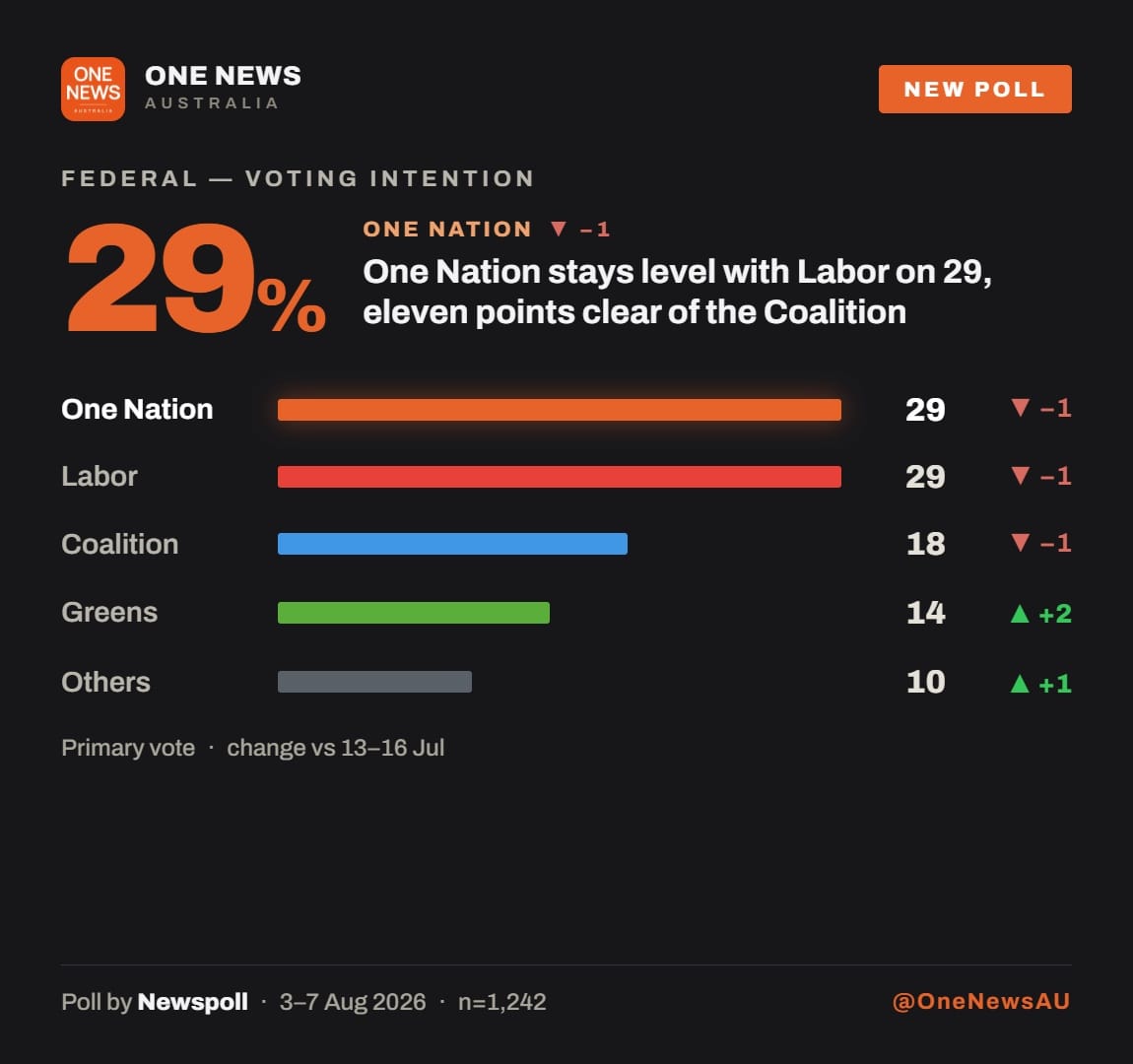
Newspoll's latest federal survey, conducted 3 to 7 August from a sample of 1,242 and posted through the AusPoll account on X, has One Nation and Labor tied for first on 29% each, both down a point, with the Coalition falling another point to 18. The Greens are up 2 to 14 and Others up 1 to 10.
This is the second Newspoll running with One Nation level at the top, and the trend underneath it is the part worth holding onto. Across the last three Newspolls Labor has gone from 33 to 30 to 29, while One Nation has gone 29, then 30, then 29. Labor has shed four points since June and One Nation has finished exactly where it started, through a month of concentrated attack on Pauline Hanson, a fortnight of soft state polling out of Victoria, and a Roy Morgan reading that put the party as low as 24.
The Coalition is the one going backwards. Angus Taylor's primary vote has fallen to 18, a single point above the record low Newspoll gave it in June, and it now sits eleven points behind both of the parties in front of it. The Liberals spent the winter being told by their own side that going after One Nation would win those voters back, and three Newspolls later they are worse off than when they started.
Before anyone quotes a two party estimate, add the votes up. One Nation 29 plus the Coalition 18 is 47. Labor 29 plus the Greens 14 is 43. More Australians are voting for right of centre parties. Labor still wins the two party count because Labor and the Greens tell their voters to preference each other, so their votes combine. One Nation and the Coalition have not made that arrangement, and they do not need to yet. Those deals are made at election time, and when it matters the right will do the same thing the left already does.
8:55pm 8 August 2026 — Roy Morgan's leader numbers: Babyface Jess stalls on 35.5% as One Nation's new leader takes 16% in four days
The same Roy Morgan SMS poll of 2,084 Victorians asked who would make the better Premier. Ben Carroll leads on 46.5%, Jess Wilson is second on 35.5%, and One Nation's Warren Pickering, four days into the job, is on 16%.
Start with where Pickering's 16 came from, because it did not come from Labor. This is the first three way preferred premier poll Victoria has had, so there is no clean before and after. What there is: a One Nation leader most Victorians could not pick out of a line up, four days into the job, with no campaign and no advertising, already sitting on 16% while the Liberal leader is stuck on 35.5%. Every other poll this month shows One Nation growing out of the Coalition's vote rather than Labor's, and there is no reason to think the leaders behave differently to the parties.
Jess Wilson is ony 36-years-old and has never had a job outside politics. Victorian Young Liberals president at 26, staffer to federal treasurer Josh Frydenberg, policy director at the Business Council of Australia, then handed Kew, one of the safest Liberal seats in the state, over party veteran David Davis. Her father was a Liberal MP before her. She has never been a minister, never run a department, never delivered a budget, and in November she asks Victorians to hand her the entire state. Babyface Jess is the fourth Liberal leader offered to Victoria in a single term, and she lost her first attempt at the job in December 2024, eliminated in the opening round.
Victorians do like her, and her approval sits at 58.5%. Being liked is not the question. The question is whether someone who has spent her whole adult life inside the machine that produced her has ever had to carry anything, and the answer on the record is no.
Then there is Ben Carroll, who is being sold as a fresh start. He's been in this government since 2014, in cabinet since 2017, and Deputy Premier since Daniel Andrews walked out in 2023. He held infrastructure, industry and justice portfolios through the Andrews years, then education under Jacinta Allan. Every decision Victorians are angry about was taken in rooms he was sitting in. He has announced a royal commission into the construction sector and a review of the Suburban Rail Loop, which is a novel way of saying he intends to investigate his own government's record. New face, same cabinet, same twelve years.
That is the choice being offered to Victoria on 28 November. A short-term Liberal leader who has never run anything, a Labor Premier who helped run it into the ground for years alongside Daniel Andrews and Jacinta Allan, and One Nation's leader had four days and has already 16%.
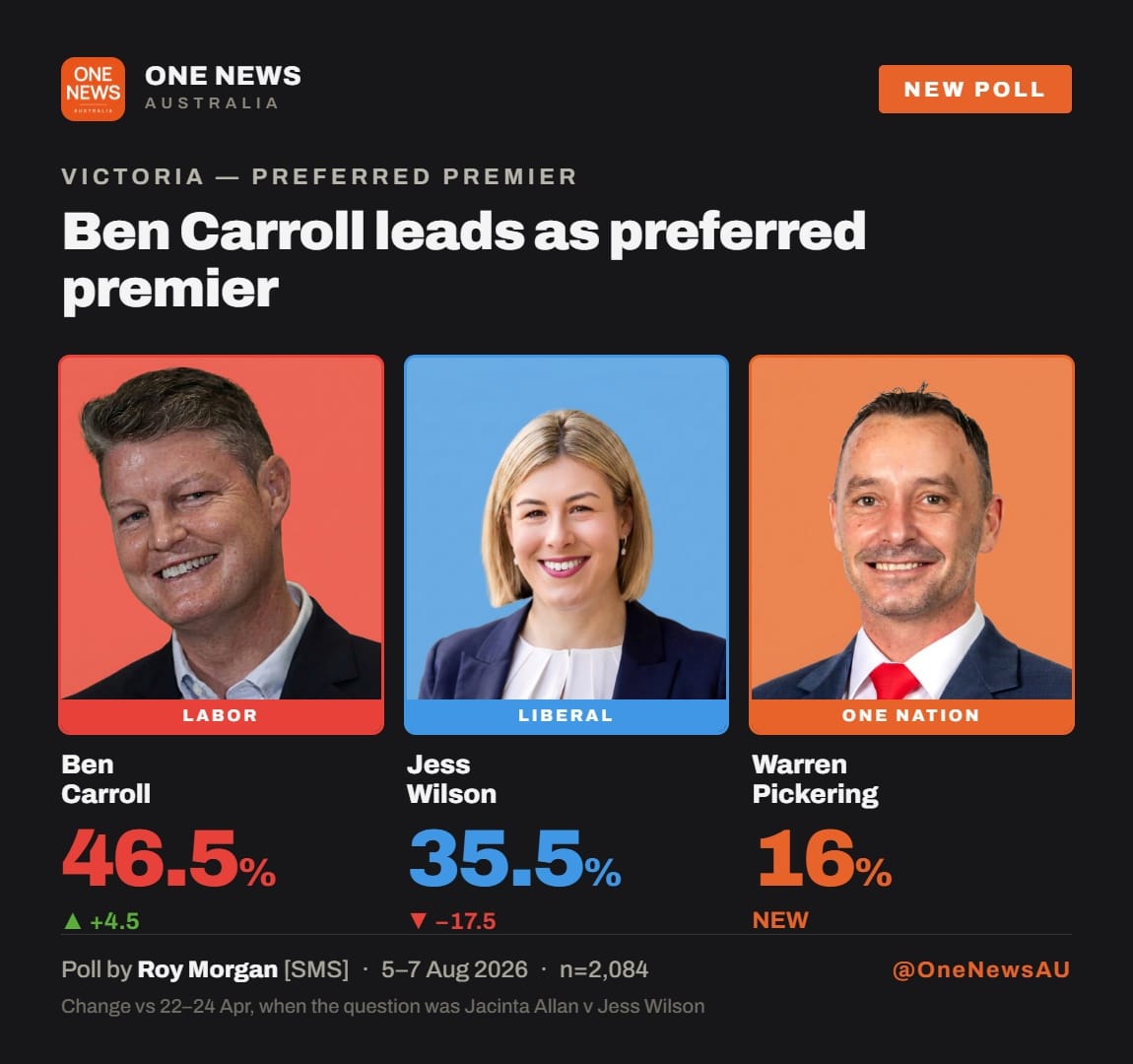
7:50pm 7 August 2026 — Roy Morgan Victoria: One Nation holds 23.5 through a new Premier's honeymoon, and this one did count the candidates
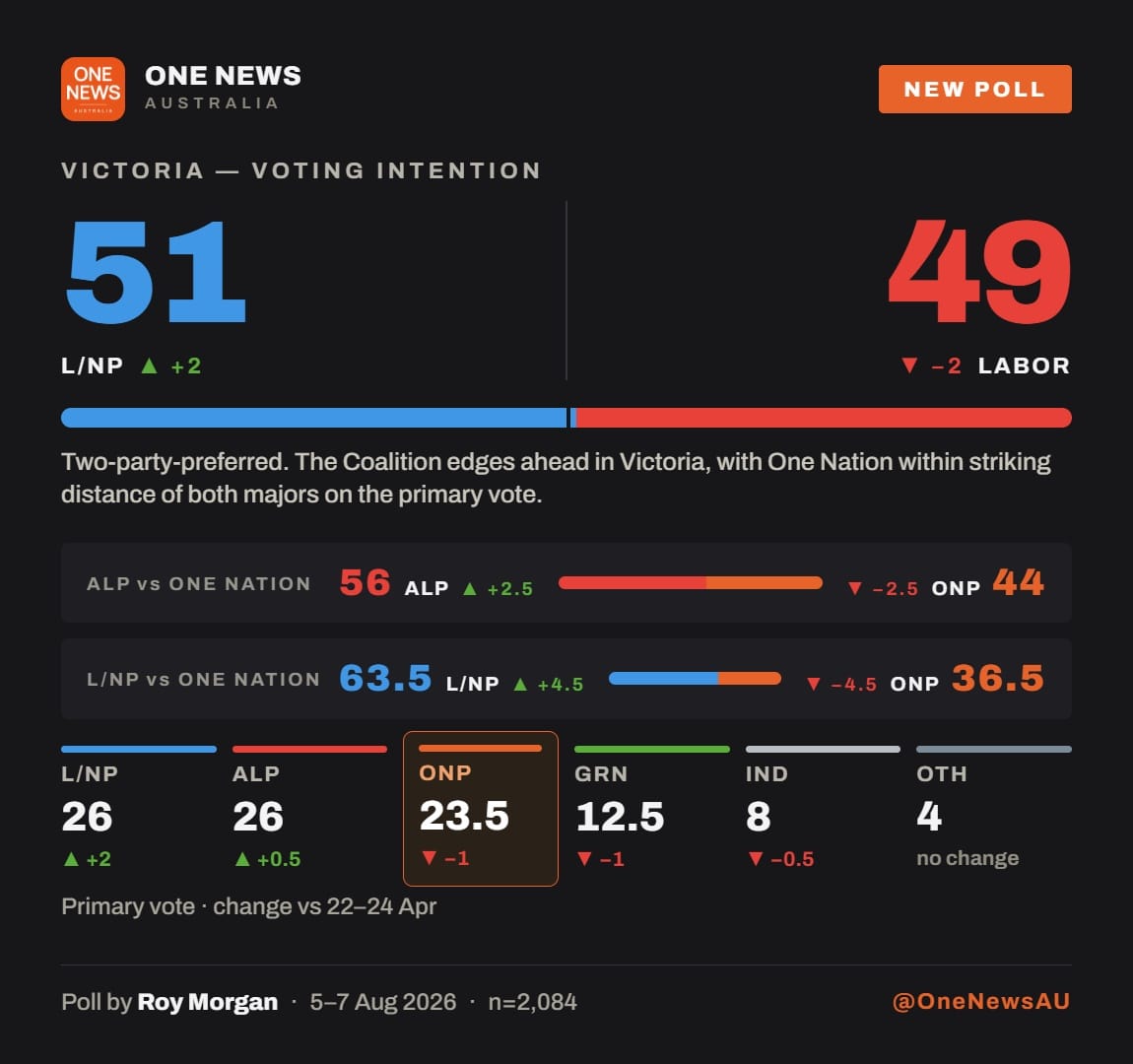
A special SMS Roy Morgan poll of 2,084 Victorians, conducted 5 to 7 August, has the Coalition and Labor level on 26% primary with One Nation third on 23.5, down 1 since April. The Coalition leads Labor 51 to 49 on two party preferred. Roy Morgan says the result points to a hung parliament, with second and third preferences deciding seat after seat.
Unlike the Freshwater and RedBridge polls earlier this week, this one was in the field after the announcements, not before them. Roy Morgan states it explicitly: the survey was conducted after Ben Carroll became Premier on 28 July, after his cabinet reshuffle completed on 4 August, and after One Nation named Warren Pickering as its Victorian leader on 3 August. Every one of those events is inside these numbers.
That context is doing most of the work in this poll, and it is not about One Nation. Victoria has a brand new Premier, and Ben Carroll is enjoying the honeymoon that comes with it. His approval sits at 51%, up 18.5 points on the April reading taken while Jacinta Allan still had the job, and disapproval has fallen 23.5 points. A first term of goodwill for a new leader is the single biggest change in Victorian politics since April, and against it One Nation gave up one point.
The hard number for One Nation is not the primary vote, it is the preference flow. Roy Morgan has the Coalition beating One Nation 63.5 to 36.5 head to head, and says the reason is that Labor voters preference the Coalition heavily over One Nation. On the three party count, which distributes Greens, minor party and independent preferences, Labor sits on 43.5, the Coalition on 30 and One Nation on 26.5. One Nation is drawing level on votes and losing on flows, and no amount of primary vote fixes that on its own.
Roy Morgan's 23.5 is the strongest One Nation number of the three Victorian polls this week, ahead of Freshwater and RedBridge on 22, and it comes off the largest sample of the three at 2,084. Warren Pickering was named leader four days before this poll closed, which is long enough to register in a survey and nowhere near long enough to campaign. The Victorian election is on 28 November.
2:10pm 5 August 2026 — RedBridge Victoria: One Nation draws level with Labor as the Coalition opens a fourteen point lead
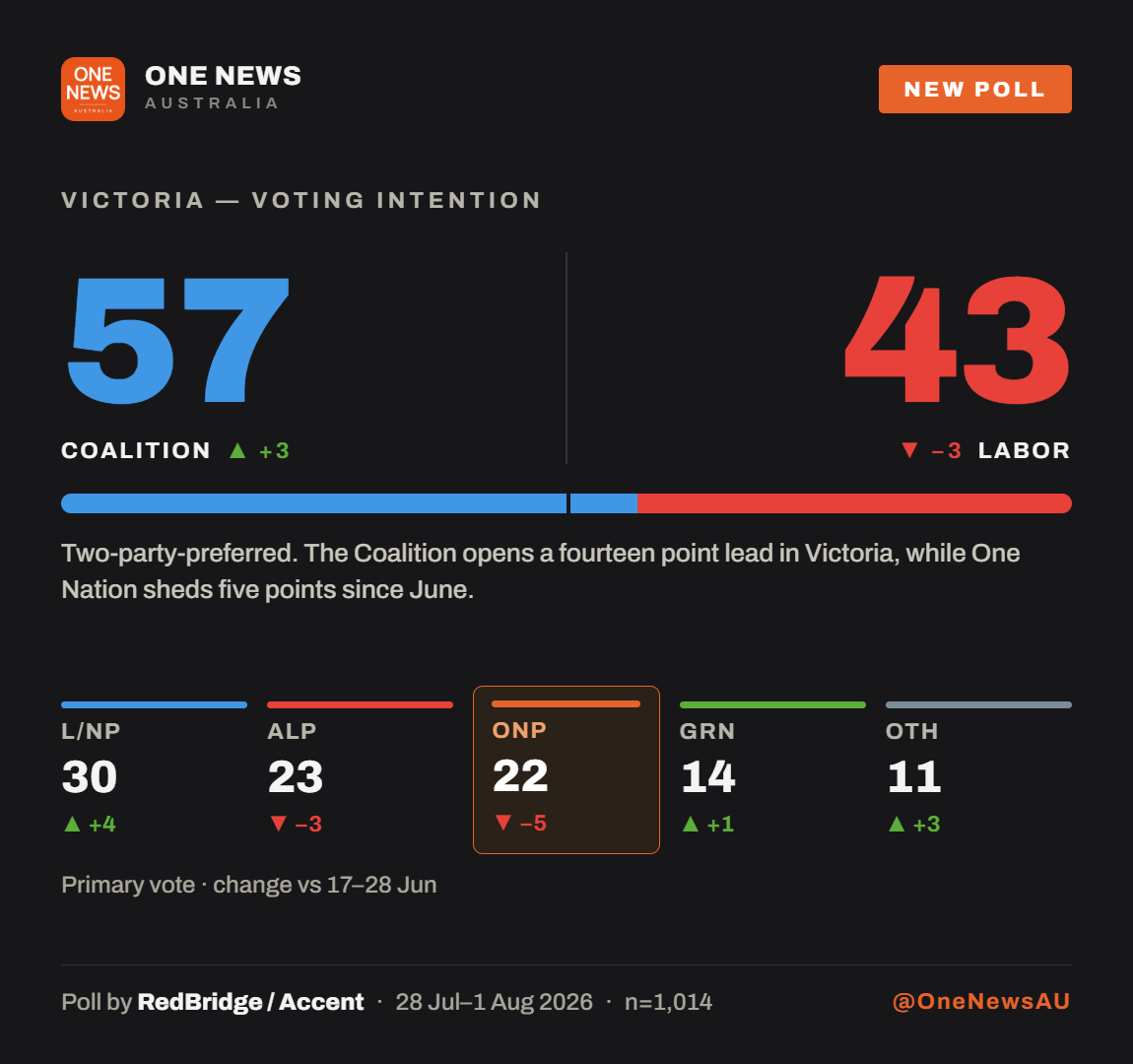
A second Victorian poll in two days, this one from RedBridge and Accent, conducted 28 July to 1 August from a sample of 1,014. The Coalition is first on 30% primary, up 4, with Labor down 3 to 23 and One Nation down 5 to 22. The Greens are on 14 and Others on 11. On two party preferred the Coalition leads 57 to 43, a fourteen point lead in a state Labor has governed for most of the past decade.
Like the Freshwater poll before it, this one closed before One Nation had a Victorian ballot paper to offer. Fieldwork finished on 1 August, the day before the party unveiled its Victorian team, so neither of the two polls now shaping the Victorian narrative includes a single named candidate. The next round is the first that will.
The reversal is RedBridge's own. In July the same firm, polling for the Victorian Trades Hall off a sample of 6,500, had One Nation first in Victoria on 27 and the two majors tied behind it on 26. A month later it has One Nation on 22 and the Coalition eight points clear. Freshwater independently landed on the same shape this week, the Coalition on 30 and One Nation on 22, so two houses now agree even though one of them is contradicting itself a month apart.
Look past the Coalition number and there is a Labor government on 23% in its own state, down 3, with One Nation a single point behind it and the pair effectively tied for second. Jacinta Allan's party is being squeezed from both sides at once with an election on 28 November. One Nation held no Victorian seats and polled in single figures there eighteen months ago. Being level with the government on its worst week of the year is not where the party wants to sit, but it is not where it started either.
5:35am 5 August 2026 — Roy Morgan: One Nation eases to 24 as the Coalition closes to within half a point
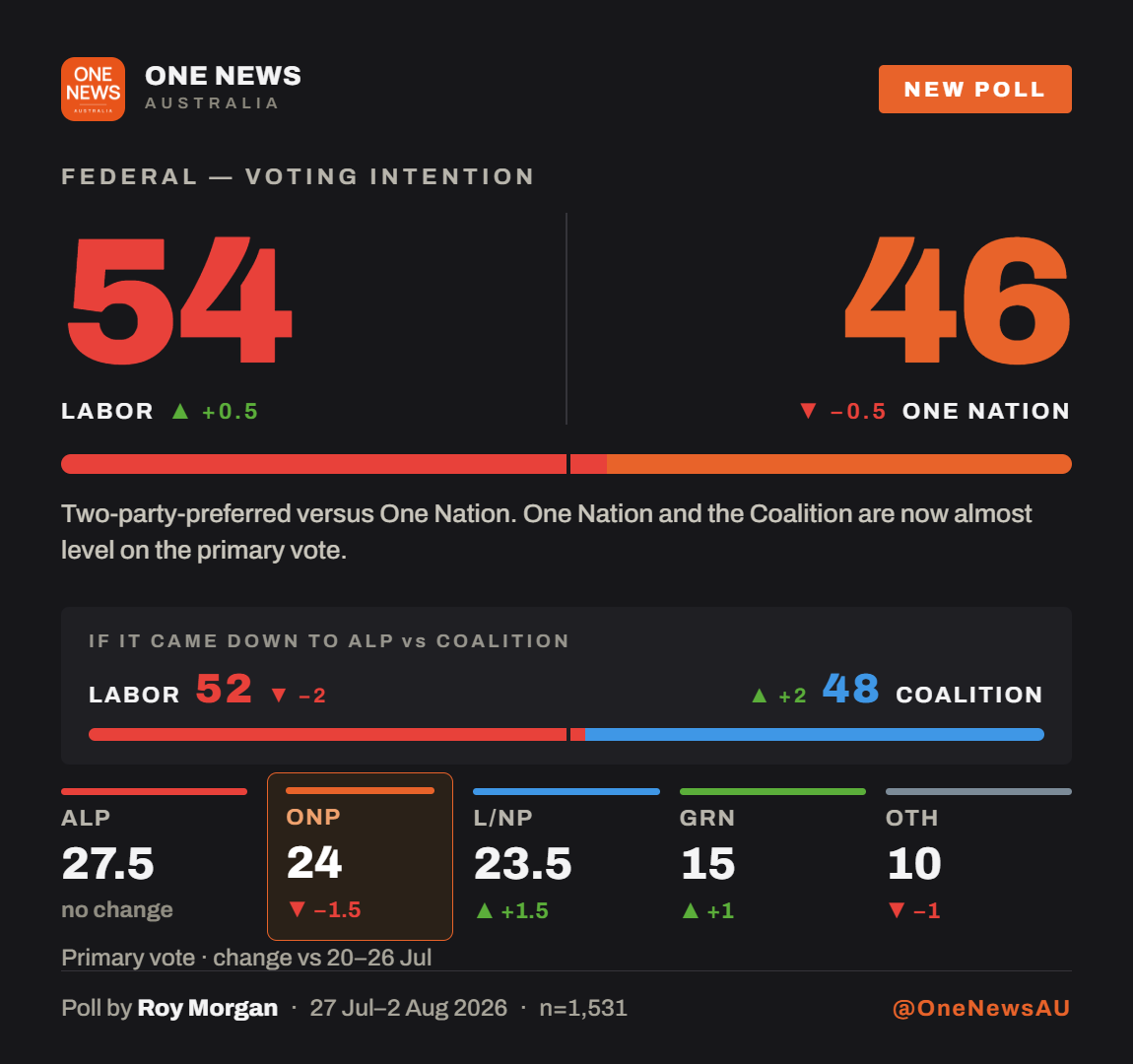
Roy Morgan's weekly survey, conducted 27 July to 2 August from a sample of 1,531, has One Nation down 1.5 points to 24% with the Coalition up 1.5 to 23.5, the closest the two have been in months and the Coalition's best reading since the May budget. Labor is unchanged on 27.5, the Greens are up 1 to 15 and Others fall to 10. On the count that matters in One Nation seats, Labor leads One Nation 54 to 46.
Read it against the same fortnight elsewhere before drawing conclusions. RedBridge, polling 27 to 30 July, had One Nation first on 31 and Labor at its worst of the year. Newspoll had One Nation on 30 in mid July. Roy Morgan's own series has run 31.5, then 26, then 22.5, then 28, then 22.5 and now 24 since the middle of June, a swing of nine points in six weeks that no other pollster records. On the spread of published polling, 24 sits at the bottom of the range rather than in the middle of it.
The Coalition's recovery is the part worth watching, because it is showing up in more than one house. RedBridge had the Coalition up 4 in the same week, Freshwater had it up 3 in Victoria, and Roy Morgan now has it at its highest since May. Three pollsters moving the same way is a pattern rather than noise, and the votes are coming back to a party that spent the winter in the teens.
One Nation's own answer to that is arriving now rather than later. The party is yet to release costings and has only begun naming candidates, and the argument inside One Nation is that voters cannot commit to a party they cannot yet see on their own ballot paper. The Victorian team was unveiled on 2 August, the final day of this survey's fieldwork, so none of it is in these numbers. If the candidates and the costings do what the party expects, the next round of polling is where it shows up.
4:30am 5 August 2026 — Freshwater Victoria: the Coalition stretches to 30 as One Nation slips to 22, in a poll that closed before the candidates were unveiled
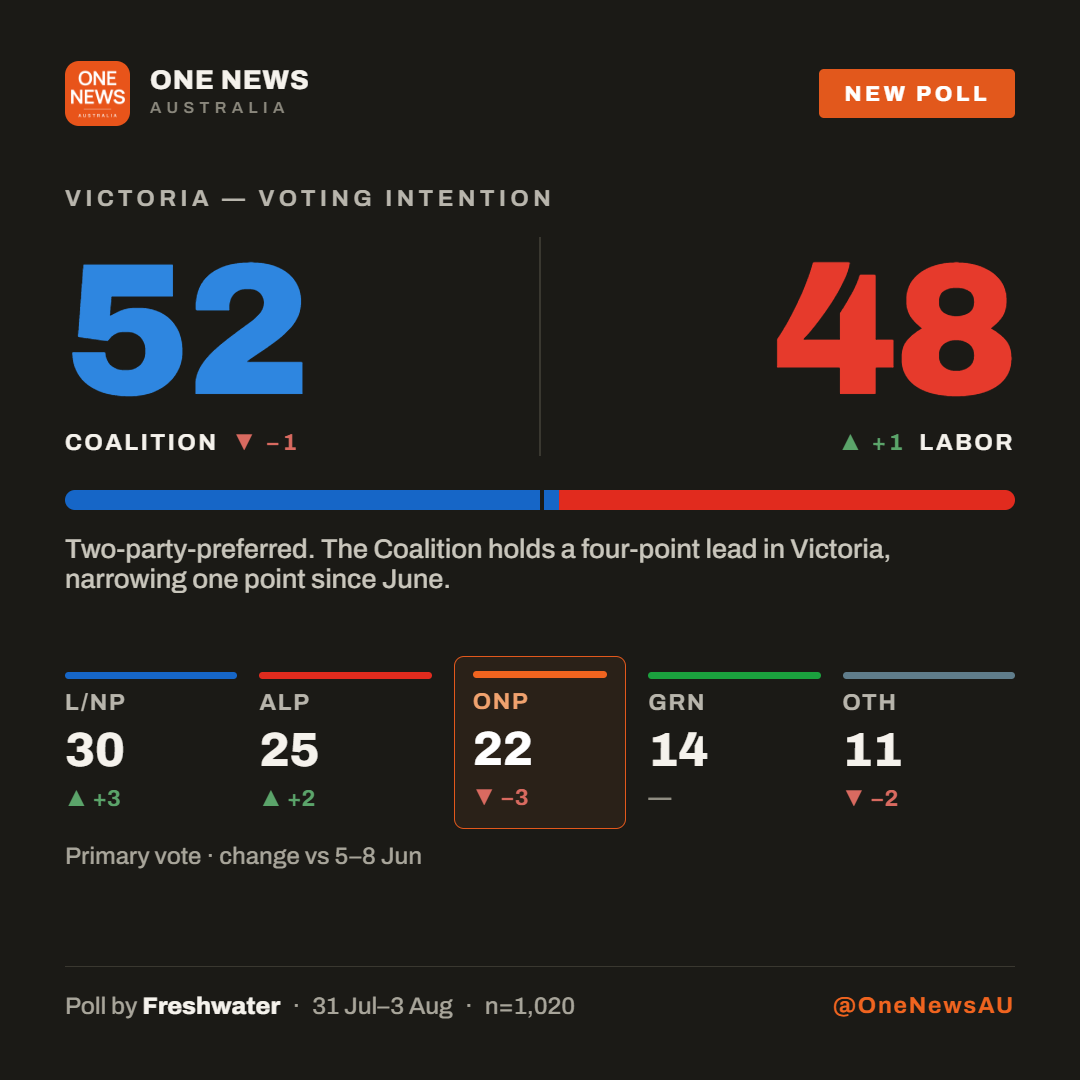
Freshwater's new Victorian poll, conducted 31 July to 3 August from a sample of 1,020 and posted through the AusPoll account on X, has the Coalition first on 30% primary, up 3, with Labor second on 25, up 2, and One Nation third on 22, down 3. The Greens hold 14 and Others sit on 11. On two party preferred the Coalition leads 52 to 48, narrowing a point since June.
The timing is the first thing to understand about it. Fieldwork ran to 3 August, so the survey was almost entirely in the field before One Nation unveiled its Victorian team on 2 August. Whatever effect a full slate of named candidates has on the Victorian vote, this poll was closing as it happened. The next one is the first real test.
The second thing is who the pollster is. Freshwater last surveyed Victoria in early June, and against that benchmark One Nation is down 3. But it is a different house to the ones that had One Nation in front here: RedBridge, polling for the Victorian Trades Hall off a 6,500 sample last month, had One Nation first on 27, and DemosAU had it second. Freshwater's 22 is the lowest reading any pollster has given One Nation in Victoria since autumn, and its 30 is the best number the Coalition has had all year.
The floor is the story regardless. One Nation was polling in single figures in Victoria eighteen months ago and did not hold a seat in the state. On its worst published number of the winter it still takes more than a fifth of the Victorian primary vote, in the state that was supposed to be immune, with an election on 28 November and its candidates now on the board.
7:15am 3 August 2026 — DemosAU puts One Nation on 60 seats and the Coalition on 13 as Jane Hume rules out a deal
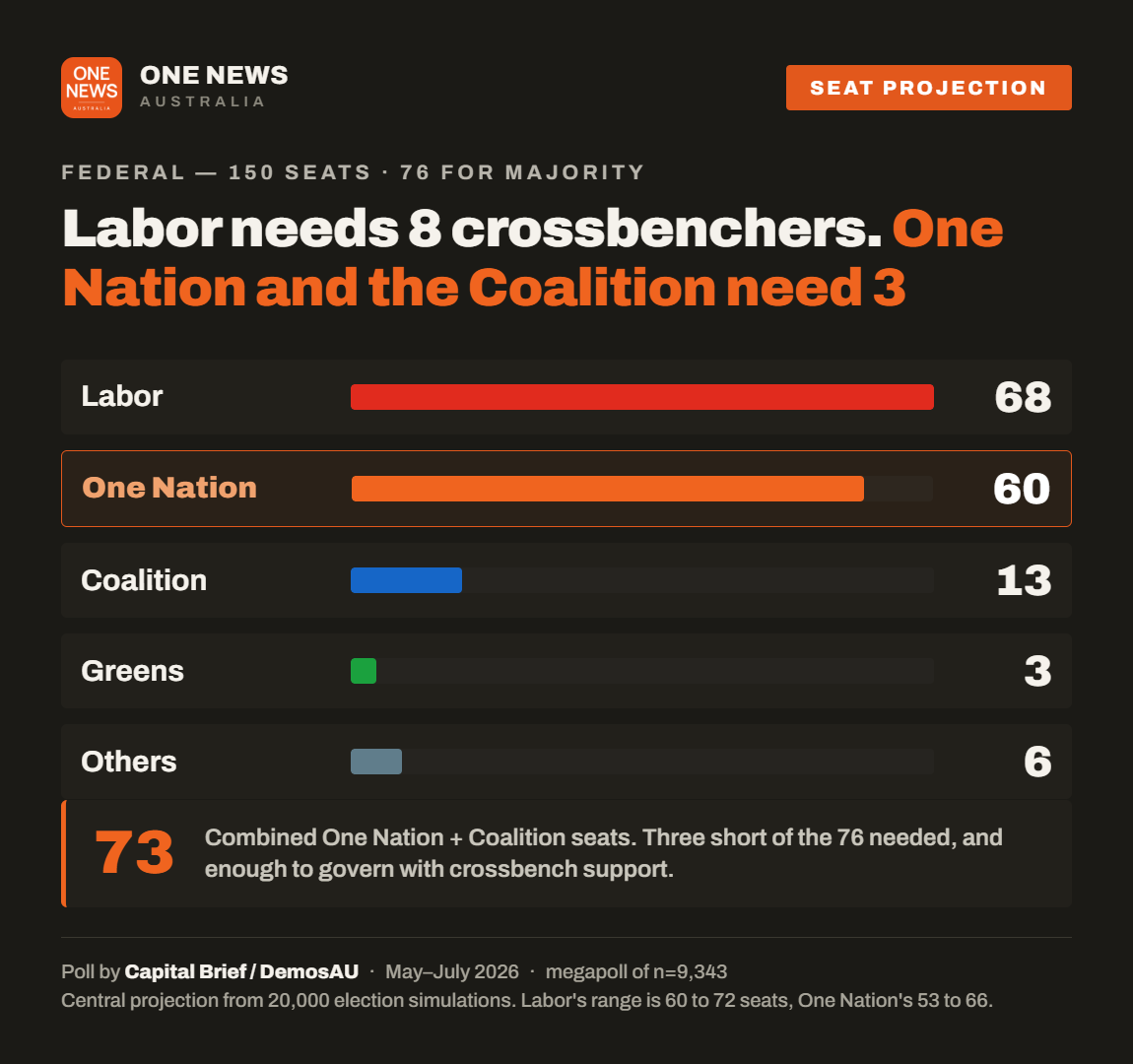
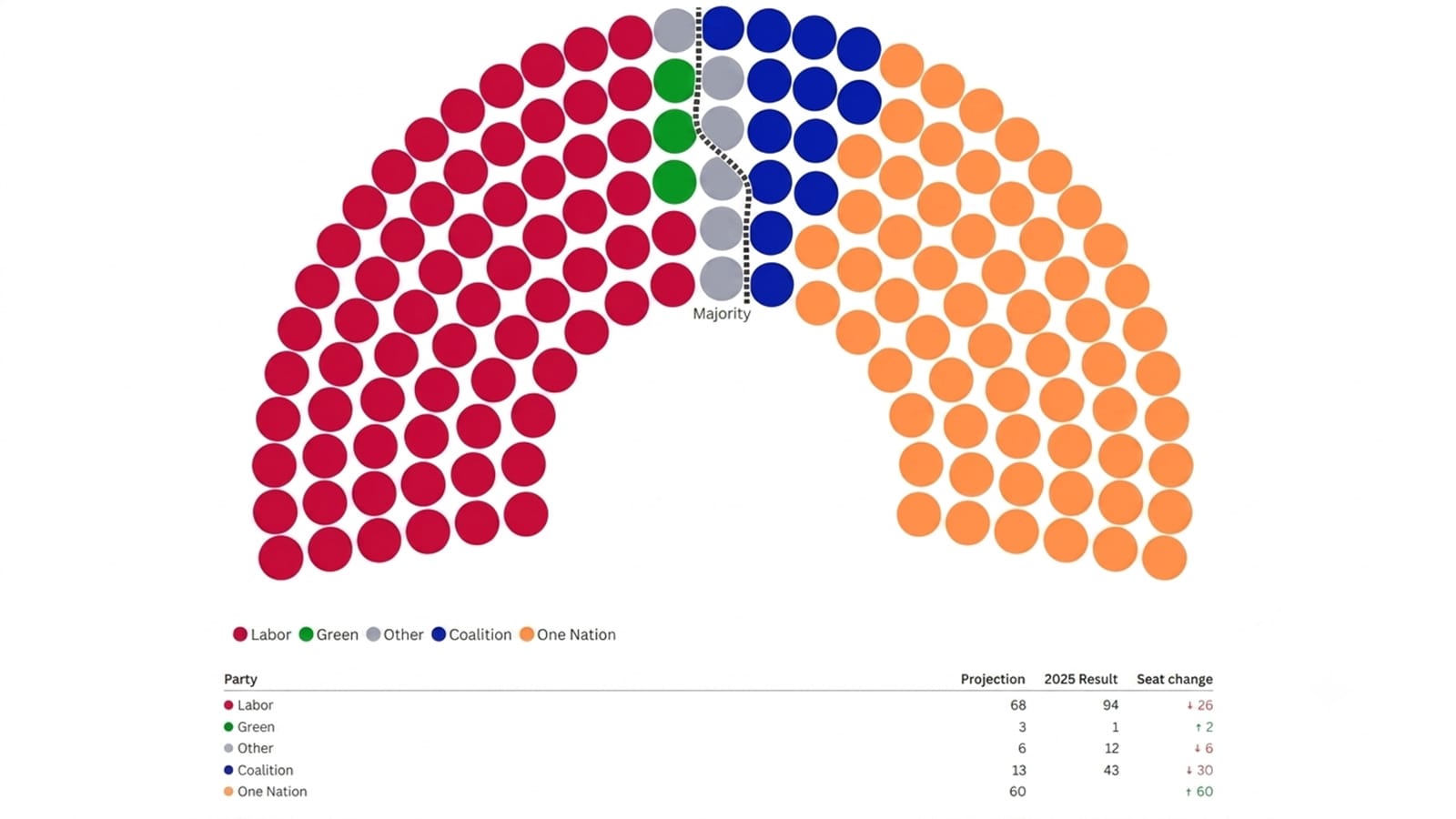
DemosAU's seat projection for Capital Brief, built from 9,343 voters and run through 20,000 election simulations, puts One Nation on 60 of the 150 lower house seats and the Coalition on 13. Labor lands on 68, the Greens on 3 and others on 6, and nobody reaches the 76 needed to govern.
That leaves 9 crossbenchers holding the result, and the count that follows is the one nobody in the Coalition wants to do out loud. Labor on 68 would need 8 of those 9 to stay in office. One Nation and the Coalition on a combined 73 would need 3. The bloc that says it wants Labor gone is the better placed of the two to do it.
Deputy Liberal leader Jane Hume spent Sunday on ABC's Insiders ruling out the arrangement those numbers point to, saying the Liberals will never govern in coalition with One Nation, then declining repeatedly to rule out accepting its support in a hung parliament. Shadow energy minister Dan Tehan told News24 the same thing when he was asked about confidence and supply, the deal where a smaller party keeps a government in office without joining it.
“Well, look, that's a hypothetical and, you know, you have to wait and see what the makeup of the parliament is after any election,” Tehan said.
The Coalition sits on 13 seats in this model and 22% in the latest RedBridge. The party it says it will never partner with sits on 60 seats and 31%. Hume was asked whether the Liberals would take One Nation's help. On these numbers the harder question is whether One Nation is going to need hers.
6:40pm 2 August 2026 — RedBridge federal: Labor sinks to its worst as One Nation leads on 31 and the Coalition takes the two party lead
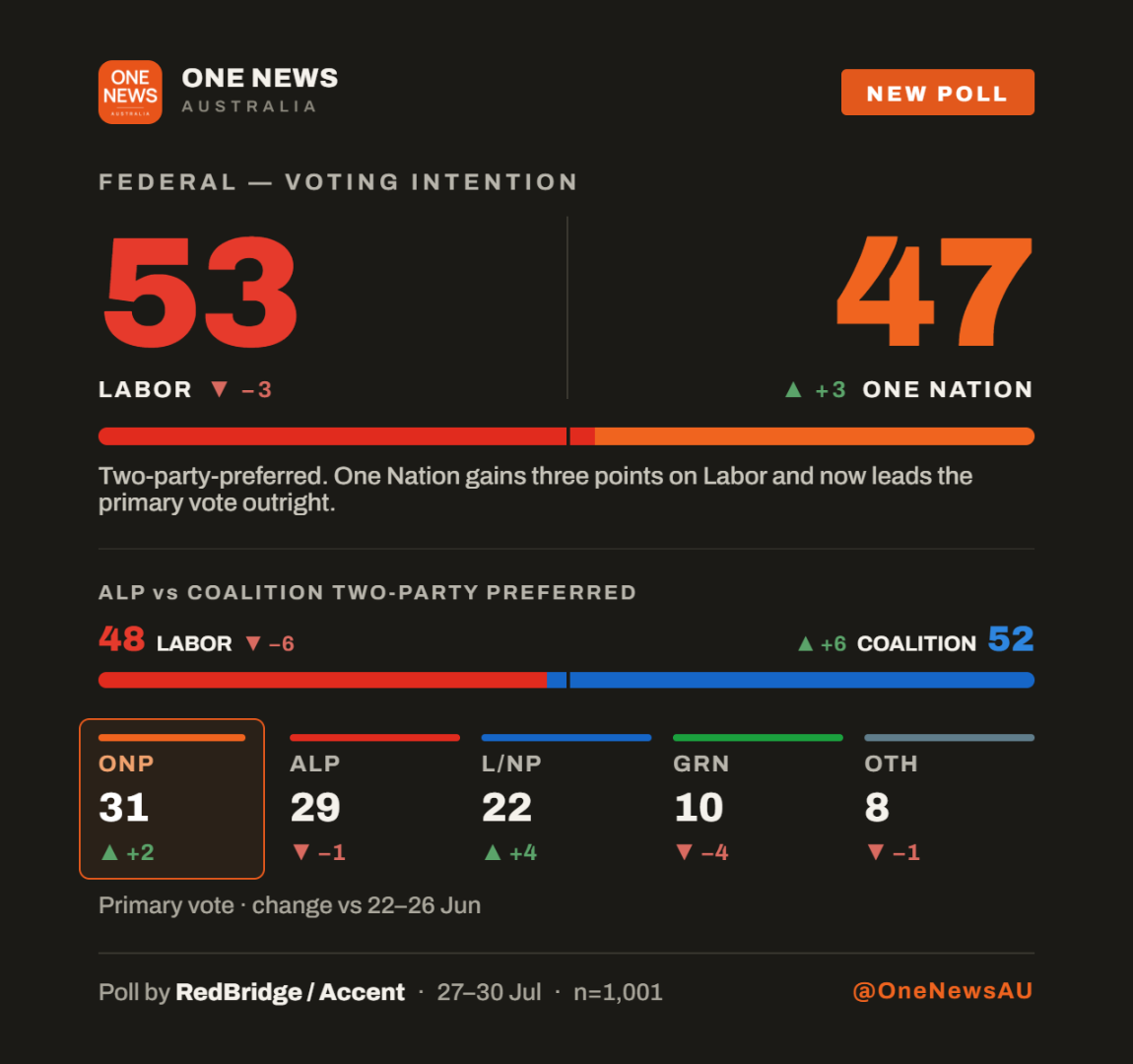
RedBridge and Accent's federal poll, conducted 27 to 30 July from a sample of 1,001 and posted through the AusPoll account on X, has One Nation first on 31%, up 2, with Labor down 1 to 29 and the Coalition recovering 4 points to 22. On the traditional two party count the Coalition now leads Labor 52 to 48, a 6 point swing since June and the first time this series has put the Coalition in front.
For Labor this is the grim one. A 29% primary is its lowest of the year in this series, its two party lead has not just narrowed but reversed, and it comes from RedBridge, the pollster whose director Kos Samaras is a former Labor campaign strategist. When the number is this bad in the poll most likely to be kind to you, it is not a rogue.
The Coalition's two party lead looks better than it is. That count only decides a seat if the Coalition makes the final two, and on 22% primary it is third, nine points behind One Nation. The contest that increasingly matters, Labor against One Nation, RedBridge has at 53 to 47, tightening 3 points in a month. One Nation leads the primary vote outright and is closing the count that will actually be run in its seats.
Numbers like these start succession talk, and it has already started. One News has reported the positioning around Jim Chalmers as the man Labor turns to if Anthony Albanese's vote keeps sliding. The problem is what Chalmers brings with him. His signature economic idea, the capital gains overhaul One News reported as a death tax trap, passed parliament in June and is now law. It quietly freezes a tax bill on every asset Australians own, and never spells out that a death in the family does not set it off. Labor's fix for punishing voters is to promote the man who wrote the tax.
5:15am 29 July 2026 — YouGov: Labor falls to a record low 28% primary as One Nation holds second on 25%
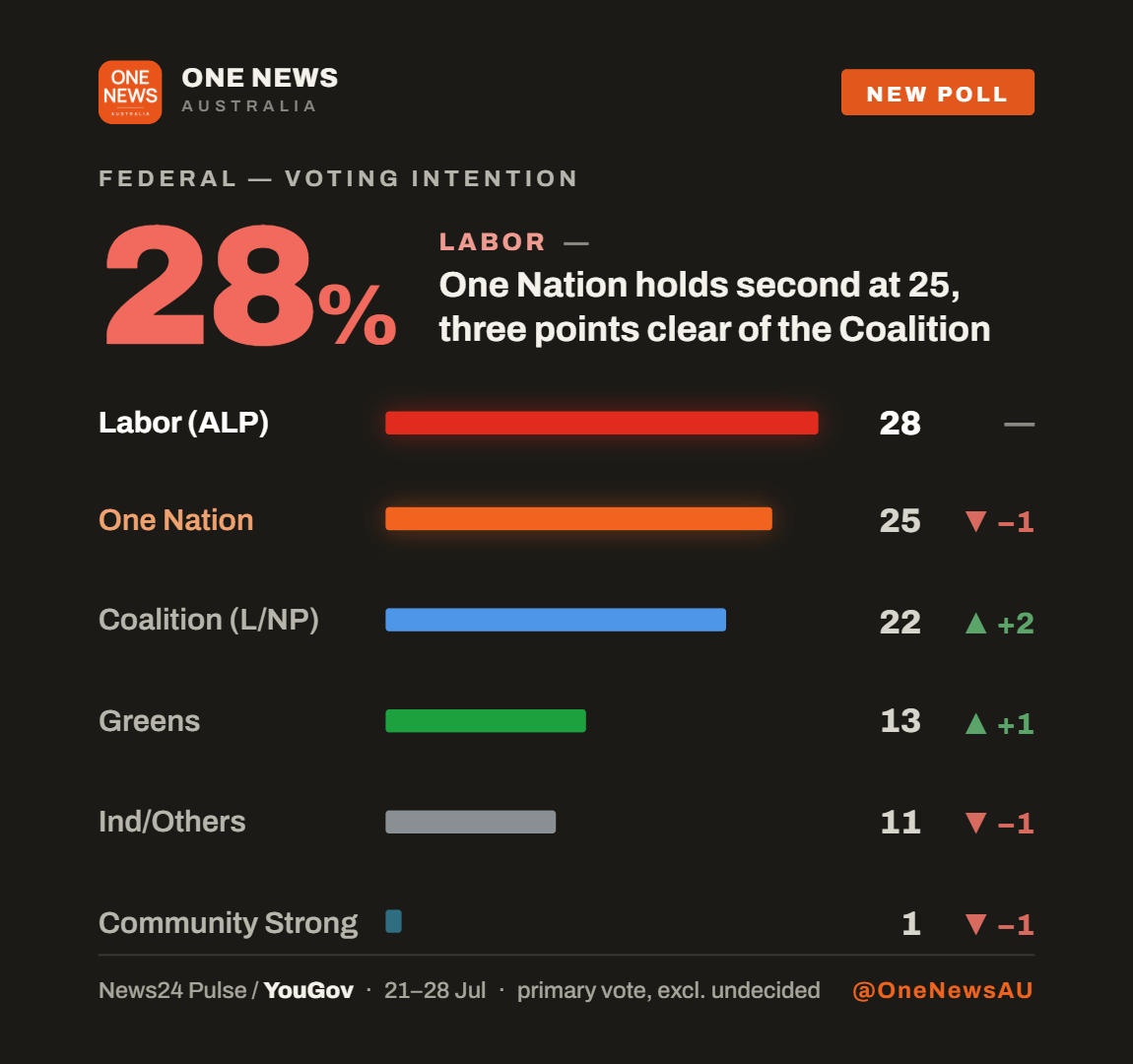
The latest News24 Pulse / YouGov poll, published alongside Pauline Hanson's voter Q&A special, has Labor's primary vote at a historically low 28%, with One Nation second on 25% and the Coalition trailing on 22%. Fieldwork ran from 21 to 28 July.
Labor still leads on the two party preferred count, 53 to 47 over the Coalition and 56 to 44 over One Nation, but YouGov's own director says the numbers are no endorsement of the government.
“In an election held now, Labor would easily win a majority of seats, despite having the lowest primary vote for a party winning a majority since Federation,” YouGov Director of Public Data Paul Smith said.
A governing party on 28% isn't winning voters, it's winning preference flows, and Labor has now polled below 30% in the same week Roy Morgan put One Nation on 25.5%. The two party gap is the only thing keeping Labor's majority alive, and Pauline Hanson's answer to it is the 100 day plan she laid out on News24 on Tuesday night.
6:10pm 28 July 2026 — One Nation jumps 3% to overtake the coalition as Labor's lead narrows
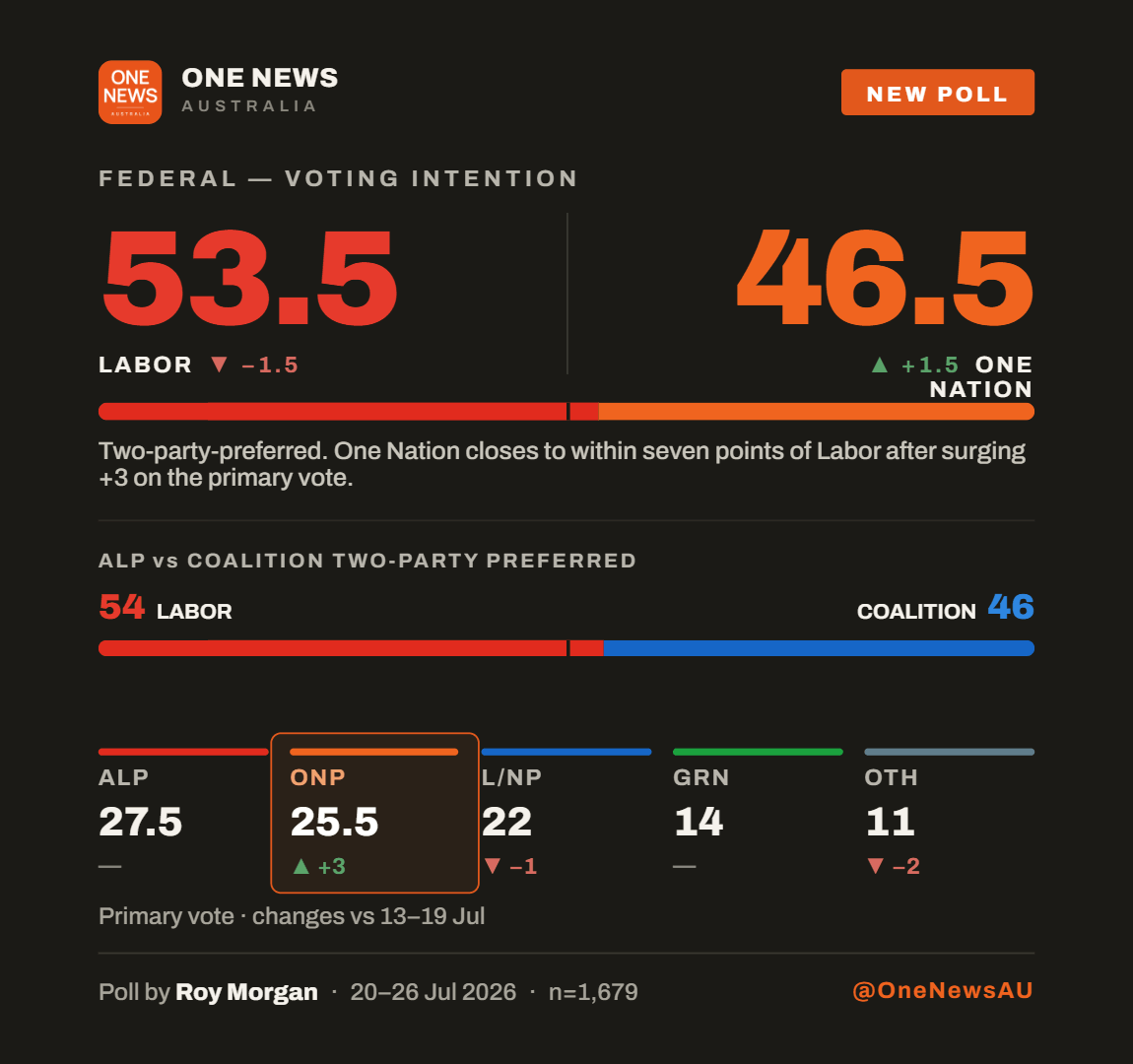
One Nation's primary vote has jumped 3% to 25.5% this week, pushing the party back past the L-NP Coalition on 22% and into second place behind Labor on 27.5%, according to the Roy Morgan Poll of 1,643 electors conducted from 20 to 26 July. Roy Morgan says the recovery was driven by gains in New South Wales (up 3.5%), Victoria (up 4%) and Queensland (up 4%), and came in the week Pauline Hanson returned from Europe and launched Luke Herdegen's campaign for the Western Australian seat of Secret Harbour.
In a head-to-head contest, Labor leads One Nation 53.5% to 46.5%, with One Nation clawing back 1.5% this week. Against the Coalition, Labor's two-party lead has narrowed 2% to 54-46.
The number that should worry the government is buried further down. Roy Morgan's Government Confidence Rating sits at 69, more than 30 points below neutral, and 58% of Australians say the country is going in the wrong direction. Labor holds an election-winning lead in a country that, by Roy Morgan's own measure, doesn't think the country is being run well. That is a soft lead, and One Nation's 3% bounce in a single week shows how quickly it moves.
5:00am 27 July 2026 — DemosAU's 9,343 voter mega poll puts One Nation on 30% and nobody on 76 seats
DemosAU's MRP model for Capital Brief, built from 9,343 voters surveyed between May and July, has One Nation first on a 30% primary vote. Labor sits on 26, the Coalition on 21, the Greens on 13 and Others on 10.
Run through 20,000 Monte Carlo simulations, the model gives Labor 60 to 72 seats, One Nation 53 to 66, the Coalition 11 to 22, the Greens 1 to 5 and Others 3 to 7. Inside the Coalition number the Liberals take 11 to 20 and the Nationals anywhere from nothing to 2. You need 76 to govern. On this model nobody gets there.
‘One Nation is now leading across many Outer Metro seats in Brisbane and Perth and also a few in outer Sydney and Outer Melbourne,’ DemosAU head of research George Hasanakos said.
The preference numbers are the ones the Liberals should read twice. One Nation preferences flow to the Coalition at 80%, and 67% of Coalition preferences come back to One Nation. That is a right of centre bloc already behaving like a bloc, which is exactly what the WA Liberals conceded when they put One Nation third and Labor tenth in Secret Harbour. One Nation has gone from a party the majors preferenced last to one they cannot govern around.
7:00am 22 July 2026 — DemosAU ACT: One Nation debuts on 14% and leaves the Canberra Liberals unable to govern
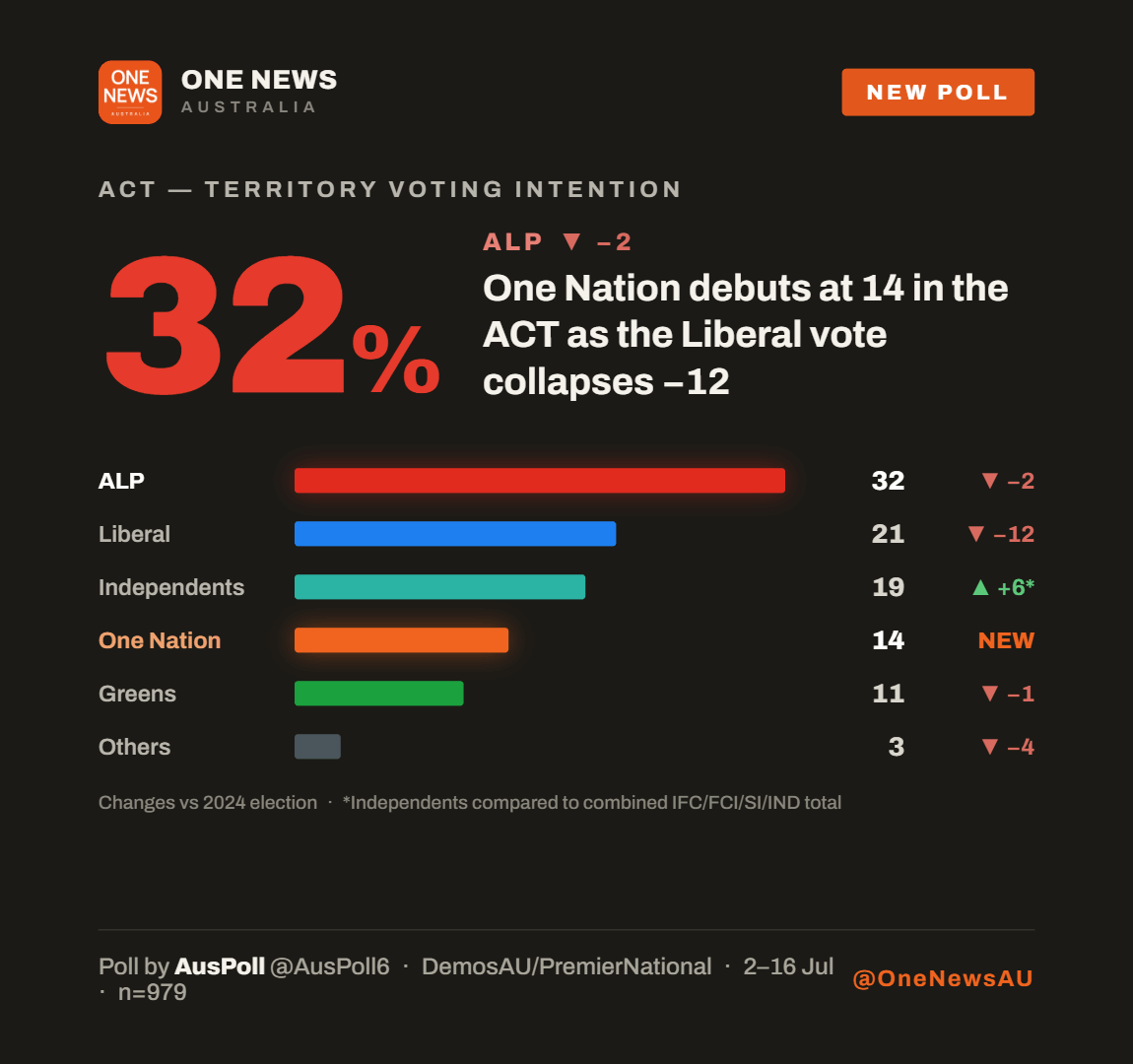
A DemosAU poll for PremierNational, conducted 2 to 16 July from a sample of 979 Canberra voters, has One Nation debuting on 14% in the ACT. The Canberra Liberals crash 12.5 points to 21%, Labor slips 2.1 to 32, the Greens hold 11 and independents climb 6.1 to 19.
The ACT is the safest ground Labor and the Greens have anywhere in the country, the one parliament the Liberals have never won, and One Nation has walked in and taken 14% at its first time of asking. On these numbers the Liberal vote falls more than four times as far as Labor's.
George Hasanakos, DemosAU's head of research, said the Canberra Liberals would be guaranteed just one seat in each of the five electorates, and that 'a One Nation contingent in the Legislative Assembly would make attracting enough independents to form government an almost impossible task'.
It is the same pattern the tracker keeps recording in state after state. One Nation is not just carving up disaffected Liberals, it is replacing the Coalition as the main force on the right, and it is now doing it inside Labor's safest territory.
5:45pm 21 July 2026 — Roy Morgan: the Coalition noses half a point ahead of One Nation, in the poll that swings hardest
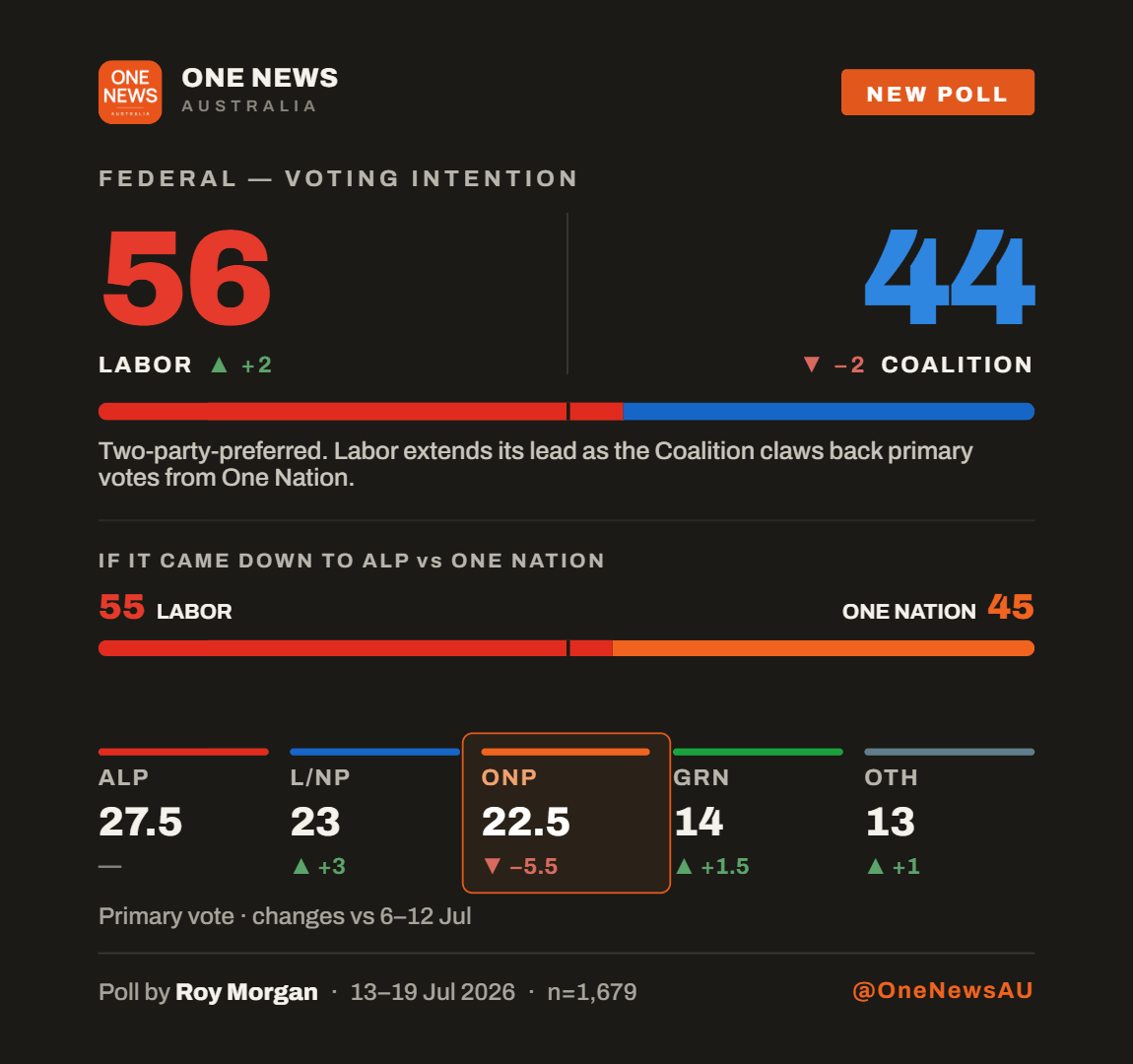
Roy Morgan's weekly survey, conducted 13 to 19 July from a sample of 1,679, has One Nation down 5.5 points to 22.5%, with the Coalition up 3 to 23 and edging half a point in front. Labor is unchanged on 27.5, with the Greens on 14 and Others on 13.
Half a point is inside any margin of error, so call it a tie for second. The sharper question is which poll to believe, because Newspoll was in the field the very same week and found a different country: One Nation on 30, level with Labor at the top, and the Coalition on 19. An eleven point gap between two pollsters surveying the same voters in the same week is not a story about voters changing their minds. Roy Morgan's own weekly series has now swung by at least 3.5 points every week for a month, 31.5 to 26 to 22.5 to 28 and back to 22.5, movement no other pollster records, drawn from the kind of research panel most Australians never get asked to join. Newspoll, YouGov, DemosAU and Resolve all had One Nation between 26 and 30 in July.
Roy Morgan's write-up blames Pauline Hanson's European trip. Newspoll polled through the same fortnight and had her level first with her approval rating recovering to net zero. Both cannot be true, and every other pollster in the field sits with Newspoll.
Even inside Roy Morgan's soft week, the shape of the contest holds: its final round count is still Labor against One Nation, 55 to 45, and its own confidence rating has 59.5% of Australians saying the country is heading in the wrong direction under this government. The wildest poll in the field on its wildest fortnight still thinks the last two parties standing are Labor and Pauline Hanson's.
5:20am 20 July 2026 — Newspoll: One Nation back on 30, level at the top, as Labor equals its worst primary since 2022
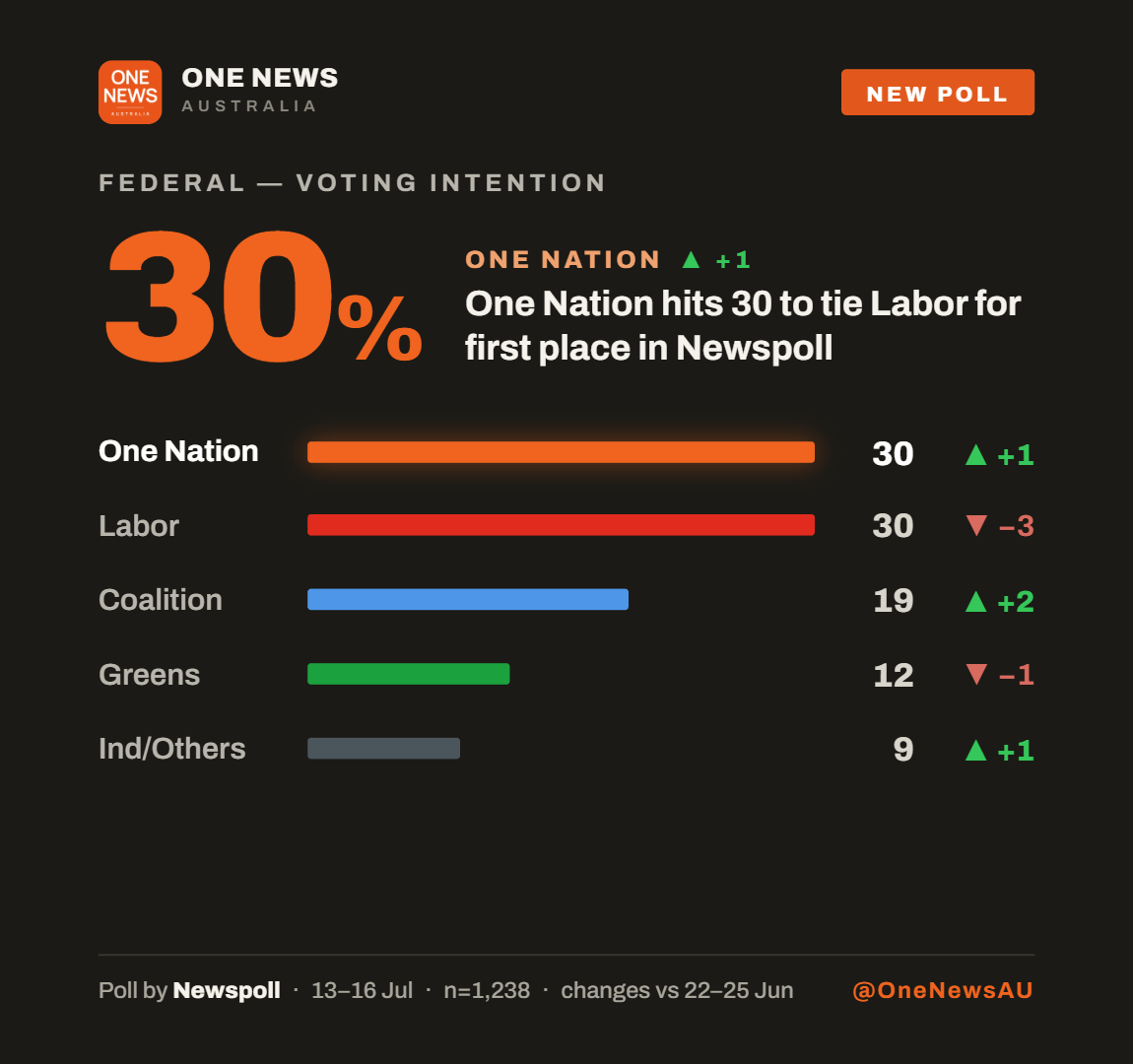
Newspoll is back in the field and Pauline Hanson is back at the top of it. The survey of 1,238 voters, conducted 13 to 16 July has One Nation up 1 to 30% and level with Labor, whose primary fell 3 to 30, its equal lowest since Anthony Albanese won the 2022 election. The Coalition lifted 2 to 19, the Greens slipped to 12 and Others sit on 9.
The fieldwork ran through a fortnight of scrutiny of Hanson's overseas trips, her party's policies and decades old comments from Malcolm Roberts, with Angus Taylor promising a One Nation government would deliver an eternity of pain. And the result has landed just as the attacks escalate: her CPAC speech picked over line by line, Albanese lecturing her from the Tiwi Islands about talking Australia up, and NSW Premier Chris Minns going furthest of all:
“I think that would be bad for our economy, bad for community cohesion, and bad for young people who may not have white pigmentation.”
It is a scare tactic, and it is Labor's, not hers. Hanson has never called for anyone to be treated differently because of their skin. Her CPAC speech argued that migrants should assimilate and that Australians should not have to apologise for being white. Minns turned that into a warning about pigmentation, a threat nobody made, aimed at frightening migrant communities away from a party that nearly one in five voters from non English speaking homes already supports in the latest YouGov breakdown.
And the poll says the scare is not landing. The attacks moved Labor's number, not Hanson's. Labor has not polled this low since the Gillard years, while Hanson's personal standing improved to net zero, 47% satisfied and 47% dissatisfied, the only leader in the poll not underwater. Albanese sits on minus 18, Taylor on minus 21.
12:45am 15 July 2026 — Two party preferred: pick the final round and see who wins the flow
The tracker's second interactive is live below. Two party preferred is the count that actually decides the election, where everyone's preferences flow to the last two parties standing. Tap between the two final rounds the pollsters now model: Labor against the Coalition, and Labor against One Nation.
Against the Coalition, Labor's final round lead has barely moved all winter: 54.5 to 45.5 in mid June, 54 to 46 at the end of June, 54 to 46 last week, and 53 to 47 in the new YouGov. Against One Nation the pollsters split. RedBridge and YouGov both make it 56 to 44, while Roy Morgan has run it as close as 52.5 to 47.5.
A year ago the Labor versus One Nation pairing did not exist in anyone's polling. Now every major pollster runs it, which tells you who they think the last two parties standing will be. The wall between One Nation's primary vote lead and government is the preference flow, and the tabs below show its size: three to six points, depending who you ask. That is the number that has to move before 2028.
📊 Interactive two party preferred box loads here on the live site. Do not delete this block.
11:30pm 14 July 2026 — YouGov's comprehensive breakdown: One Nation owns the workers, the regions and the over 50s
YouGov has broken its latest poll down into every group in the country, by age, sex, state, class and past vote. Use the interactive below to explore any of them. Here is the short version.
One Nation's strengths are workers, the regions and older Australians. It is the number one party for working class voters, for rural and provincial Australia, and for everyone over 50. And its base is the most loyal in the country, with 91% of its 2025 voters still on board.
The weaknesses are real and they cluster in the same places. Young voters, where the party runs fourth and the Greens lead. The inner cities, where Labor is far ahead. The well off, who are still voting Coalition two to one over One Nation, and the middle class, where the party sits third behind both majors. And the ACT, NT and Tasmania, the one part of the country where even the independents poll ahead of it.
The threat right now is not Labor, it is the Coalition. 38% of people who voted Coalition last year now back One Nation, but a fortnight ago that was 46. The Coalition is quietly winning some of those voters back, and that is where its small recovery came from.
So the job is clear. Hold the ex Coalition vote, and give the middle class and the young a reason to move: get moving on detailed, costed policies and named candidates.
📊 Interactive poll box loads here on the live site. Do not delete this block.
8:50pm 13 July 2026 — RedBridge Victoria: One Nation takes the lead in the unions' own polling
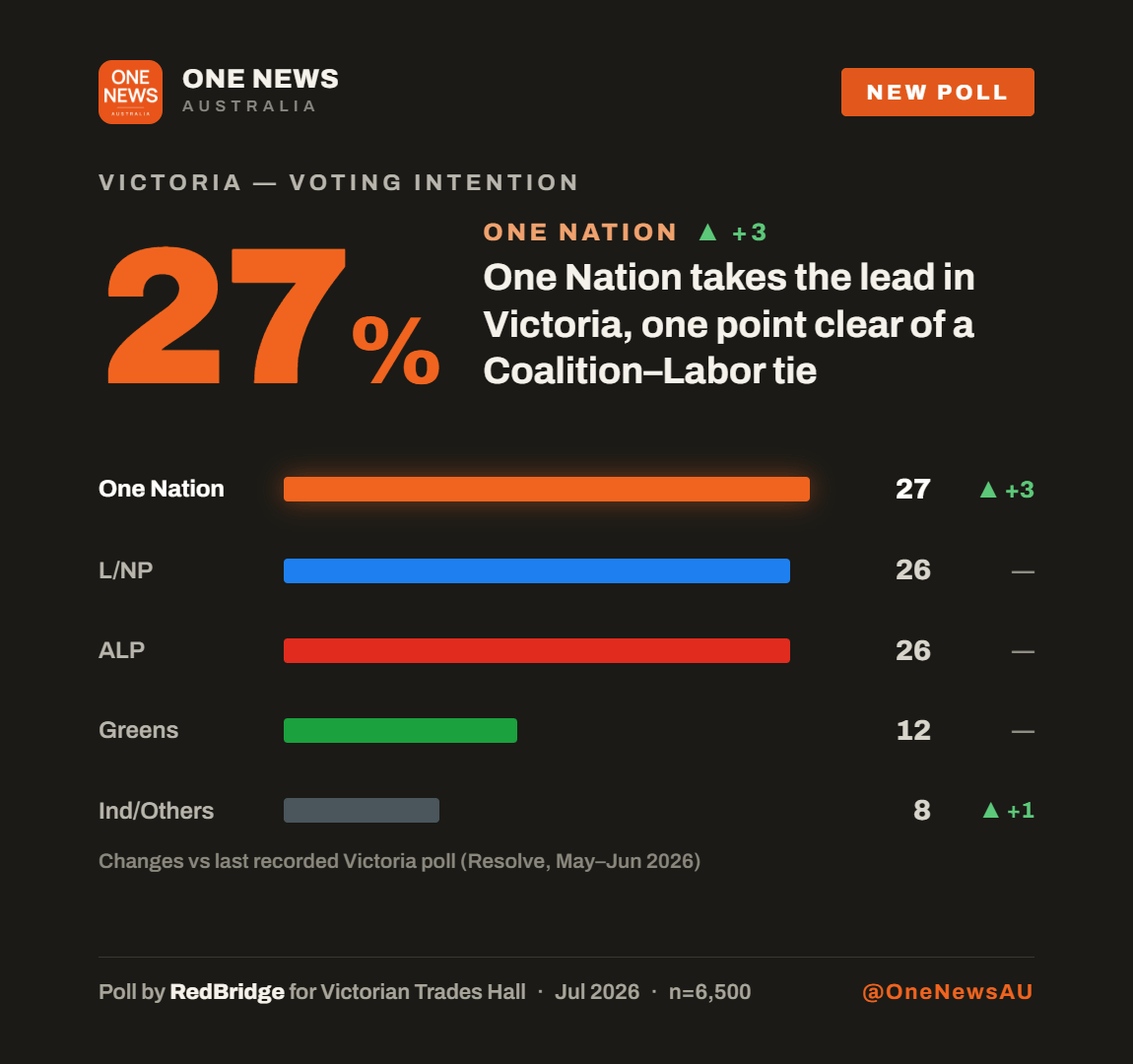
A huge new Victorian poll has One Nation on top. RedBridge, polling for the Victorian Trades Hall off a 6,500 sample, has One Nation first on 27%, up 3, one point clear of the Coalition and Labor tied on 26.
It matters who paid for it. The Victorian Trades Hall is the peak union body, about as Labor-friendly a client as exists in this country, and its own poll has One Nation leading the state. In the last Victorian poll, Resolve had One Nation on 24 with the two majors just ahead. Three points later it is in front.
And it is leading the most progressive state in the country before One Nation has even named its candidates for 28 November. The lead is banked. The candidates are the multiplier.
4:55pm 13 July 2026 — One Nation hits 47.5 head to head with Labor, and the gap more than halves in a week
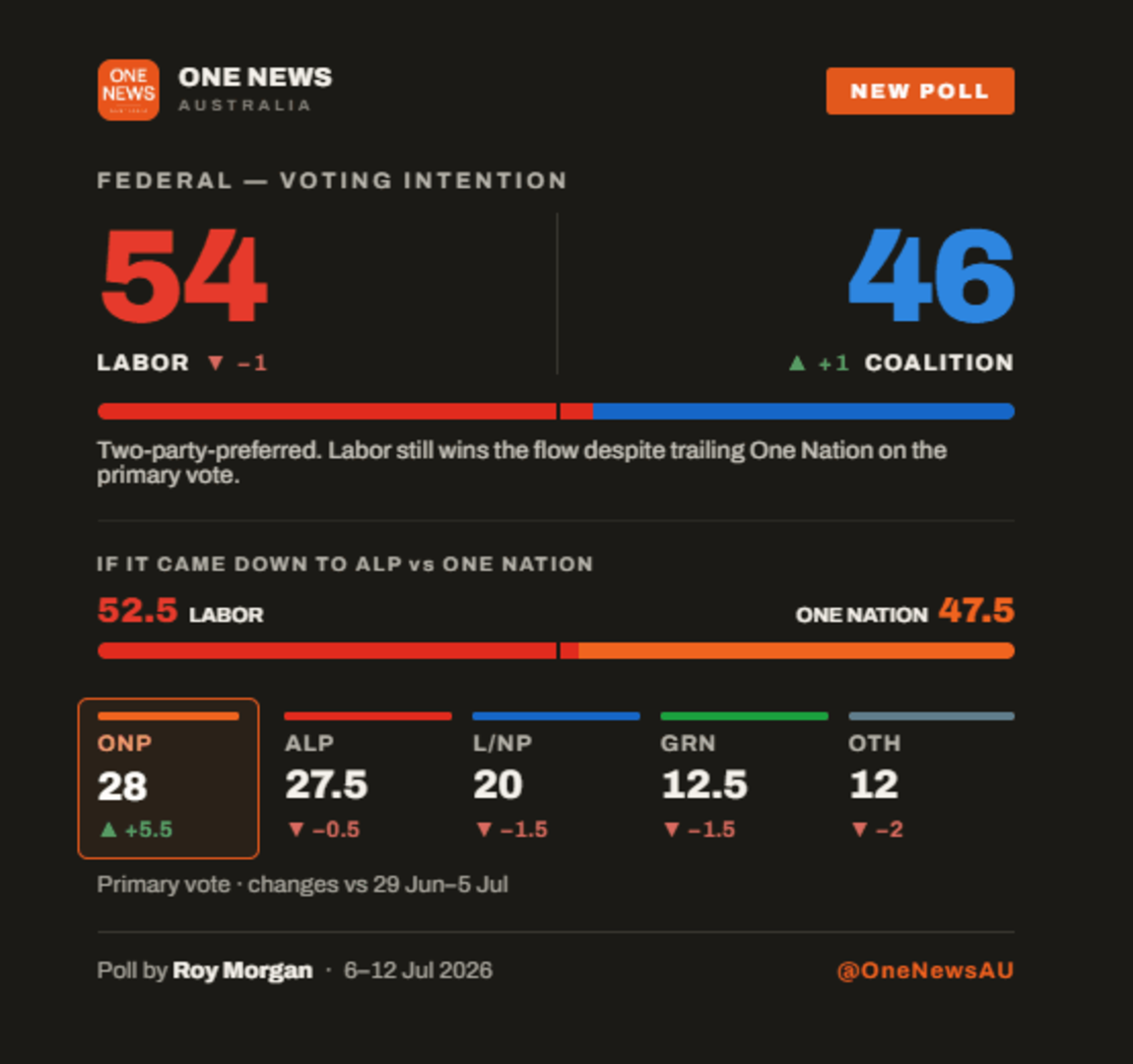
Roy Morgan's weekly survey also runs the number that actually decides elections, the two party preferred, and it now publishes a pairing that didn't exist in anyone's polling a year ago: Labor versus One Nation. This week it sits at 52.5 to 47.5, with One Nation up 3.5 points in seven days. A fortnight ago the same measure read 56 to 44.
Two party preferred is where the race lands after everyone's preferences flow to the last two parties standing. Primary votes decide who makes the final round, preferences decide who wins it. Labor still leads this measure, and 6.5% couldn't say. But the movement is 44 to 47.5 in a fortnight, and there's a sharper point underneath: on the traditional Labor versus Coalition pairing, Roy Morgan has the Coalition on just 46. One Nation's 47.5 makes it the stronger final round opponent to Labor of the two.
The pairing existing at all is the tell. Pollsters model the final round they believe the country is heading towards, and for thirty years that meant Labor versus the Coalition. Roy Morgan now runs Labor versus One Nation every week.
4:39pm 13 July 2026 — Roy Morgan polled the same week as Resolve and found One Nation leading the primary vote
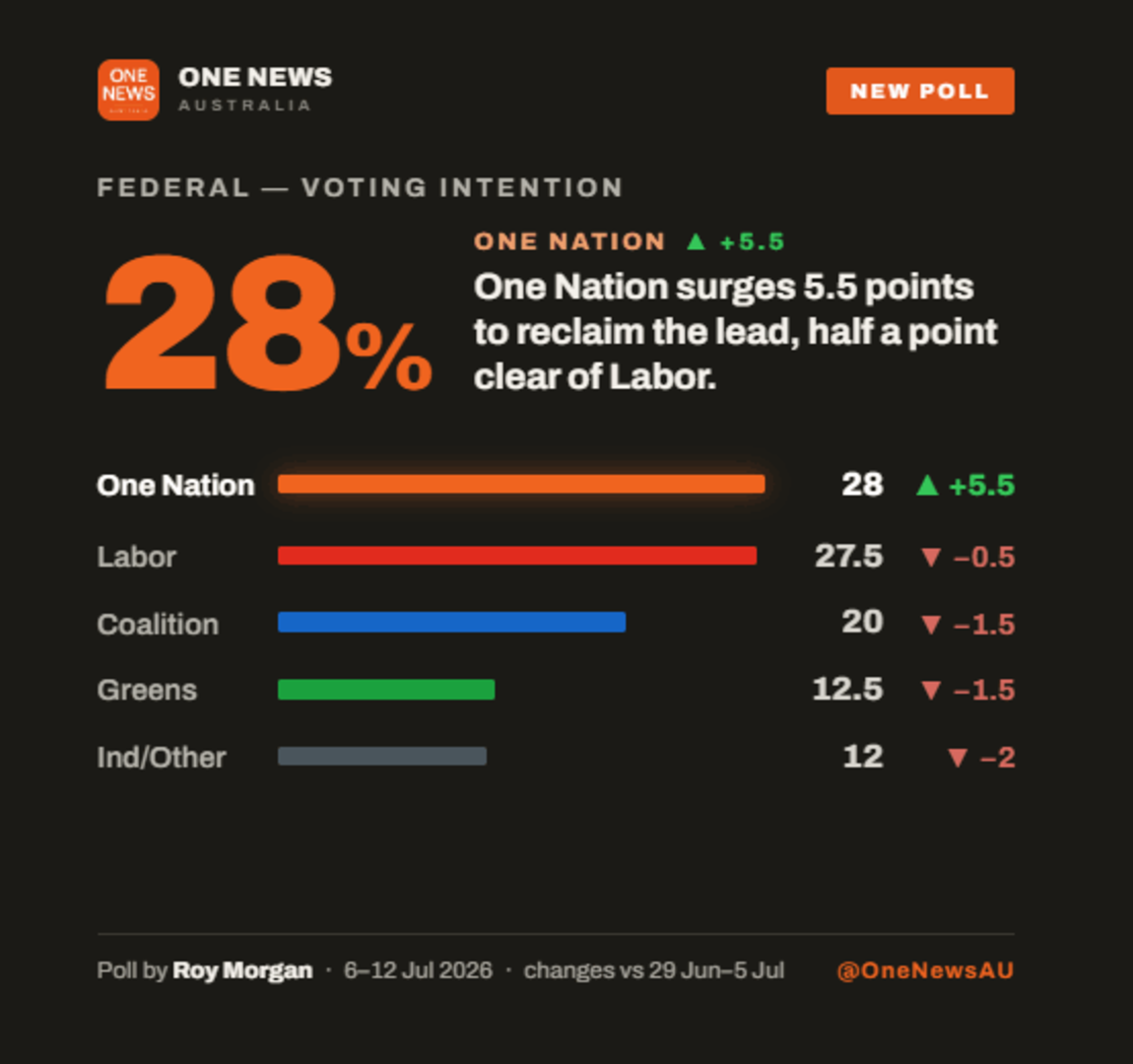
Roy Morgan's weekly federal survey, fielded 6 to 12 July, has One Nation on 28%, up 5.5 points in a week and half a point clear of Labor on 27.5. The Coalition sits on 20.
Resolve polled the country over the exact same days, 6 to 11 July, and found the opposite: One Nation on 26, two points behind Labor. That's the poll that became the weekend's "varnish has come off" headlines in Nine's papers.
Same days, same country, two different answers, and only one of them can be close to right. Which one? That's the catch: you can't tell. Roy Morgan publishes full weekly tables, swings and all, so its misses sit in plain view. Resolve won't name its panels, publish a crosstab or show who was sampled, so there's nothing to check. Roy Morgan is too volatile for our trend chart, which averages five pollsters instead, but volatility you can see beats a sample you can't. Who pays for a poll, who runs it and who gets asked decided which number you read this weekend.
12:10pm 13 July 2026 — Who runs Resolve: one Liberal linked pollster, and the dislike score Nine's report didn't carry
One News has been through the public record on Resolve, and it is effectively one man: Jim Reed, a pollster who spent years at Crosby Textor, the Liberal Party's own campaign research firm, before opening his own shop. The business register shows "Resolve Strategic" traded as Reed personally, a sole trader, until a company was incorporated in June 2024. His website names no other staff.
Unlike YouGov, Essential, DemosAU and Newspoll's Pyxis, Resolve is not a member of the Australian Polling Council, so it publishes no methodology statement, no crosstabs, no panel names and no state splits. Nobody outside the firm can check who its 2,252 respondents actually were, which states they came from, or how they voted last time.
And one number was missing from the report Nine's mastheads published on Sunday. Resolve rates each leader on likeability both ways. Albanese's numbers ran in full, 39 like and 53 dislike, as did Taylor's, 41 and 34. Hanson topped the field on 45 like, and her dislike score did not appear in the published report. That missing figure is the one that would show whether the poll's own data makes her the most popular leader in the country. One News has the full breakdown on who runs Resolve, who pays for it and what the published report left out.
8:05pm 12 July 2026 — Resolve preferred PM: Hanson drops 8 to 25 as support leaks to both Albanese and Taylor
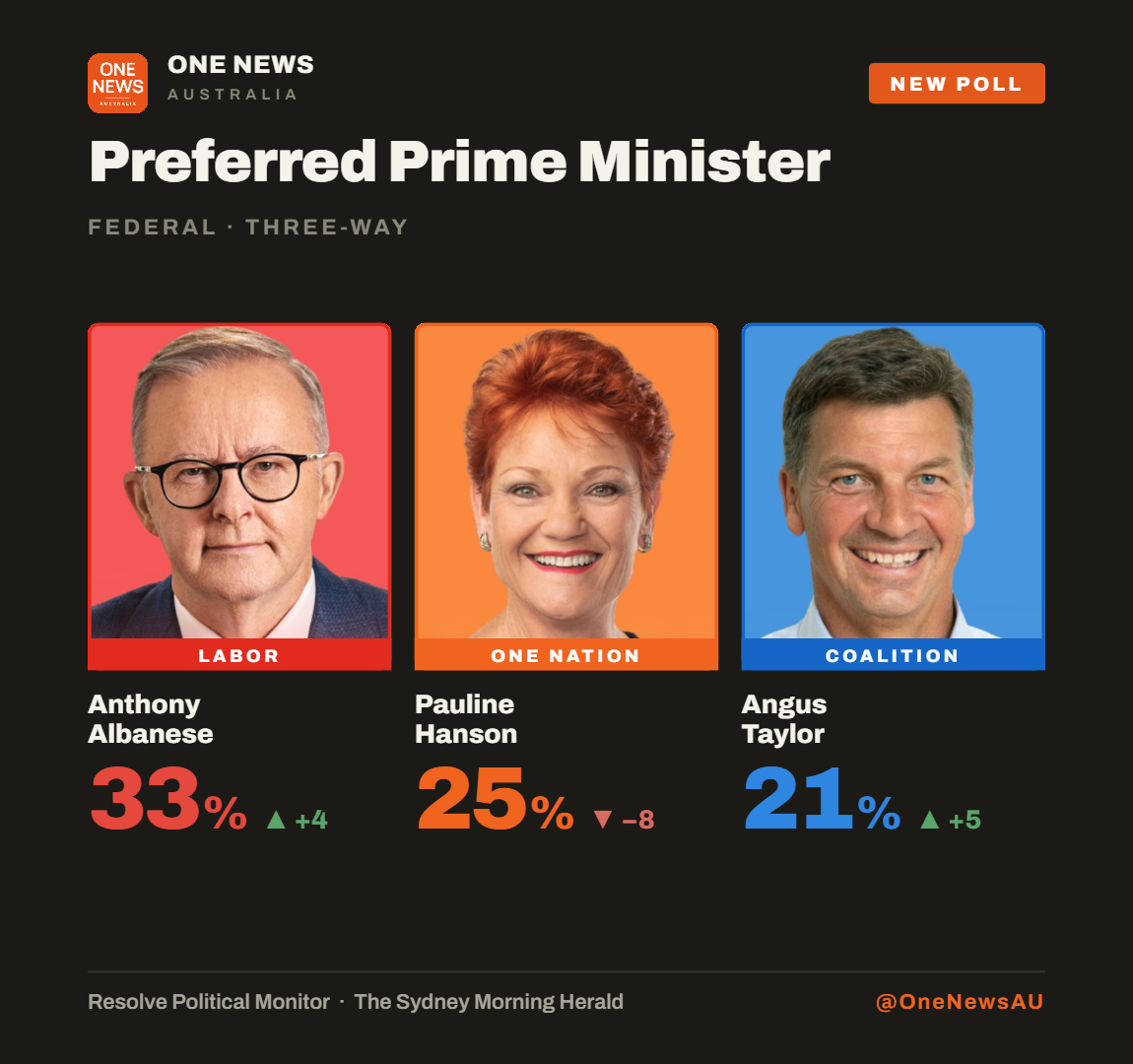
The latest Resolve Political Monitor, has Pauline Hanson down 8 points to 25% as preferred prime minister, slipping behind Anthony Albanese on 33, up 4, with Angus Taylor up 5 to 21.
The fall came from both directions at once. Albanese took 4 points back on the left and Taylor picked up 5 on the right, so Hanson shed support to Labor and the Coalition in the same poll. Sky News put the drop down to softening among women and migrant voters.
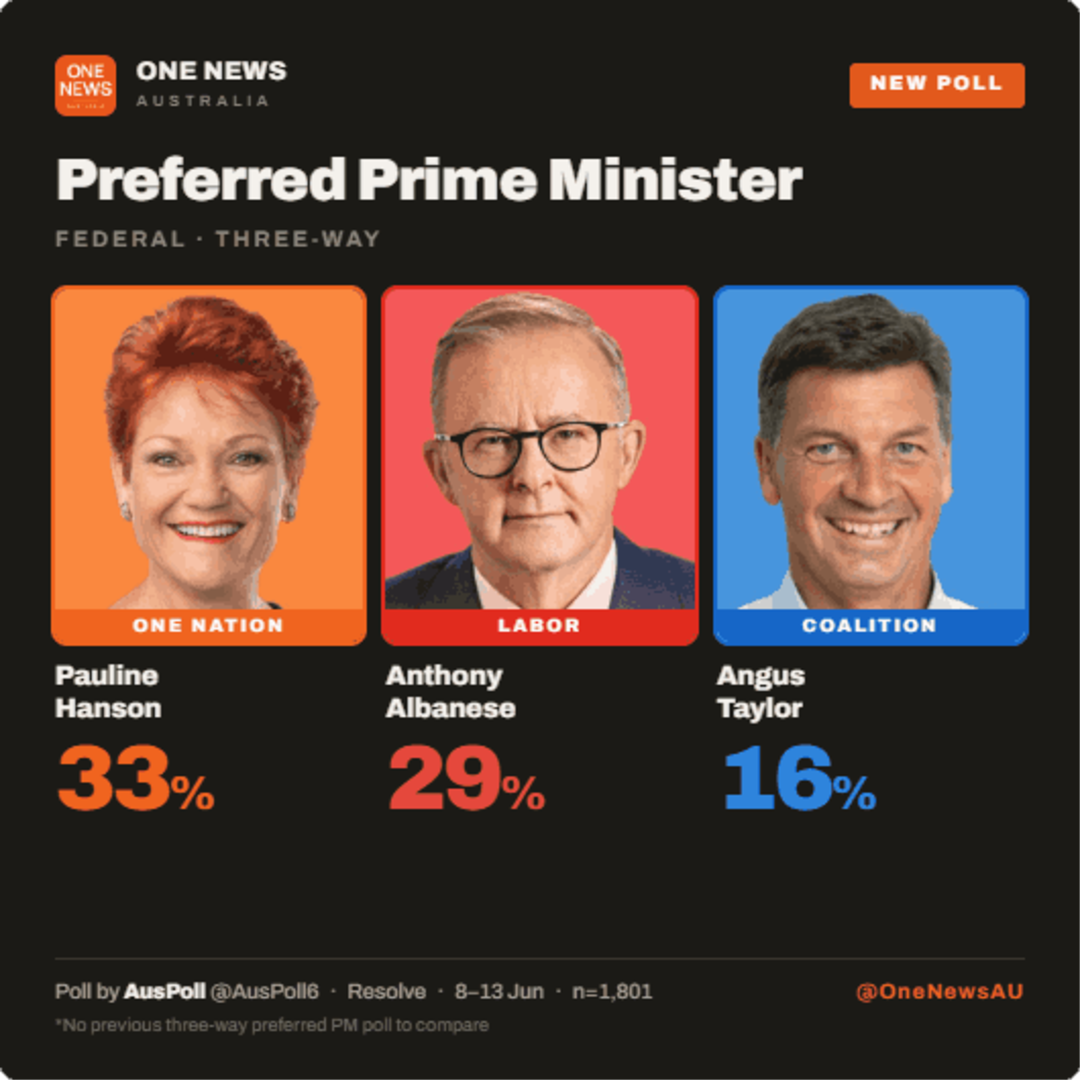
It is worth keeping in proportion. June was the first three-way preferred PM poll ever published, and Hanson led it outright on 33. One fortnight of hostile coverage has trimmed that lead, but it hasn't erased the movement behind it. One Nation still leads or runs a clear second on the primary vote almost everywhere in the country.
The number is a message about what comes next. A wave built on broad frustration has to turn into something voters can hold. The answer is detail. Put the policy on the table in full, the tax, energy and immigration numbers people can actually weigh, and announce the Victorian candidates ahead of the 28 November state election, where One Nation currently leads the primary vote. Costed policy and names on ballots are what carry a movement from a mood to a majority.
7:05pm 12 July 2026 — Resolve federal: One Nation slips to 26 but holds second, two behind a steady Labor
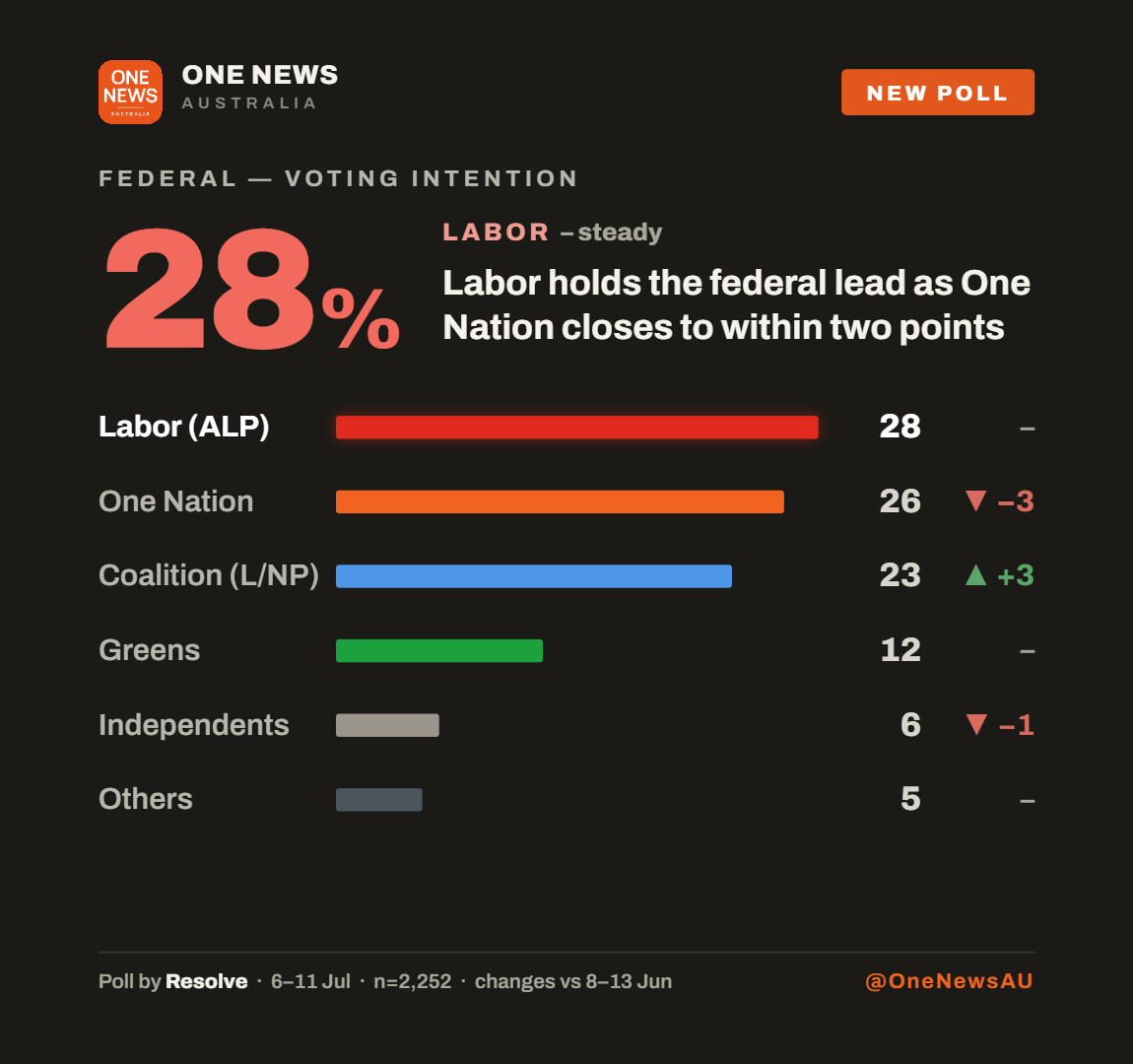
Resolve's latest federal poll, conducted 6 to 11 July from a sample of 2,252 and posted through the AusPoll account on X, has Labor steady on 28% and One Nation down 3 to 26, still second and within two points of the lead. Resolve does not publish a two party preferred, so the primary vote is the whole picture.
The Coalition's 3-point lift to 23 is the number the Liberals will point to, and it is their best federal Resolve reading in months. It still leaves them third. On a fortnight where One Nation gave ground back and the Coalition picked it up, the Coalition finished the exchange still sitting behind Pauline Hanson's party.
The dip is real, not noise. One Nation was on 29 in Resolve last month, and this fits the softening every pollster has caught since the monoculture row. But 26 and a clear second is still a long way from the 18 Resolve had One Nation on at the start of the year. Even in an off fortnight, the floor now sits higher than the ceiling used to.
6:50am 9 July 2026 — DemosAU Tasmania: One Nation debuts at 21%, equal second in the state that held out longest
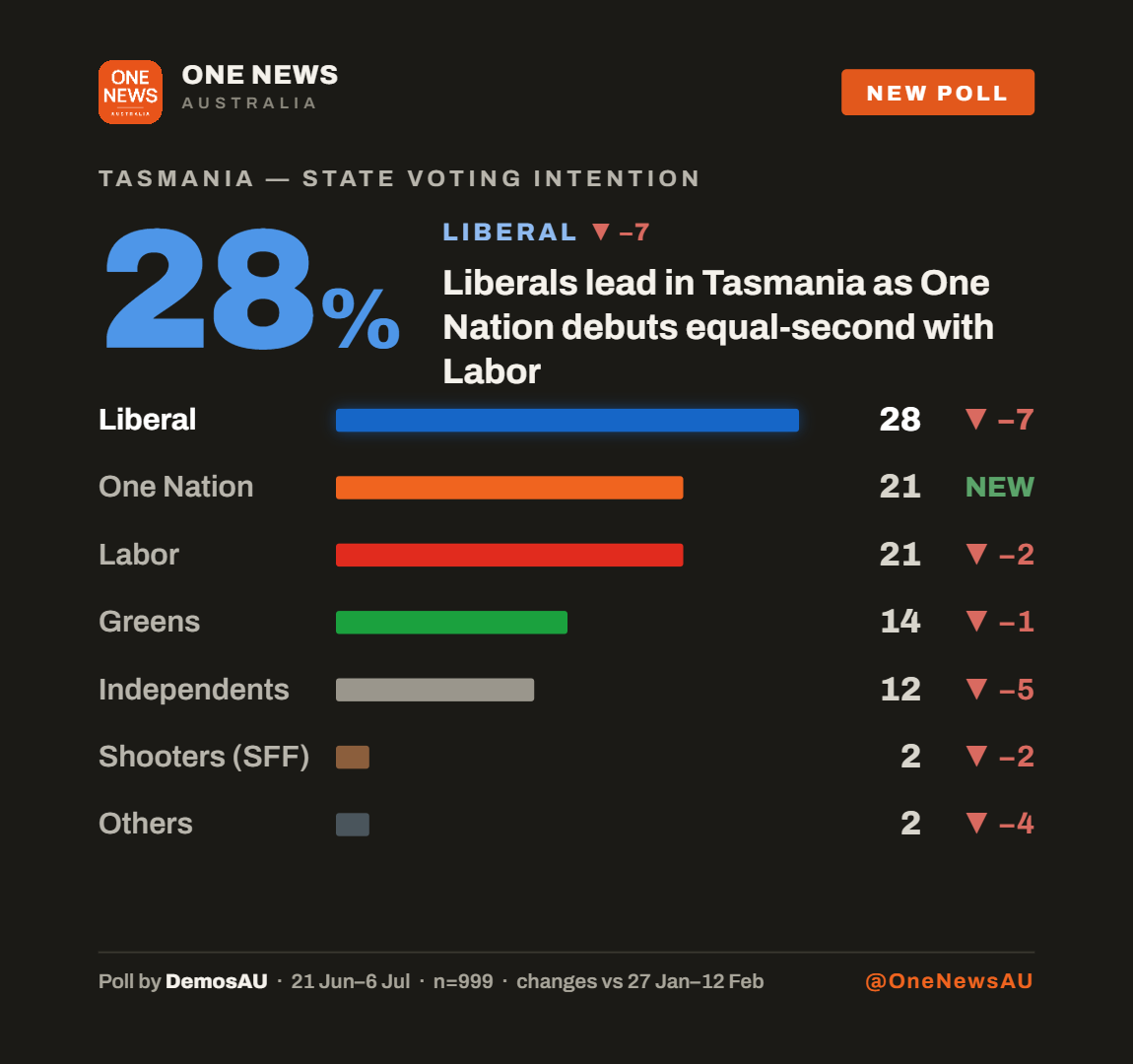
DemosAU's first Tasmanian poll to measure One Nation as its own party, fielded 21 June to 6 July from a sample of 999 and posted through the AusPoll account on X, has the party debuting on 21%, level with Labor for second and behind only a Liberal Party that has crashed 7 points to 28.
That NEW tag next to One Nation is the whole story. A year ago the party was not a small number in Tasmanian polling, it was absent. It has never won a seat in the Tasmanian Parliament, and as recently as DemosAU's January survey it wasn't listed at all, folded into Others as not worth its own line. Tasmania, with its Hare-Clark system and its unusually strong independent vote, was the one state written off as immune to the orange wave. It has just walked in at equal second.
The 21 came from everywhere at once. The Liberals shed 7, the Independents 5, Others 4, the Shooters 2, with Labor and the Greens making up the rest. Add those drops together and they total the exact 21 One Nation arrived with. Every other party on the board paid for it.
The line on One Nation was always that it worked up north and never somewhere like Tasmania, and Tasmania was supposed to be the proof it had a ceiling. Instead the party has gone from nothing to equal second in a single debut reading. There is no longer a state on the map the orange wave hasn't reached.
3:20am 4 July 2026 — Newspoll's big quarterly check-up: One Nation wins Queensland, ties South Australia
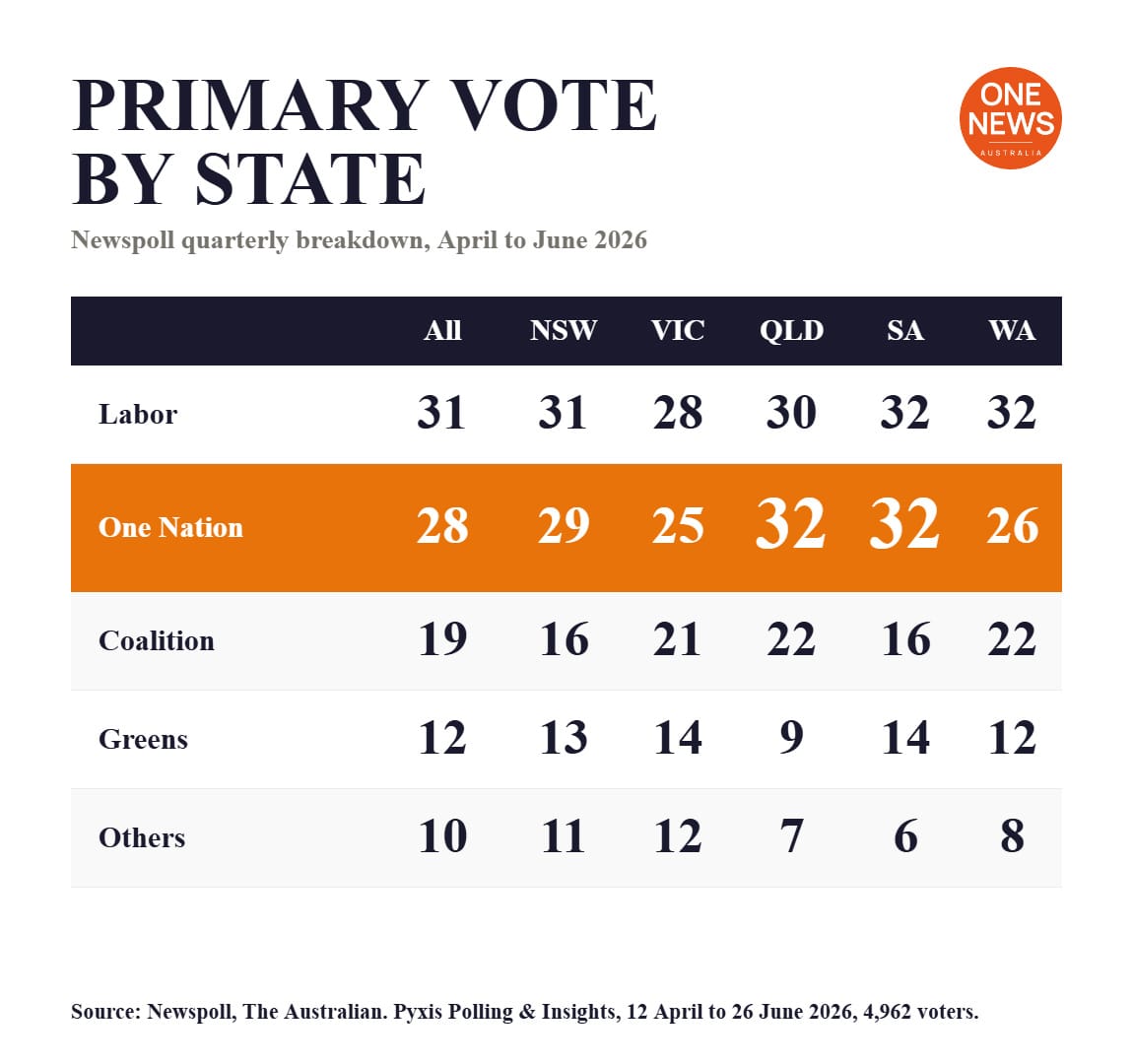
Newspoll has released its quarterly report card, posted through the AusPoll account on X. This one is special. Instead of the usual 1,500 voters in a week, it rolls up 4,962 voters across eleven weeks, April through June, for The Australian. Think of it as the term average rather than one good test.
And the term average says One Nation is now the most popular party in Queensland on 32%, ahead of everyone. In South Australia it is locked with the Labor government on 32 apiece. Everywhere else it holds a solid second: 29 in New South Wales, 26 in the West, 25 in Victoria.
Now find the Coalition on the card. Third in every single state. Sixteen in New South Wales, the state that built the Liberal Party. Sixteen in South Australia. The party that used to own half this table is now closer to the Greens than to the lead in most of the country.
Here's why this poll is the one that should worry Labor most. One good week can be luck. Nobody averages 28% across eleven weeks and five states by luck. The wave has a floor now, and it's high.
11:55am 2 July 2026 — One Nation overtakes Labor and Coalition for the first time in Victoria
Pauline Hanson's One Nation has topped the primary vote in Victoria for the first time, hitting 27% against 26% apiece for Labor and the Coalition in the latest Financial Review/RedBridge/Accent Research survey of 5,516 Victorians, with Premier Jacinta Allan's approval rating sinking to a historic low.
The Coalition still leads 54 to 46 on two party preferred, enough to end 12 years of Labor government at the state election on 28 November. But the primary vote tells the real story. Jess Wilson's Liberals polled 40% in December after she toppled Brad Battin, and have since bled a third of that vote, most of it straight to One Nation, while Labor has slumped from 33% a year ago to 26%.
Victoria was supposed to be the state where One Nation couldn't work. It now leads the primary vote in the most progressive state in the country, five months from polling day, without holding a single seat there. Voters aren't swinging from the government to the opposition, they're walking out on both majors at once, and whoever forms government in November will likely be negotiating with Hanson's party to pass anything through the upper house.
10:00am 1 July 2026 — Essential joins the tracker: One Nation on 26 with the Coalition stuck on 23
Essential's fortnightly report, conducted 24 to 28 June from a sample of 1,017, has Labor on 30%, One Nation on 26, the Coalition on 23 and the Greens on 10, with 5% undecided. On 2025 election preference flows Labor leads roughly 51 to 49.
Essential consistently reads friendlier for the Coalition than YouGov or Newspoll, partly because it keeps undecided voters in the published table. That makes the takeaway sharper, not softer. Even in the pollster kindest to the Coalition, One Nation is in front of it.
Line the four trackers up and the shape is the same everywhere. Labor holds the high 20s to low 30s, One Nation sits between 26 and 30, and the Coalition can't find its way out of the teens and low 20s in any of them.
9:40pm 30 June 2026 — YouGov federal: One Nation back in front on 30 as the Coalition collapses to 17
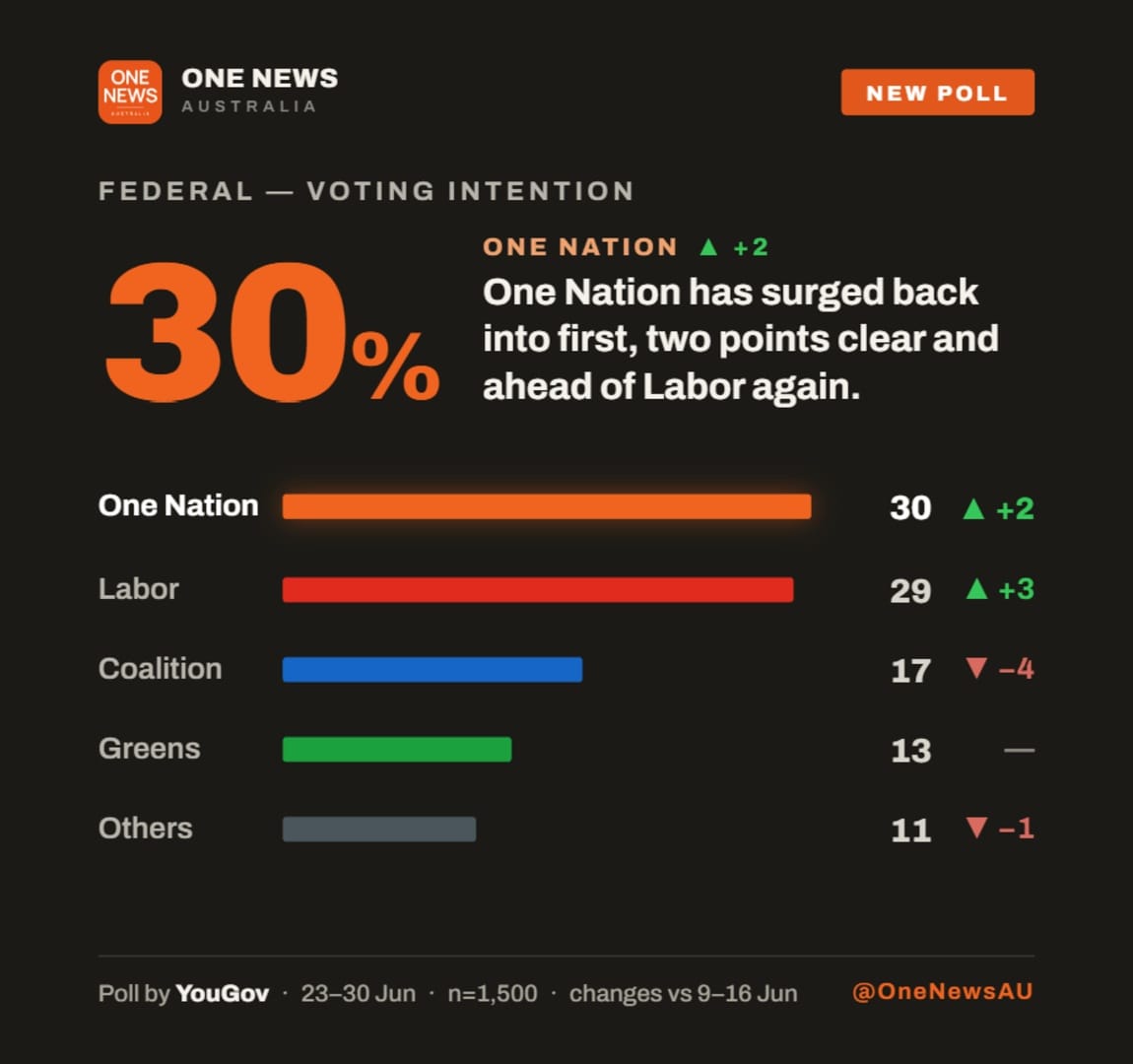
YouGov's latest federal poll, conducted 23 to 30 June from a sample of 1,500 and posted through the AusPoll account on X, puts One Nation first on the primary vote on 30%, up 2, with Labor second on 29 and the Coalition crashing 4 points to 17.
The Greens are steady on 13 and Others on 11. On two party preferred Labor leads 54 to 46, and YouGov ran the same count head to head between Labor and One Nation, where it lands at 54 to 46 as well. Labor still wins the preference count, but the party it now has to beat is One Nation.
One poll ago the headline was a 2 point wobble and a fortnight of manufactured outrage. One poll later One Nation is back in front and the Coalition has shed another 4 points into the teens. While the right spent the month fighting itself, the orange wave kept rolling and the Liberal vote kept falling. On 17%, Angus Taylor's party now sits closer to the Greens than to a primary lead.
8:00am 29 June 2026 — Newspoll federal: Labor regains the lead as the Coalition hits a record low 17
Newspoll's latest federal survey, printed in The Australian and conducted in the final week of June, has Labor on 33%, up 3, One Nation on 29, down 2, the Coalition on 17 and the Greens on 14, up 2. The Coalition's 17 is its lowest primary vote in Newspoll history.
The moves are easy to read. Labor's 3 points arrived after it scrapped its contested tax measures, and One Nation's 2 point dip lands at the end of the same fortnight of manufactured outrage over the monoculture speech that showed up in RedBridge. Nobody sheds 9 points, whatever Roy Morgan says.
Keep the number in context. 29% is nearly double the Coalition's 17, it's One Nation's second highest Newspoll result ever, and it holds the party clearly in second place nationally. A year ago One Nation's Newspoll primary had a single digit.
The real headline isn't the party that slipped 2. It's the party that used to own half of Australian politics finding a new floor at 17, with its own leader choosing this week to attack One Nation rather than the government.
5:53am 29 June 2026 — RedBridge federal: One Nation stays level with Labor while Hastie's split lifts the government
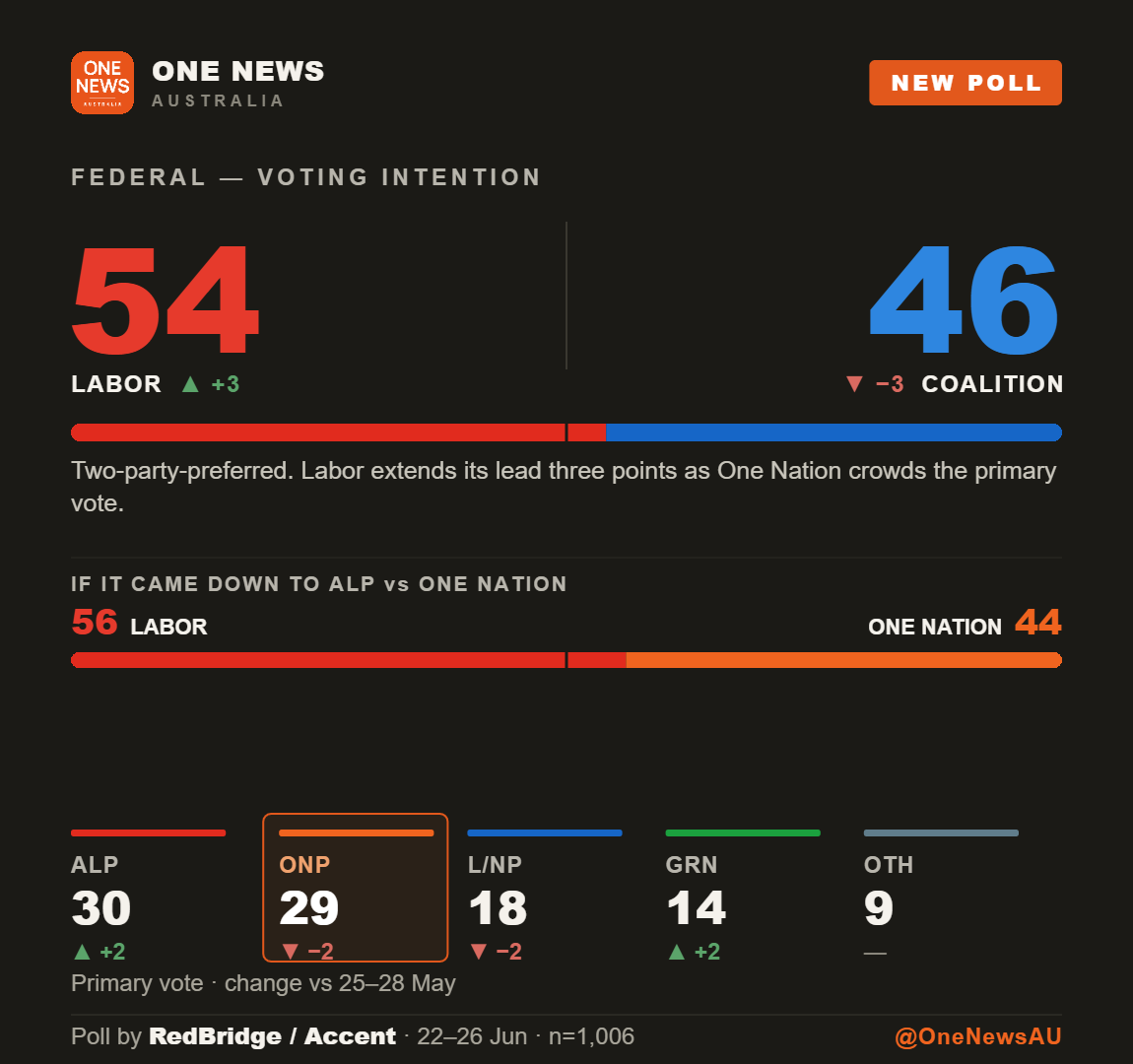
RedBridge and Accent's latest federal poll, conducted 22 to 26 June from a sample of 1,006 and posted through the AusPoll account on X, has Labor up 3 points to a 54 to 46 two party lead. One Nation eased 2 points to 29, but it stays level with Labor on the primary and eleven points clear of the Coalition on 18.
A 2 point move after weeks at the top is not the end of the world, and the fortnight behind it explains most of it. It ran on a string of claims One Nation has had to correct in public. The media said Pauline Hanson wanted to scrap paid parental leave, when the government scheme was never in her sights and she was talking about the employer funded part. A distorted account of Gina Rinehart's Townsville speech turned a pitch for chip, space and defence jobs on leased Crown land into a false story about giving land away, which One Nation opposed and still said was misreported. And the left kept refusing to grasp the difference between a monoculture and a multiculture.
The bigger driver is the one Andrew Hastie handed them. This is the fortnight he spent quoting Sun Tzu and declaring war on One Nation instead of Labor. The right spent two weeks fighting itself and the only side that gained was Labor, which RedBridge still has leading One Nation 56 to 44 head to head. The left sorts out its differences in private and preferences in one direction. A frontbencher reaching for The Art of War against his own side, and the leadership speculation around Angus Taylor that travels with it, is the story here, not a 2 point wobble.
10:15pm 27 June 2026 — DemosAU SA: One Nation now clearly second, the Liberals pushed to third
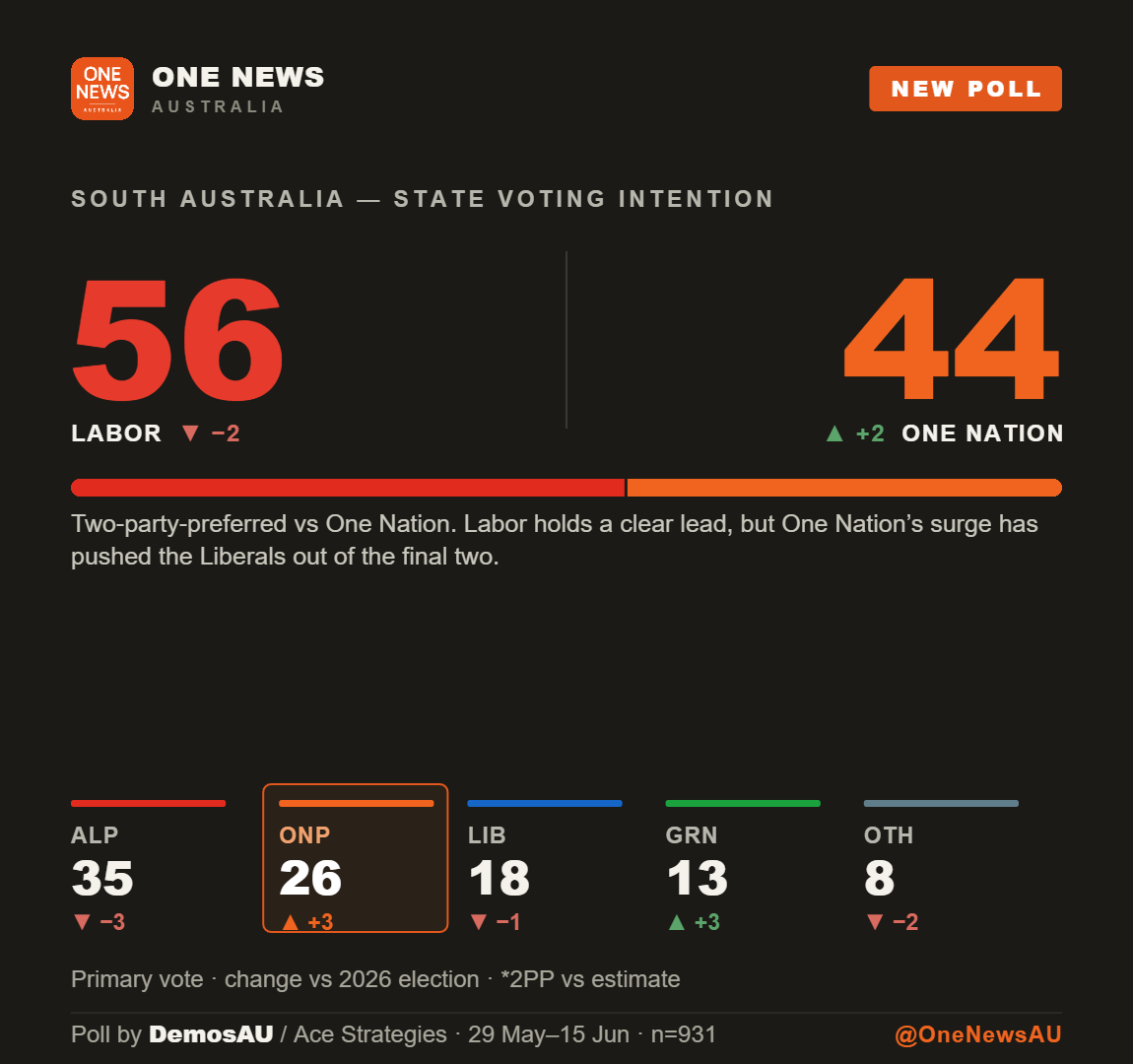
South Australia joins the tracker for the first time. Lined up against the last state election, the new DemosAU poll, taken 29 May to 15 June, shows One Nation has kept climbing while the Liberals keep slipping.
One Nation is up from 23% to 26%, and the Greens have risen from 10% to 13%. Labor has come back from 38% to 35%, the Liberals are down again from 19% to 18%, and Others have eased from 10% to 8%.
That puts One Nation clearly into second, ahead of the Liberals, and turns the main contest into Labor against One Nation. Labor leads that count 56 to 44.
The striking part is who is now third. In a state where the Liberals have always been one of the two main parties, they have fallen behind One Nation and now sit closer to the Greens than to second.
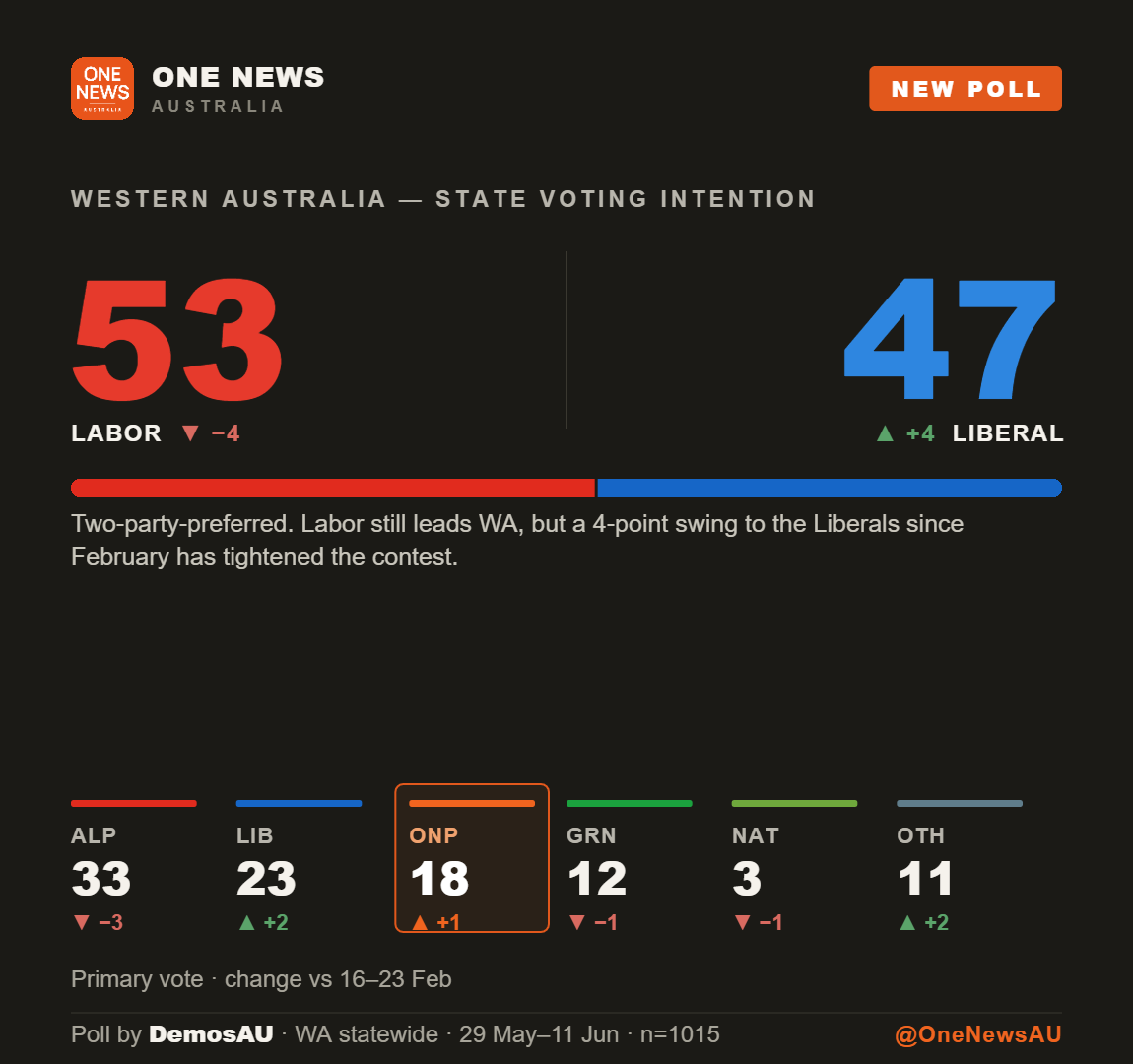
10:05pm 27 June 2026 — DemosAU WA: Labor's lead shrinks as the Liberals claw back ground
The latest DemosAU poll in Western Australia, taken 29 May to 11 June, has the contest tightening. Set against the last one in February, the movement is back towards the Liberals.
The Liberals are up from 21% to 23%, One Nation has edged up from 17% to 18%, and Others have risen from 9% to 11%. Labor is down from 36% to 33%, the Greens have slipped from 13% to 12%, and the Nationals from 4% to 3%.
On the two party count, Labor's lead has narrowed. It was 57 to 43 in February and is now 53 to 47, a 4 point swing to the Liberals.
Labor is still in front, but the gap is closing. The Liberals hold second and One Nation is third, and this time the swing has gone to the Liberals rather than to One Nation.
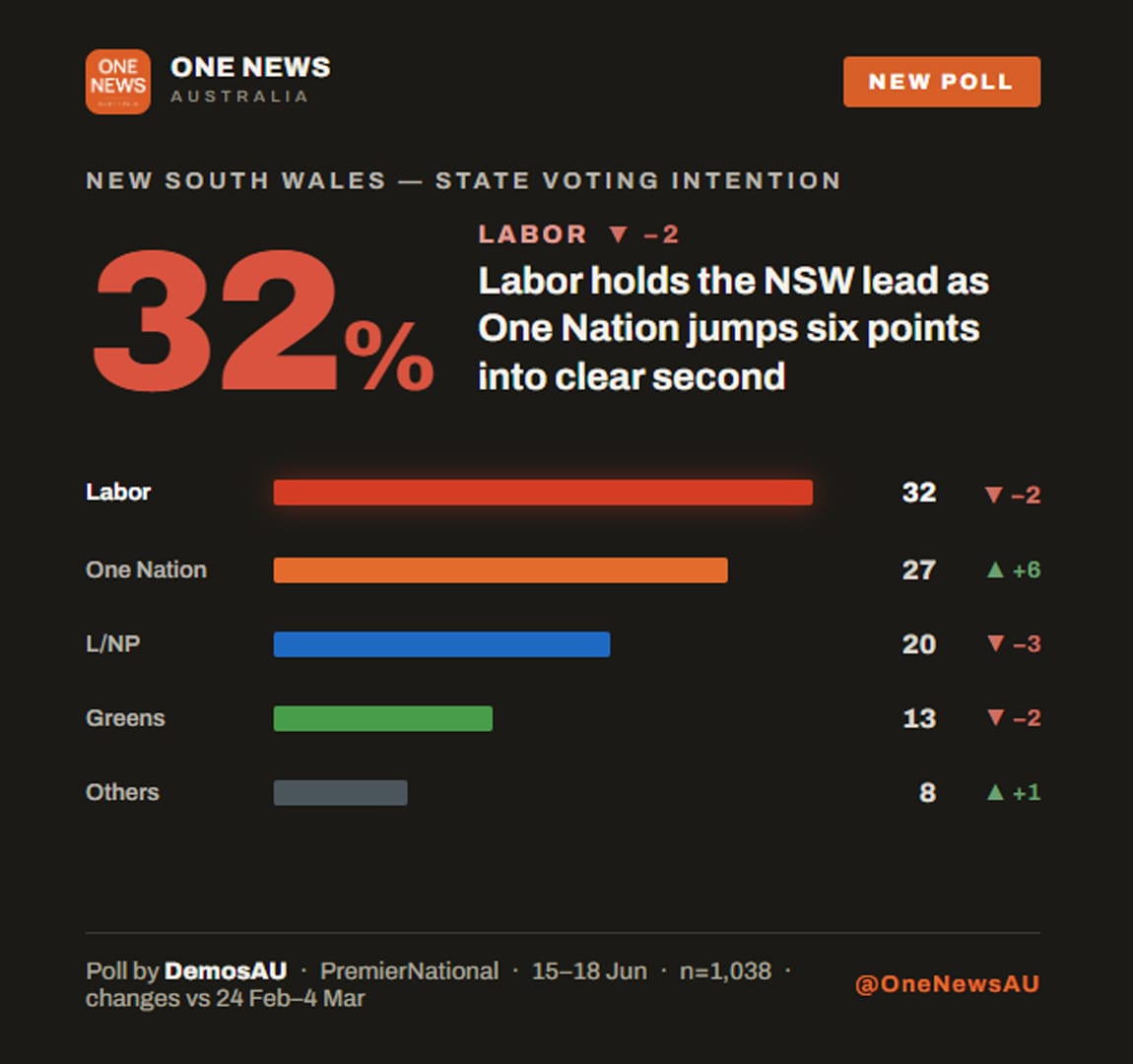
1:01pm 23 June 2026 — DemosAU NSW: One Nation jumps into second and pushes the Coalition into third
New South Wales finally gets a guernsey on the tracker, and One Nation has marked the occasion by putting on 6 points in a single poll. DemosAU and PremierNational's new state survey, fielded 15 to 18 June from a sample of 1,038 and posted through the AusPoll account on X, has One Nation on 27% and into clear second, well ahead of a Coalition that has quietly slumped to 20 and third.
Labor still leads on 32, though it's down 2 and not exactly enjoying the new neighbours. The movement underneath is the real story. The last time DemosAU polled the state, back in late February, One Nation sat on 21 and the Coalition on 23. One poll later the Liberals have handed over the silver medal and kept sliding. In the home of the blue ribbon north shore and the eastern suburbs, the party of Menzies is now running third in its own backyard, behind Pauline Hanson.
Chris Minns has just under nine months to sit with that. His minority government is one seat short of a majority, the next election is locked in for 13 March 2027, and Labor's NSW problem is the one it now has everywhere. The vote is leaking, but not to the opposition Labor was built to beat. Kellie Sloane took the Liberal leadership in November. On these numbers she's leading from third.
7:20am 23 June 2026 — Roy Morgan federal: One Nation hits a record 31.5%, two off Labor head to head
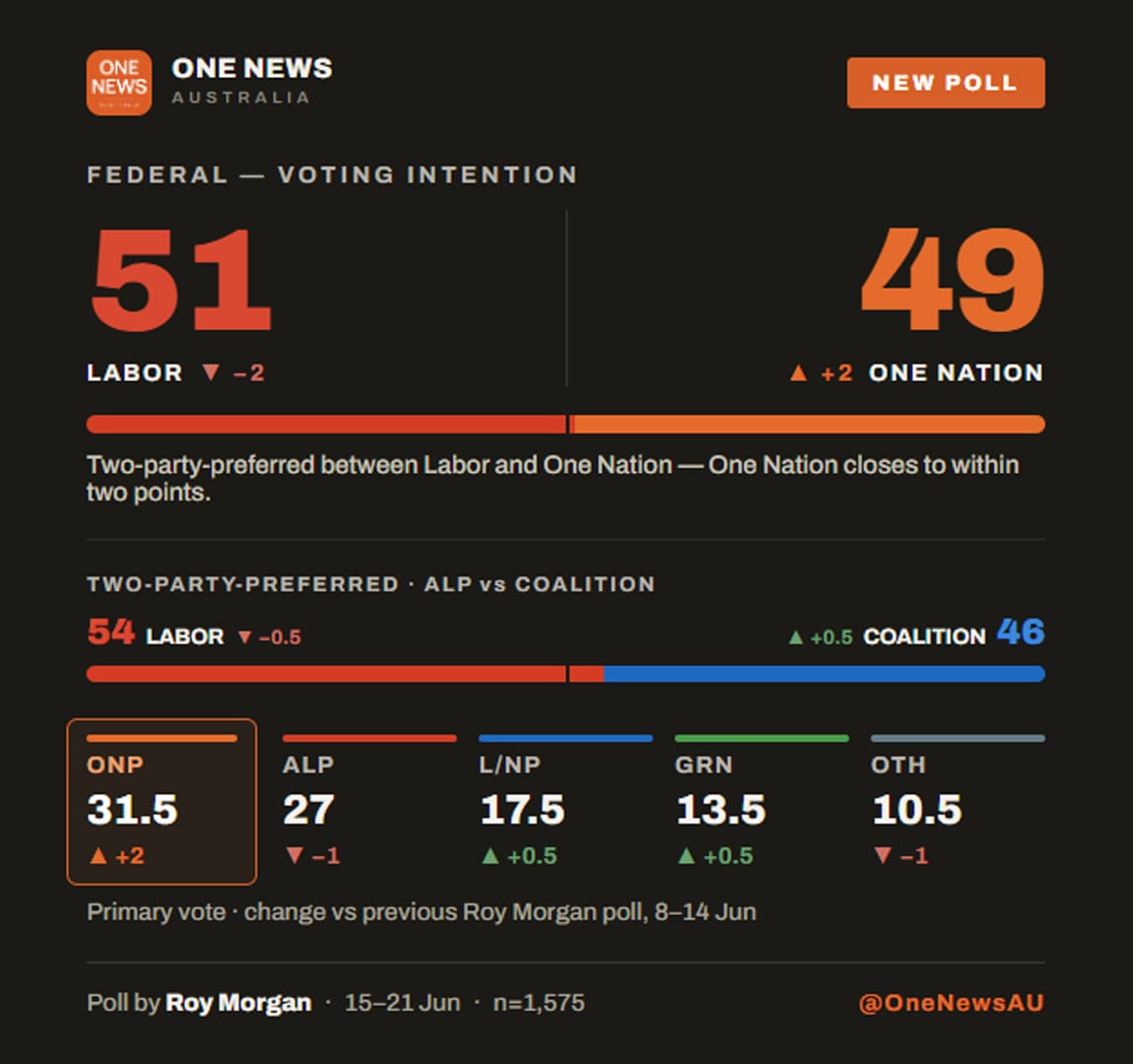
Roy Morgan's latest federal poll, conducted 15 to 21 June from a sample of 1,575 and circulated through the AusPoll account on X, has One Nation first on 31.5% primary, up 2 on the previous week and the highest figure any pollster has recorded for the party federally, just past the 31 Newspoll logged earlier this month.
The rest of the primary holds the now familiar shape. Labor sits on 27, down 1. The Coalition is on 17.5, up half a point but still third and still stuck in the teens. The Greens are on 13.5 and Others on 10.5. Off those numbers Roy Morgan ran two separate two party counts, and the gap between them is the whole story.
On the traditional Labor versus Coalition count, Roy Morgan has Labor ahead 54 to 46, the number the Coalition will hold up as proof it's still in the fight. It isn't the fight. That count only decides a seat if the Coalition makes the final two, and on 17.5% primary, third behind both Labor and One Nation, it increasingly doesn't.
The count that's starting to matter is the other one Roy Morgan published, Labor against One Nation, and there it's 51 to 49. Two points. One Nation runs Labor closer head to head than it did a week ago, and closer than the Coalition's own primary says the Coalition can.
2:30pm 22 June 2026 — One Nation projected to win up to 63 lower house seats as the Coalition faces near wipeout
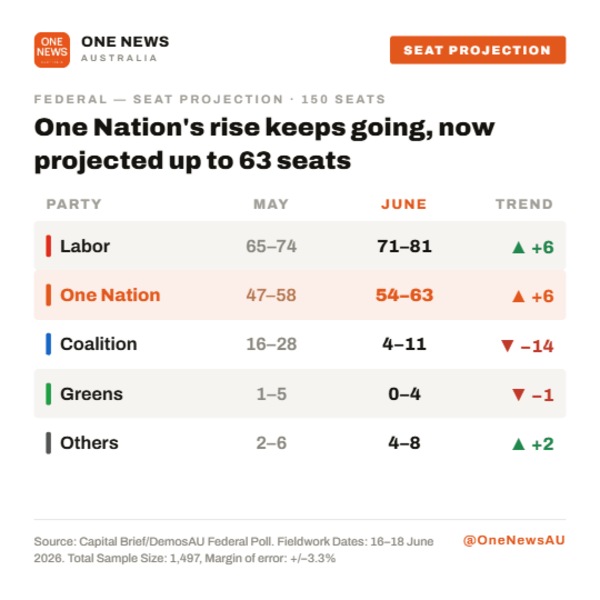
New Capital Brief / DemosAU modelling, based on 20,000 Monte Carlo simulations, projects One Nation could win between 54 and 63 of the 150 lower house seats, while the Coalition collapses to as few as four.
The same modelling puts Labor on 71 to 81 seats and still the most likely party to form government, the Coalition down from a projected 16 to 28 seats in May to just 4 to 11 now, and the Greens facing a wipeout at 0 to 4. One Nation held no lower house seats at the 2025 election and currently has just two, Barnaby Joyce and David Farley.
DemosAU head of research George Hasanakos said Labor was still the most likely party to form government, but One Nation kept closing the gap.
"On these numbers, One Nation would likely fall short of forming government, even with Coalition support. But a further improvement in support, or a further drop for Labor, could change the equation."
The number that matters is the Coalition's. A party projected to hold 16 to 28 seats a month ago is now staring at single digits, and One Nation is taking the difference almost seat for seat. Labor still leads 52 to 48 on two party preferred and remains the likeliest government, so this is not yet a One Nation win. It is the right of centre vote realigning behind Pauline Hanson while the Liberal and National parties are hollowed out from below.
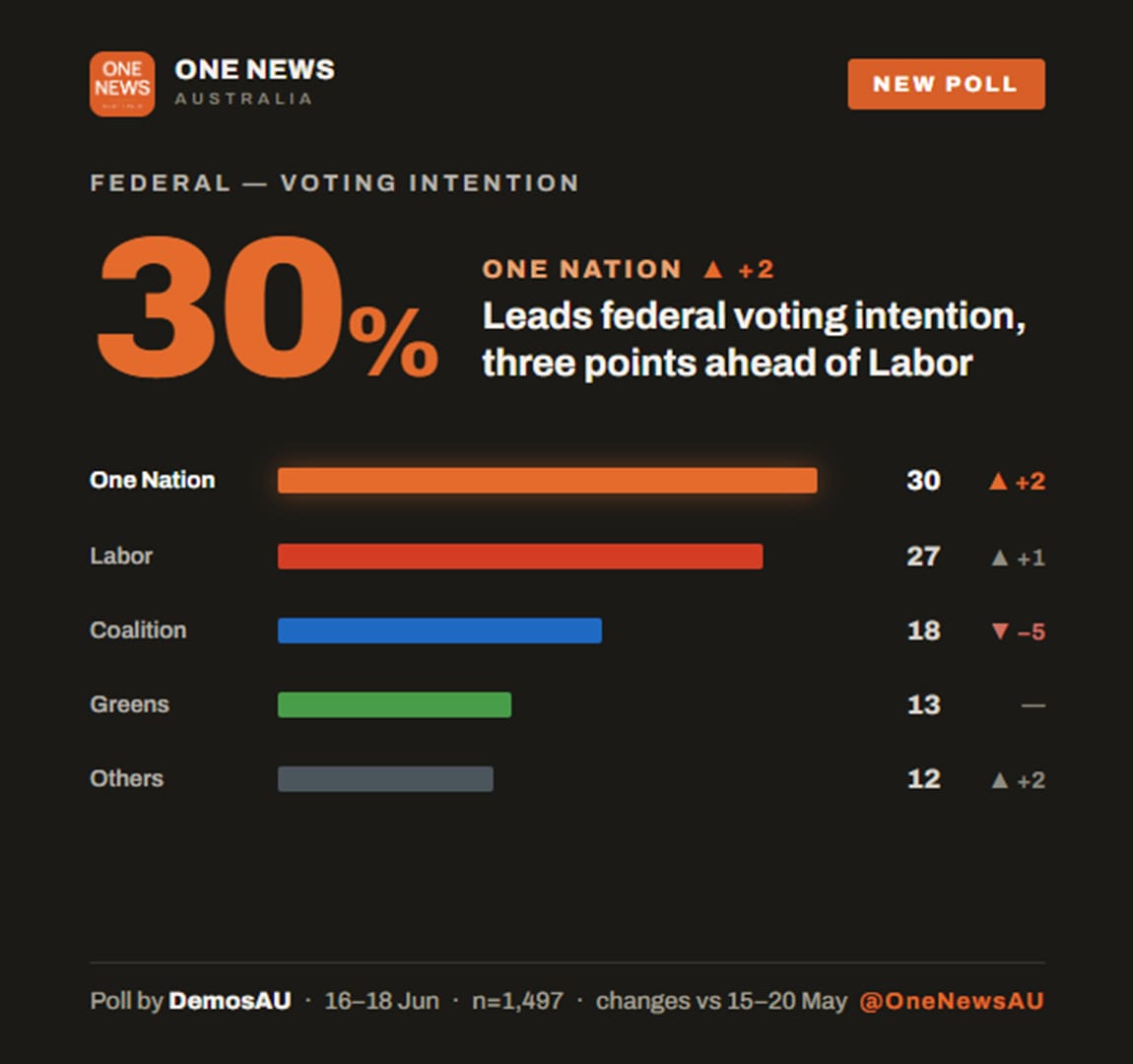
12:00pm 22 June 2026 — DemosAU puts One Nation on 30% as the Coalition primary sinks to 18%
DemosAU's latest federal poll, fielded 16 to 18 June from a sample of 1,497 and published through pollster AusPoll's account on X, has One Nation first on 30% primary, Labor second on 27% and the Coalition third on 18%, with the Greens on 13% and Others on 12%.
Every movement is measured against DemosAU's 15 to 20 May poll: One Nation up 2, Labor up 1, the Coalition down 5, the Greens flat and Others up 2. The Coalition bled those 5 points without Labor picking up anything close to them, which is the same one way trade every federal pollster has logged since the May budget. Roy Morgan's 8 to 14 June survey had the same shape, One Nation 29.5, Labor 28, the Coalition 17.
Whether One Nation leads stopped being the question weeks ago. Four pollsters had already put them first this month, and DemosAU now stretches the gap over the Coalition to 12 points. The live question is how far the floor under the Coalition drops. On 18% it sits third, 5 points above the Greens, in a primary vote it used to win outright.
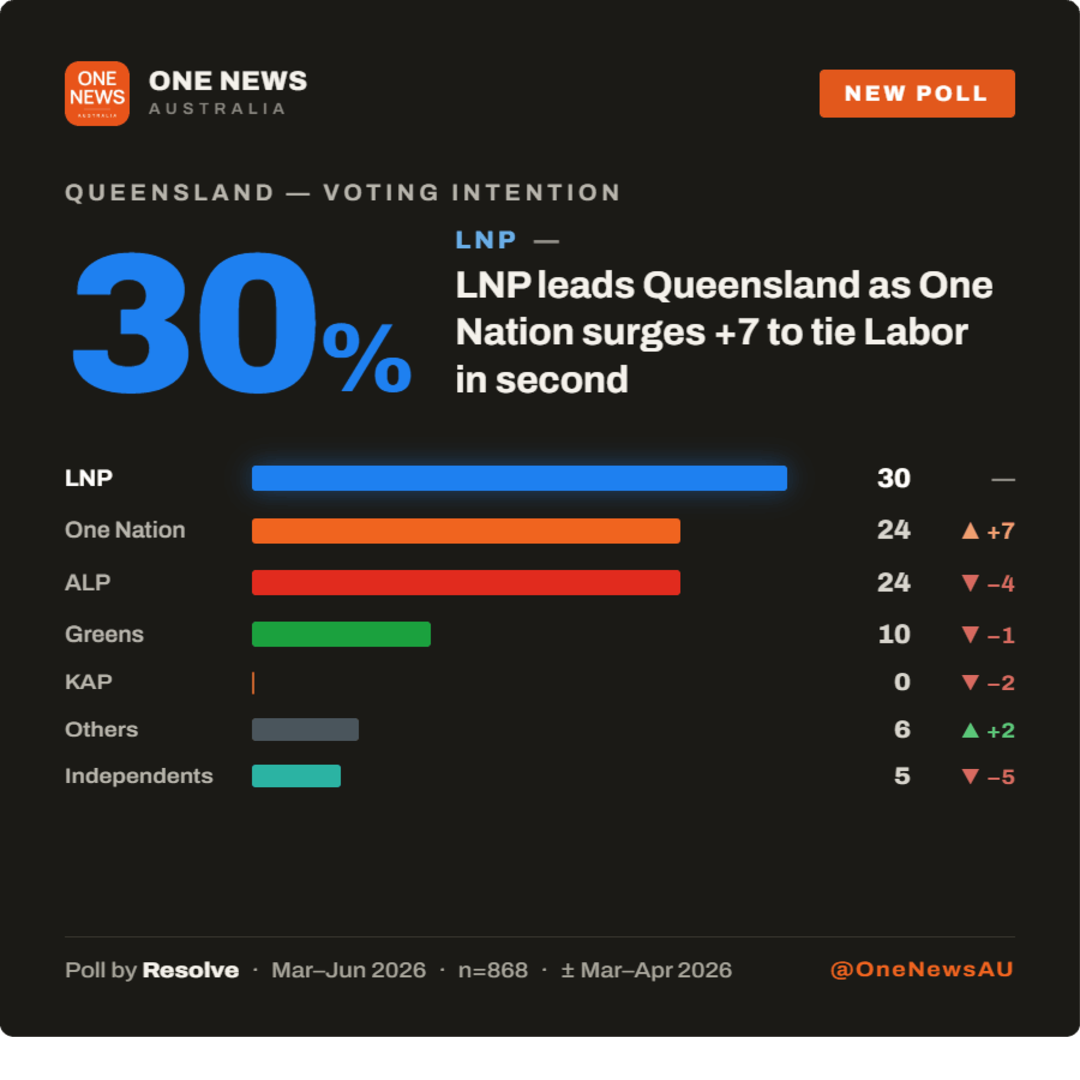
9:07pm 16 June 2026 — Resolve Queensland: One Nation jumps seven points to tie Labor for second
Resolve's latest Queensland state poll, built from the Queensland respondents in its March, April, May and June national polls (n=868), shows the Crisafulli LNP government holding firm while One Nation surges into a tie with Labor for second place.
The trajectory inside Resolve's own Queensland series tells the story. In January-February One Nation was on 16. In March-April they were on 17. Now they're on 24. Labor has fallen six points across the same period. The LNP government has held flat. The opposition is being hollowed out while the incumbent doesn't move.
This is the Queensland version of the federal pattern with a local twist. In other states, One Nation is harvesting Labor government vote while the Liberals sit on the sidelines. In Queensland the LNP is the government and One Nation is harvesting the opposition's vote instead. Labor as opposition is being eaten from below while the incumbent holds firm.
Also worth flagging the Katter's Australian Party collapse from 2 to 0 in the same series. KAP has been a fixture in Queensland parliament since 2013, but in Resolve's polling the party has gone from minor force to rounding error in four months. Their voters appear to have ended up in One Nation's column.
The right of centre primary now sits 20 points ahead of Labor plus Greens. The next Queensland state election is locked in for October 2028, giving the right two and a half years to consolidate.
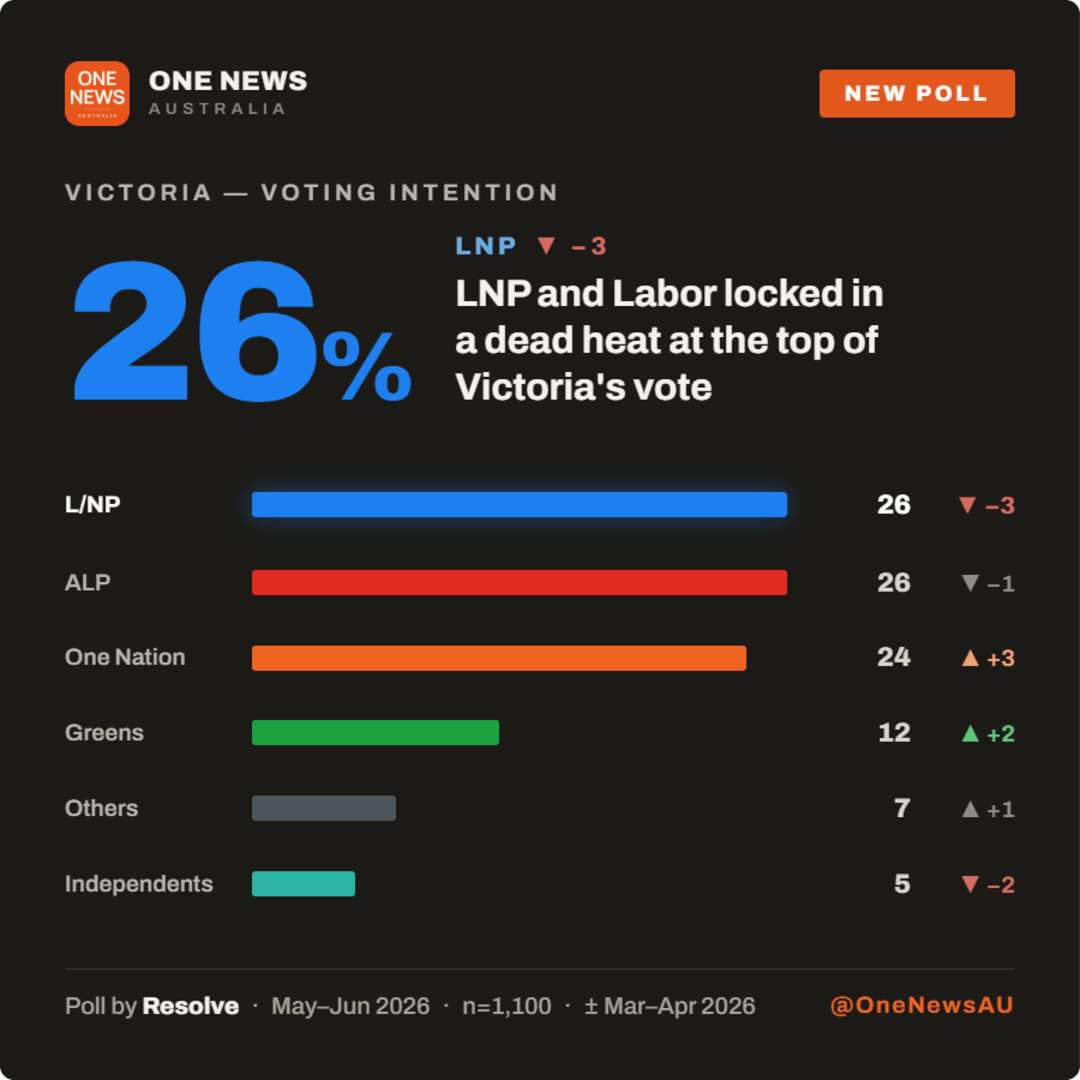
4:46pm 15 June 2026 — Resolve Victoria: Coalition collapses to a three way tie as One Nation closes in
The third Victorian state poll in two weeks lands the closest contest yet, conducted across May and June from a combined sample of 1,100.
The Coalition collapse is the headline. Resolve had the Coalition on 39% in Victoria as recently as November-December 2025. Six months later they're on 26. Same pollster, same state, 13 points gone. Over the same period One Nation has gone from buried inside "Others" to 24%, a near perfect inverse trajectory.
The three pollsters now broadly agree on the dynamic in Victoria even where they disagree on the topline. DemosAU had the Liberals on 30, Freshwater had them on 27, Resolve has them on 26. The Coalition is deflating, Labor is anaemic, and One Nation now claims a 23 to 25% slice of the Victorian electorate in every published poll.
One methodology note worth flagging. Resolve's Victorian state poll is built from the Victorian respondents in its May and June national polls, so this is partly month old data, not a single fresh fieldwork. The trend is the story, not the precise number. The combined Coalition and One Nation primary now sits 12 points ahead of Labor plus Greens. The right of centre majority in Victoria is no longer disputed. The November election will tell us which half of it carries the most seats.
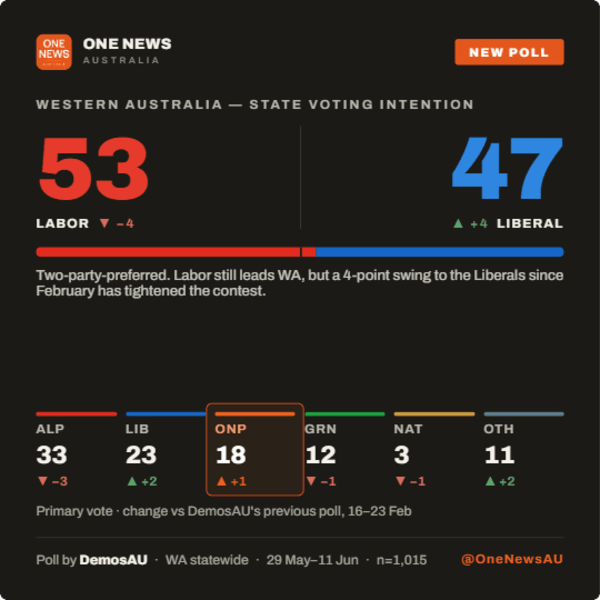
3:01pm 15 June 2026 — DemosAU WA: Labor leads 53-47, but the Liberals can't pick up what Labor is losing
A new DemosAU Western Australian poll, conducted 29 May to 11 June from a sample of 1,015, has Labor leading 53 to 47 on two party preferred. That's a 4 point swing to the Liberals since DemosAU's February poll, and Labor's cushion is narrower than the 57-43 it won by at the March 2025 state election.
The primary vote tells you where Labor's vote is actually going, and it mostly isn't the Liberals. Labor down 3 to 33. Liberals up 2 to 23. Nationals down 1 to 3. One Nation up 1 to 18. Others up 2 to 11. The combined Liberal and National primary sits on 26, barely 8 points ahead of One Nation, which has gone from barely registering at the 2025 election to a serious presence in 15 months. The Liberals have actually gone backwards from 30 in DemosAU's November poll to 23 today.
This is WA's version of the federal pattern. Even where Labor is ahead, the Liberals can't capitalise on government decline because One Nation is harvesting the votes first. Roger Cook keeps his 2PP lead only because Labor's losses are spread across three buckets, not absorbed cleanly by the opposition.
The honeymoon is over. The next election is just under three years away on 10 March 2029. WA Labor still has a 6 point 2PP cushion, but the direction of travel is the same as every other Labor government in the country.
7:55pm 14 June 2026 — #BREAKING: Hanson leads Albanese in a first for any pollster
Pauline Hanson leads Anthony Albanese as preferred Prime Minister in Resolve's latest federal survey, the first time any pollster has put a One Nation leader ahead of a sitting PM. Newspoll a week ago had Albanese leading Hanson 44 to 38. YouGov had Albanese ahead 47 to 41 in early June. RedBridge's three way had it Albanese 31, Hanson 25, Taylor 14. Resolve is the outlier, for now.
A word on the methodology. Newspoll and YouGov force a head to head, Albanese versus Hanson, pick one, which props up the incumbent because he's the default for undecided voters. Resolve gives you a list and lets you pick anyone, which lowers the incumbent's number and lifts challengers with strong name recognition. Hanson has had near total name recognition for thirty years, so the method helps her at the margins. But not by enough to close a four point gap.
The buried number is Angus Taylor on 16%, less than half the One Nation leader and 13 points behind a Prime Minister voters don't seem to like much. The Liberal Party room will hate reading that on Monday.
7:22pm 14 June 2026 — Resolve federal: four pollsters now agree, One Nation leads
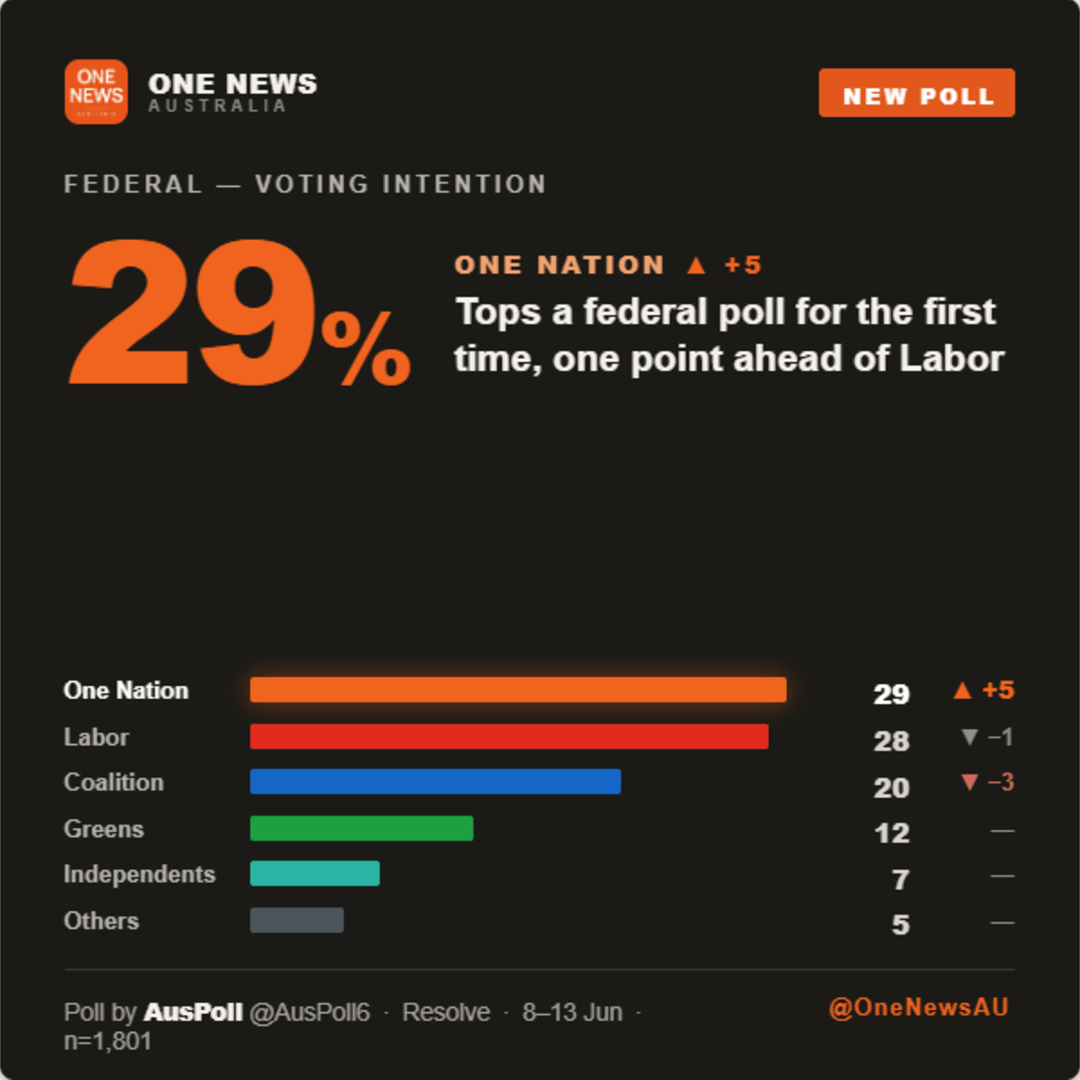
Resolve becomes the fourth pollster in three weeks to put One Nation first on federal primary vote. YouGov had it on 29. Roy Morgan had it on 29.5. DemosAU had it on 28. Resolve has it on 29 today. Four firms, four methods, identical ordering. The rogue poll defence is dead.
The buried number is the 20. That's Angus Taylor's Coalition, down three in a month, in third place federally, and not far ahead of the Greens. The combined Coalition and One Nation primary now sits at 49% against Labor plus Greens on 40. The trajectory inside Resolve's own series finishes the story.
In January 2026 it was:
* Labor 30
* Coalition 28
* One Nation 18
Six months later in June 2026 it's:
* Labor 28
* Coalition 20
* One Nation 29
The Coalition has emptied eight points of primary into One Nation's column without Labor moving. Resolve refuses to publish a headline two party preferred on principle, so this poll lands with no 2PP for either side to fight over. The primary is the story, and the story is that everybody else has caught up to what One Nation's been saying for months.
6:45pm 13 June 2026 — Freshwater Victoria: 47% don't know who should replace Allan, Carroll leads the field on 21%
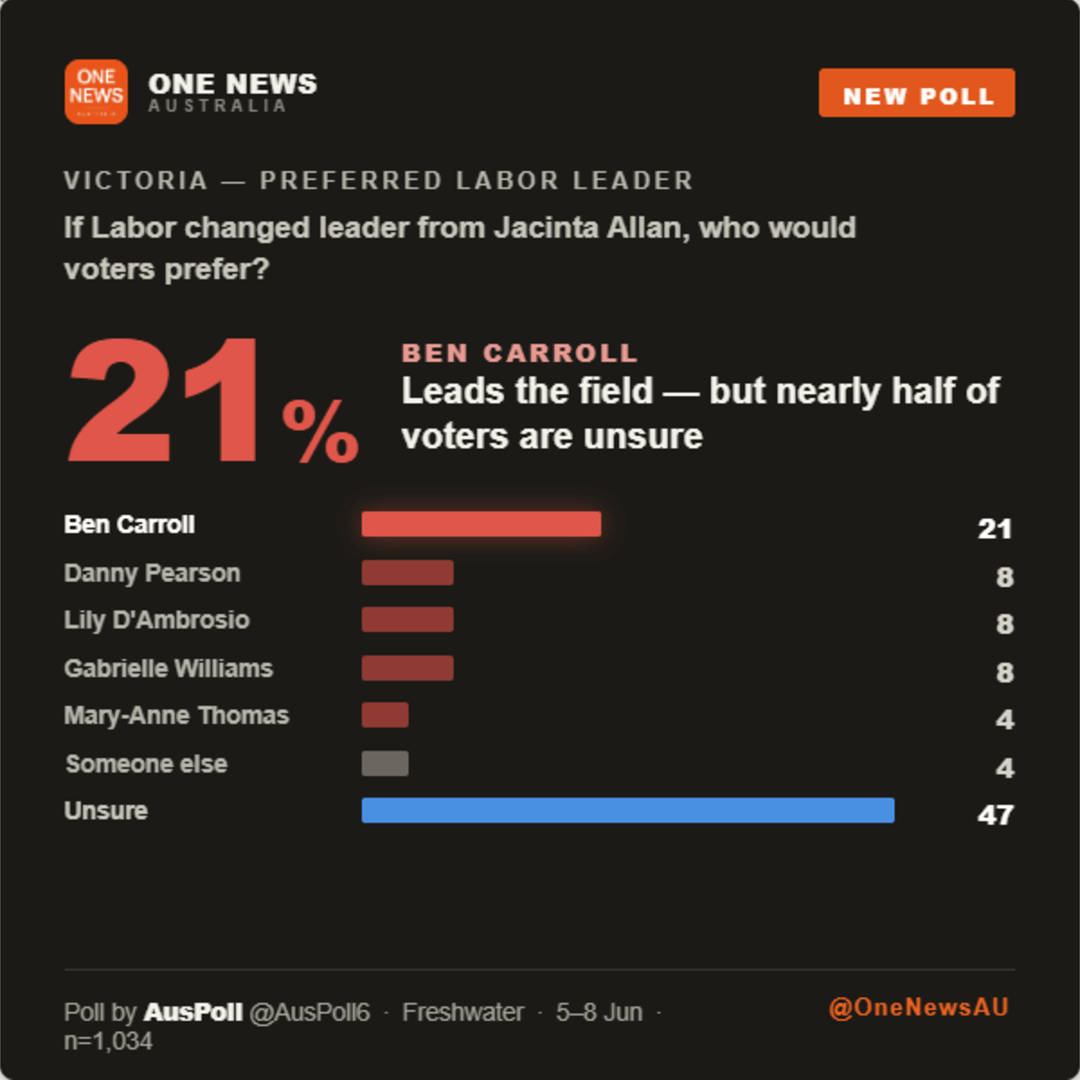
Freshwater's follow up question to its Victorian poll asks the obvious next question, and the answer is its own problem. If Labor changed leader, Deputy Premier Ben Carroll leads the field on 21%, Climate Action Minister Lily D'Ambrosio and Transport Minister Gabrielle Williams are tied on 8%, former Finance Minister Danny Pearson on 8%, former Health Minister Mary-Anne Thomas on 4%, someone else on 4%, and 47% unsure. Same poll, conducted 5 to 8 June from a sample of 1,034.
A curious detail in the candidate list. Pearson and Thomas both resigned from cabinet in the April reshuffle and confirmed they wouldn't contest November, so 12% of respondents have picked candidates who won't be in parliament after Allan is. Freshwater polled them anyway, presumably for name recognition, but realistically the only active cabinet contenders on the list are Carroll, D'Ambrosio and Williams.
Carroll's 21% is the clearest preference by a country mile, but it's still only a third of the 62% who want a change. Nobody else in active cabinet cracks double digits. He comes from Labor's right faction, Williams from Allan's own left faction, and AAP reported this week that both have been touted as possible replacements with no MP publicly putting their hand up.
This is what Freshwater's head of research Jordan Meyers warned about when the first numbers dropped: "A clear majority of voters now say it is time for Labor to change leader. The complication for Labor is that changing leader is no quick fix." Translation: the state wants the door, but it can't agree on which room comes next.
Victorian Labor hasn't changed leaders this close to an election since 1999. The numbers say they want to. The same numbers say they don't know what they'd get.
8:05pm 12 June 2026 — DemosAU Victoria: Coalition leads 55-45, the exact reverse of 2022, Labor falls to third on 21%
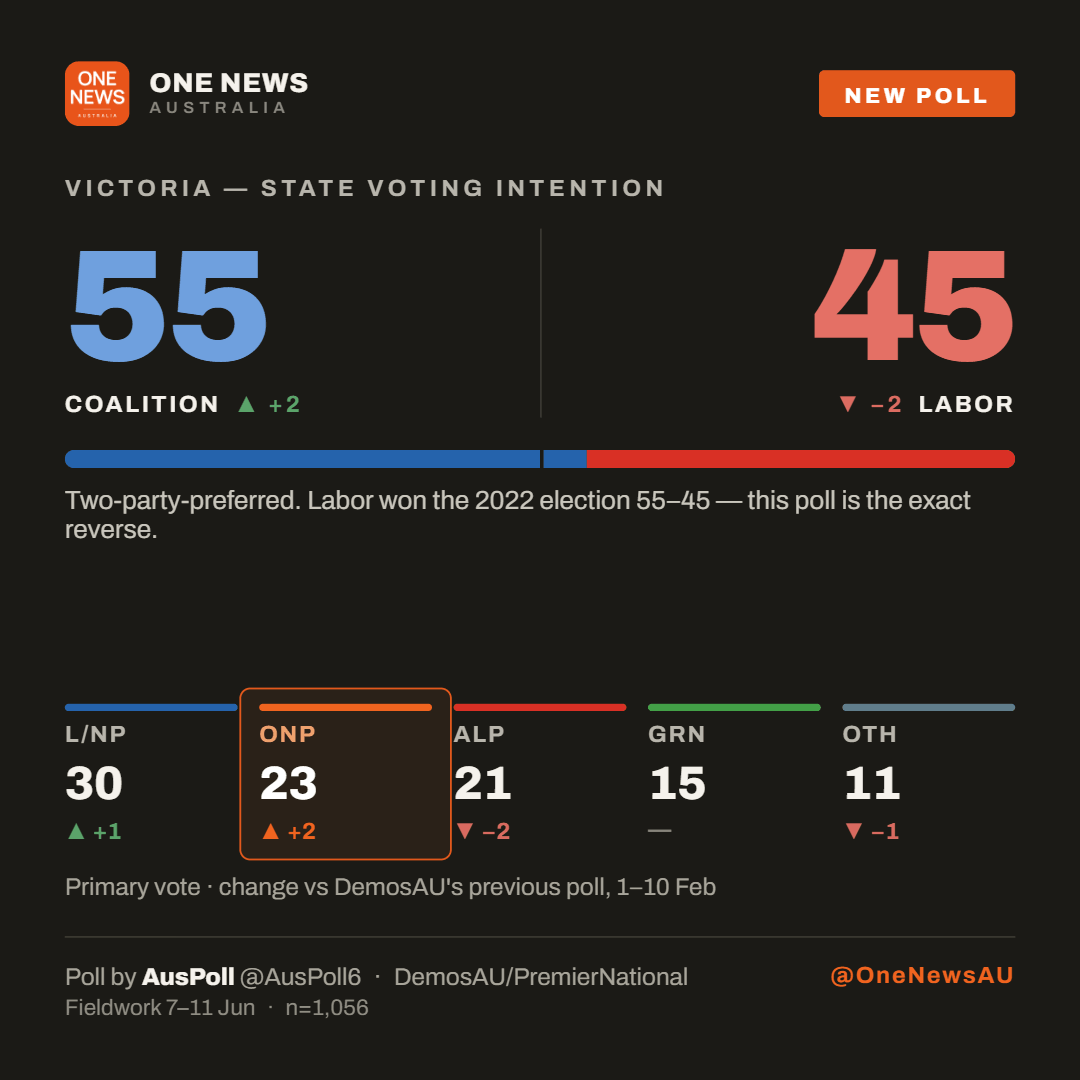
A new DemosAU/PremierNational Victorian election poll, conducted 7 to 11 June from a sample of 1,056 by AusPoll, has the Coalition leading Labor 55 to 45 on two party preferred. Labor won the 2022 election 55 to 45. Same number, opposite direction, a clean 10 point swing in one term of government.
On primaries it's Coalition 30, One Nation 23, Labor 21, Greens 15, Others 11. That 21 is Labor's worst primary vote of the entire term, below even the 22 Resolve recorded last year. Labor won government in 2022 with 37.
It's also the second pollster in a week to put Labor third in its own state. Freshwater had One Nation 25 and Labor 23 on Sunday. DemosAU has One Nation 23 and Labor 21 today. Different firms, different methods, same ordering. The rogue poll defence lasted four days.
The field dates are the quiet detail. This was polled across the spill speculation and Jacinta Allan's "all in" press conference on Monday. Voters watched the week Labor said Victorians don't want navel gazing, then handed Labor its worst number on record.
Between them, the Coalition and One Nation now hold 53% of the Victorian primary vote.
3:30pm 12 June 2026 — Freshwater Victoria: 62% say Labor should change leader, only 24% want Allan to stay
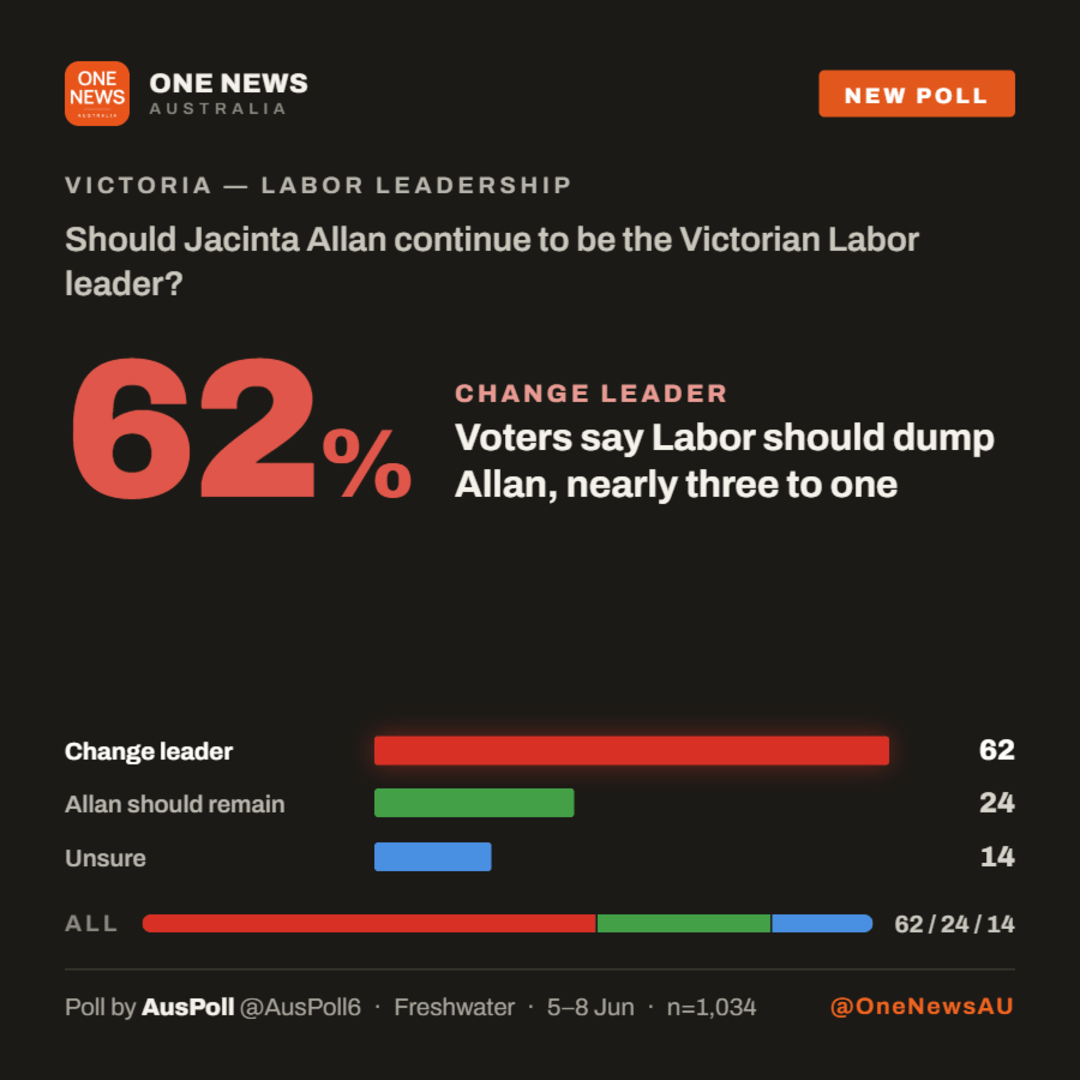
The leadership question from Freshwater's Victorian poll has now surfaced in full, and it reads like an exit interview. Asked whether Jacinta Allan should continue as Victorian Labor leader, 62% said the party should change leader, 24% said she should remain and 14% were unsure. Same poll that put Labor third, conducted 5 to 8 June from a sample of 1,034.
Her own base isn't holding the line either. Among Labor voters, 39% want her replaced and just 53% want her to stay, and 29% of all voters said they'd be more likely to back Labor in November if she wasn't leading it. That last number is the one doing the rounds in the caucus group chats.
The personal trajectory backs it up. Allan's net approval fell from minus 32 to minus 37 in this poll, Jess Wilson leads her as preferred premier 49 to 25, and DemosAU independently clocked her negative rating at 57% this week. Two pollsters, one week, same diagnosis.
Which raises the question nobody in Victorian Labor will answer on the record: does she make it to November? There's no modern precedent for it. Victorian Labor hasn't switched leaders this close to an election since Steve Bracks replaced John Brumby in March 1999, and that was in opposition. Dumping a sitting premier five months out would be unprecedented. So would governing with 24% of the state wanting you to stay.
Allan's answer was that she's all in. On these numbers, 62% of Victoria has already folded and walked away from the table.